
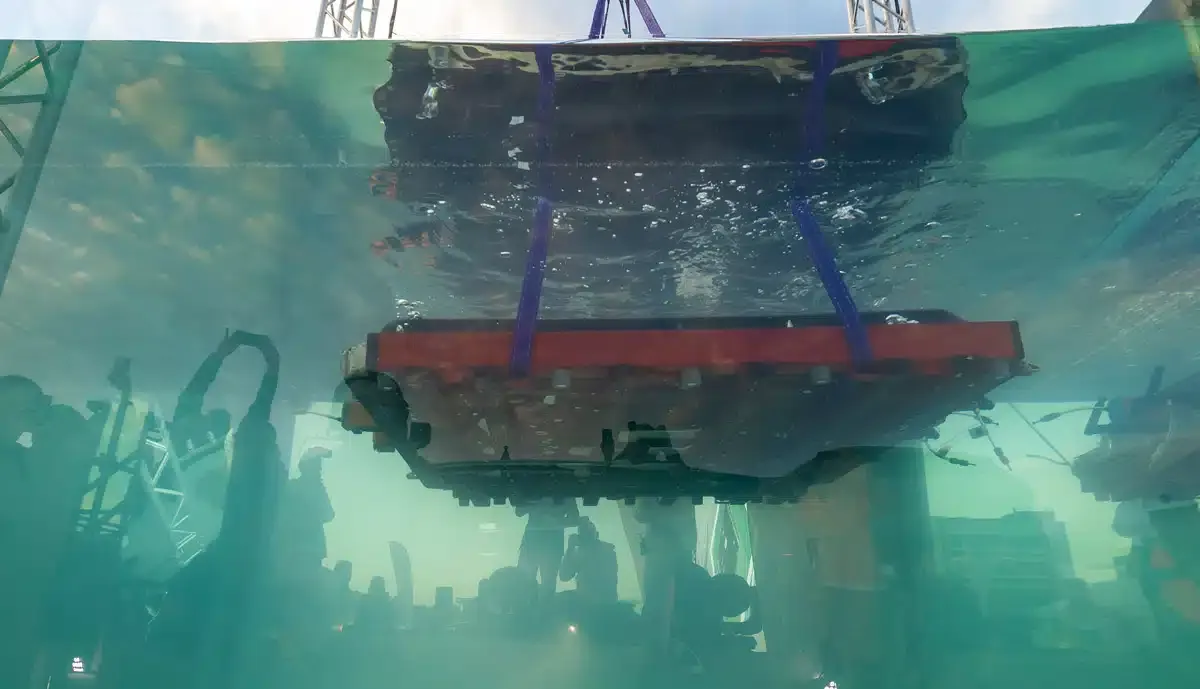
Chery submerged the battery in saltwater for 24 hours. Then the Tiggo 9 CSH hit an obstacle with its chassis.
In short:
Chery conducted a series of safety tests for the Tiggo 9 CSH model in Romania
The plug-in hybrid battery was submerged in saltwater for 24 hours
After being reinstalled in the vehicle, it was tested by hitting the chassis against a high obstacle
The test results, as expected, proved it to be safe
Chery put on a show
In this case, the manufacturer combined two tests: prolonged submersion of the battery in saltwater, followed by a mechanical test of the entire vehicle.
Engineers from the German company FEV participated in the tests, and over 150 journalists from 16 European countries watched the event.
24 hours in saltwater
The first step was to fully submerge the 34.46 kWh traction battery in a sodium chloride solution with a concentration of 3.5%. This concentration is similar to that of seawater.
The battery remained underwater for 24 hours. After removing it, engineers checked the casing, pressure equalization valve, and high- and low-voltage connectors, among other things.
According to data published by Chery, no visible corrosion, swelling of the casing, or leaks were detected. No water was found inside the electrical connectors or within the pressure valve either. However, the inspection didn’t stop there.
Airtightness and electrical insulation checked
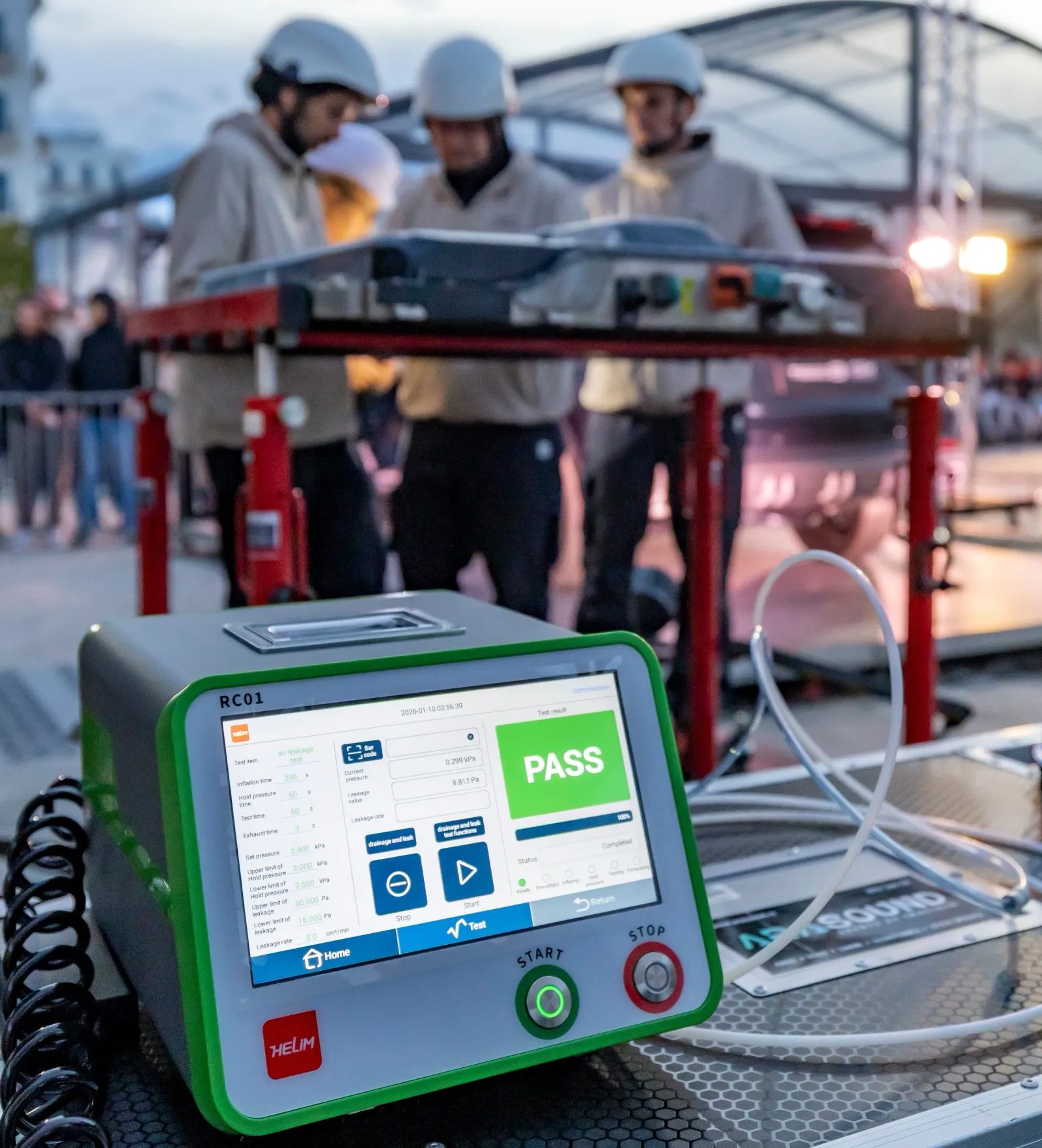
After submersion, the airtightness of the casing was measured. This involved increasing the pressure inside the battery and measuring the rate at which it decreased.
Airtightness of the battery’s casing was also tested after submersion. Air was forced into its interior, and the speed at which pressure dropped was measured. The result was 8.067 Pa per minute, while the passing threshold was 31 Pa per minute. The lower the value, the more airtight the casing, so the battery easily met the required limit.
Electrical insulation between the high-voltage circuit and the battery casing was also checked. The resistance exceeded 500 MΩ, or 500 million ohms. In this case, the higher the value, the better the insulation and the lower the risk of current flowing into the casing.
After the measurements were completed, the same battery was reinstalled in the vehicle. The Tiggo 9 CSH started normally and could proceed to the next part of the test.
The battery was put back in the car. Then the chassis test came next.
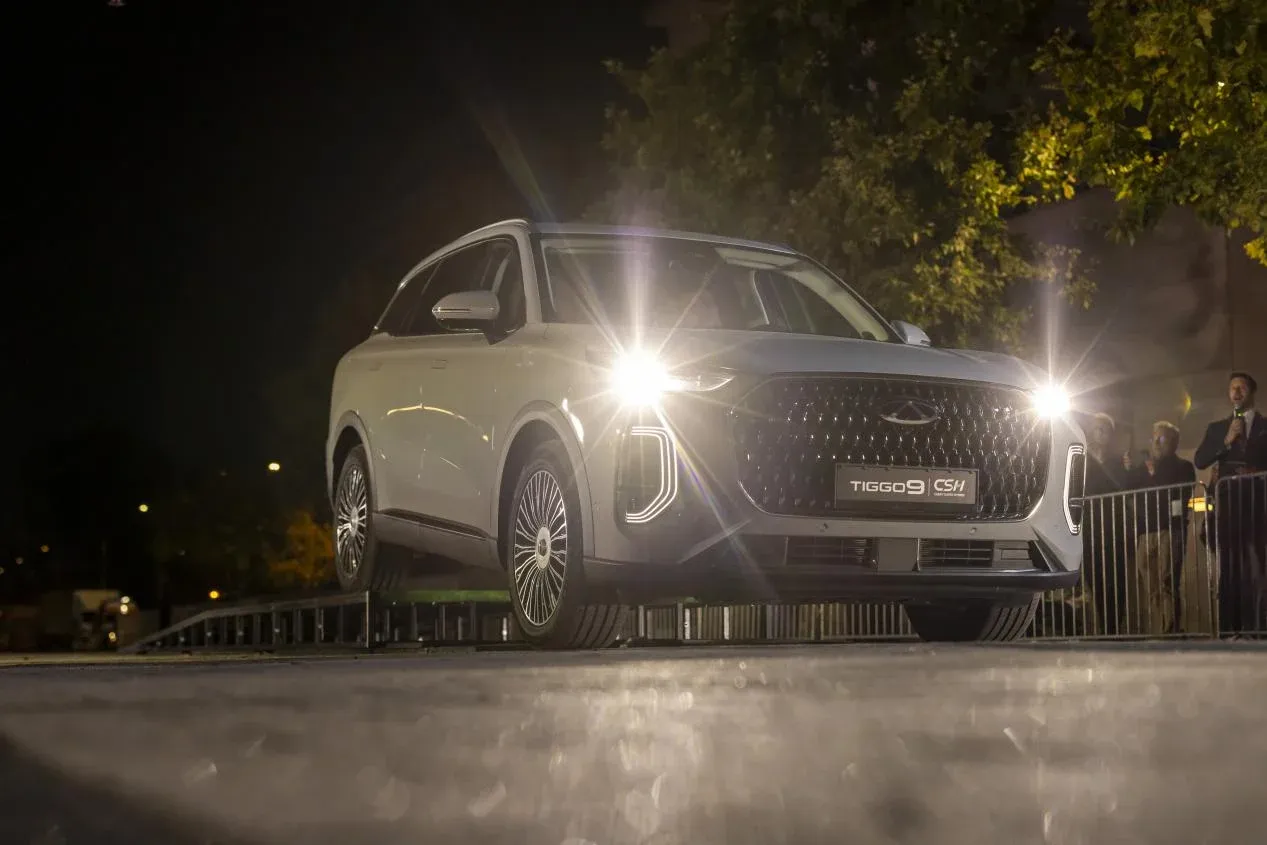
The second test was designed to evaluate the mechanical resistance of the battery’s protective measures. The vehicle was accelerated to 14-15 km/h and directed toward a barrier 250 mm high. Its structure ensured direct contact between the lower part of the vehicle and a hard surface. After passing over it, the chassis and battery enclosure were inspected again.
The PVC coating on the chassis protection was damaged, but according to the inspection results, there were no cracks or structural damage to the battery enclosure. No damage was found in the cooling system wires or the high and low voltage connectors either.
There was no electrolyte leakage or warning message on the dashboard. No thermal reaction in the cells occurred either.
The mechanical protection of the battery includes a multi-layered structure as well as a steel lower cover made from material with a strength of 780 MPa. Its purpose is to limit deformation of the battery casing when the chassis comes into contact with stones, uneven surfaces, or other obstacles.
Chery is testing more than just the casing
The manufacturer also provided some additional information regarding the safety features used in the CSH hybrid system.
The system has a function to disconnect high voltage within 2 ms upon detecting an appropriate collision event. The battery cells, on the other hand, are designed to operate in temperatures ranging from -35 to 60 degrees Celsius.
Chery also states that its hybrid solutions have been tested so far in nine regions around the world and 44 countries. The tests in Romania were part of the manufacturer’s Black Sea Safety Challenge program, during which the battery system was tested sequentially for performance after prolonged exposure to saltwater and after being struck on the lower part of the vehicle.
The combination of these two tests is crucial. After 24 hours of immersion, the battery was not replaced with another unit – it was reinstalled in the Tiggo 9 CSH, after which the car was used in another mechanical test.
Tiggo 9 is available in Poland
The tested Tiggo 9 CSH is also offered on the Polish market, where it goes by the name Tiggo 9 PHEV. It is the largest and most expensive model in Chery’s lineup in Poland. This seven-seater SUV costs from 209,900 zł and features a plug-in hybrid CSH system with a 1.5 T-GDI gasoline engine and all-wheel electric drive. The total power of the system is 428 HP, with a 0 to 100 km/h acceleration time of 5.4 seconds.
The battery has a capacity of 34.46 kWh. According to Chery’s data, the vehicle can travel up to 147 km solely on electric power, with a claimed total range of 1050 km. The battery also supports fast DC charging – it takes 18 minutes to charge from 30% to 80%. It was this battery that was used during the tests conducted on Romania’s Black Sea coast.
Piotr Sobczyk