
The Chery iCar V25 was shown in China. It is a boxy EREV model positioned between the V23 and V27 models.
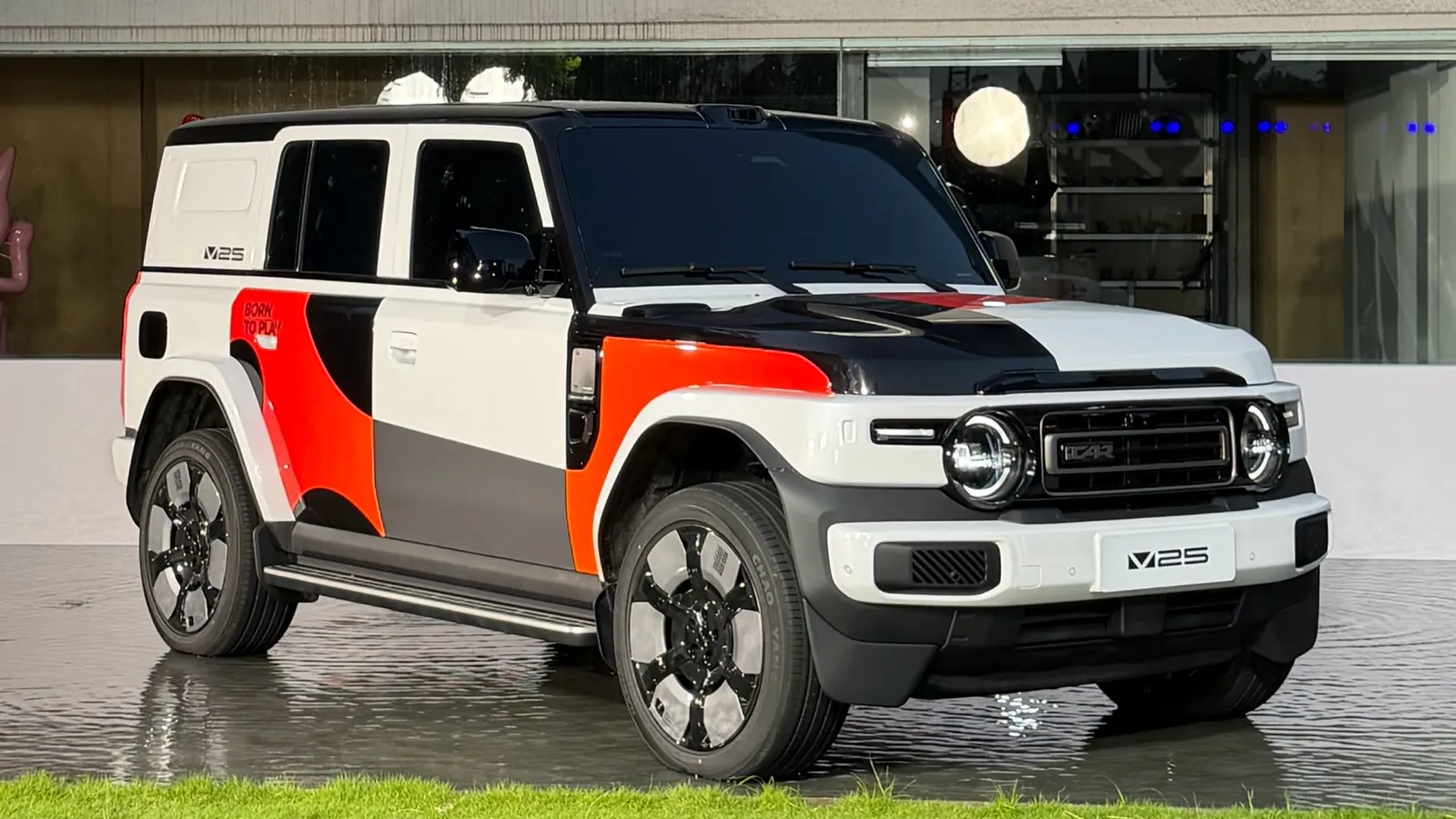
Chery unveiled the new iCar V25 at an event in Chengdu on August 14. It is an EREV with a 33.67 kWh battery and an electric range of up to 150 km WLTC, set to go on sale in the fourth quarter.
Table of Contents
Show
Hide
On paper, it appears to be an attempt to replicate a popular design from China: a boxy SUV with plenty of electronics, a small traction battery, and a gasoline generator for longer trips. The question isn’t whether it will sell in China, but whether Chery can truly use this model to expand beyond its home market.
iCar V25. A boxy SUV with a gasoline generator and 150 km WLTC range
The V25 is the third model in the V series, positioned between the compact V23 and the larger V27. Its body style is deliberately “off-road” in the fashion popular in China today: a vertical front end, round headlights, a flat roofline, and a side-opening rear hatch.
The car is 4636 mm long, 1920 mm wide, and 1855 mm high, with a wheelbase of 2820 mm. The manufacturer also includes an external trunk at the back with a capacity of 22.7 liters, which adds to its overall length. It looks somewhat like a mix of a Mercedes G-Class and a Land Rover Defender, but in a lighter, more lifestyle-oriented version.
The ground clearance is 197 mm, the approach angle is 30 degrees, and the departure angle is 28 degrees. There are also fixed side steps that, according to the manufacturer, can support up to 130 kg, along with standard 21-inch wheels fitted with tires 265 mm wide. A lightweight off-road vehicle? Perhaps. I wouldn’t consider it a true off-roader.
Chery has also added an active air intake designed to reduce drag by 15 percent. This sounds reasonable, as the aerodynamics of such a bulky vehicle are inherently poor. A brick remains a brick, even if it has a more clever front grille.
EREV powertrain. A 1.5 turbo engine acts as a generator, allowing up to 150 km of electric driving range.
The most important feature of the V25 is its EREV powertrain, meaning an electric drive with a range extender. The gasoline engine, a 1.5 turbo unit with a maximum power of 115 kW, is responsible for generating energy. It does not drive the wheels directly but functions as a generator instead.
The battery has a capacity of 33.67 kWh and uses LFP chemistry. According to WLTC homologation data, the rear-wheel-drive version is expected to offer an electric range of 150 km, while the AWD variant will have a range of 145 km.
With an empty battery, the fuel consumption is estimated to be 6.9 l/100 km for the RWD version and 7.15 l/100 km for the AWD version. These are not bad figures for a car of this size, but keep in mind that WLTC and Chinese testing conditions are still not equivalent to Poland’s winter driving conditions.
According to information previously disclosed in Chinese certification documents, the AWD version is expected to feature two electric motors, one at each axle. The vehicle will also be able to pull a trailer weighing up to 1800 kg. For a trendy EREV model, this is quite substantial—nothing just for show from the catalog.
The suspension uses a classic setup: MacPherson struts at the front and a multi-link system at the rear. The manufacturer highlights an international team responsible for tuning the chassis, which sounds good from a marketing perspective. Only actual driving tests will reveal whether there’s more to it.
ADAS with LiDAR and 560 TOPS. The Chinese are continuing to upgrade the electronics.
The V25 is expected to come equipped with either the Super Falcon 700+ or Falcon Pilot 700+ driving assistance system, depending on the brand’s naming convention. At its core is the Horizon Journey 6P chip, with a computing power of 560 TOPS.
The entire system is expected to utilize 27 sensors, including an optional LiDAR on the roof. The manufacturer promises highway navigation, urban NOA, and automatic parking. In other words, it’s a setup very similar to what almost all major players are showcasing in China today.
Here, a bit of skepticism is warranted. 560 TOPS looks good on paper, but raw computing power alone doesn’t guarantee anything. What matters are the software, map quality, system maturity, and where it can be legally used at all. If it enters Europe, the latter point might even be more important than the number of sensors.
Chery has not officially revealed the interior yet. This suggests the company is keeping some details for the launch in the fourth quarter.
The V25 is meant to help the brand return to growth
The launch of the V25 is not accidental. iCar needs a new model because the brand’s sales have been inconsistent. In July, sales reached 9,068 units, representing a year-on-year increase of 38.11%, but a month-on-month decline of 13.35%.
From January to July, the brand sold a total of 54,460 cars, which is 6.63% more than the previous year. This indicates a return to growth after a weak start to the year. The main volume model remains the V23, which starts at 122,800 yuan in China, equivalent to approximately 67,000–68,000 zł when converted at a simple exchange rate without taxes or import costs into the EU.
In practice, the V25 is meant to fill a gap in the lineup. The V23 is smaller and more budget-friendly, while the V27 is larger and more premium. The V25 is intended to be the “mid-tier” model that usually sells best, provided the price remains reasonable.
Chery is already thinking globally, but Europe is a separate story
The iCar brand will operate under the name iCaur outside of China. This is likely an attempt to avoid issues with Apple and the iCar name. Once launched in China, the car is also set to enter foreign markets, with the Middle East and other export countries mentioned among them.
Chery is also accelerating production outside of China. A factory in Selangor, Malaysia, began operations in July, starting to produce the V23 model. The plant’s initial production capacity is 100,000 cars per year.
This is important for one reason: Chery no longer appears to be a brand that only wants to “show off” at trade shows. The company is building volume and already has a significant export footprint. In July, the entire group exported 202,533 cars, breaking its own record and becoming the first Chinese manufacturer to exceed 200,000 cars per month.
Will the V25 make it to Europe? Chery hasn’t announced this yet. And that’s where the difficulties begin. EREV vehicles are popular in China, but in the EU such a model falls under a different discussion than pure BEVs. There are tariffs, homologation requirements, local regulations, and the issue of European pricing. If the V25 costs as much as it does in China plus a “exotic tax,” its advantages quickly disappear.
The idea itself, however, makes sense. For drivers who want to drive electric in the city but aren’t yet confident about charging on long trips, 33.67 kWh and 145–150 km WLTC range could represent an attractive compromise. But a compromise only works when it doesn’t cost as much as two cars in one.
Chery has thus built a car that fits well into the current Chinese market trend: a stylish design, plenty of electronics, a battery size reasonable for an EREV, and a gasoline backup engine. Now the hardest part remains — the price and determining whether there’s a similarly solid product behind its impressive exterior. What do you think? Could such a boxy EREV find real customers in Europe, or is it still mainly a Chinese preference?