
Ceer Exobot: Saudi Arabia launches its automotive brand with two eye-catching electric cars
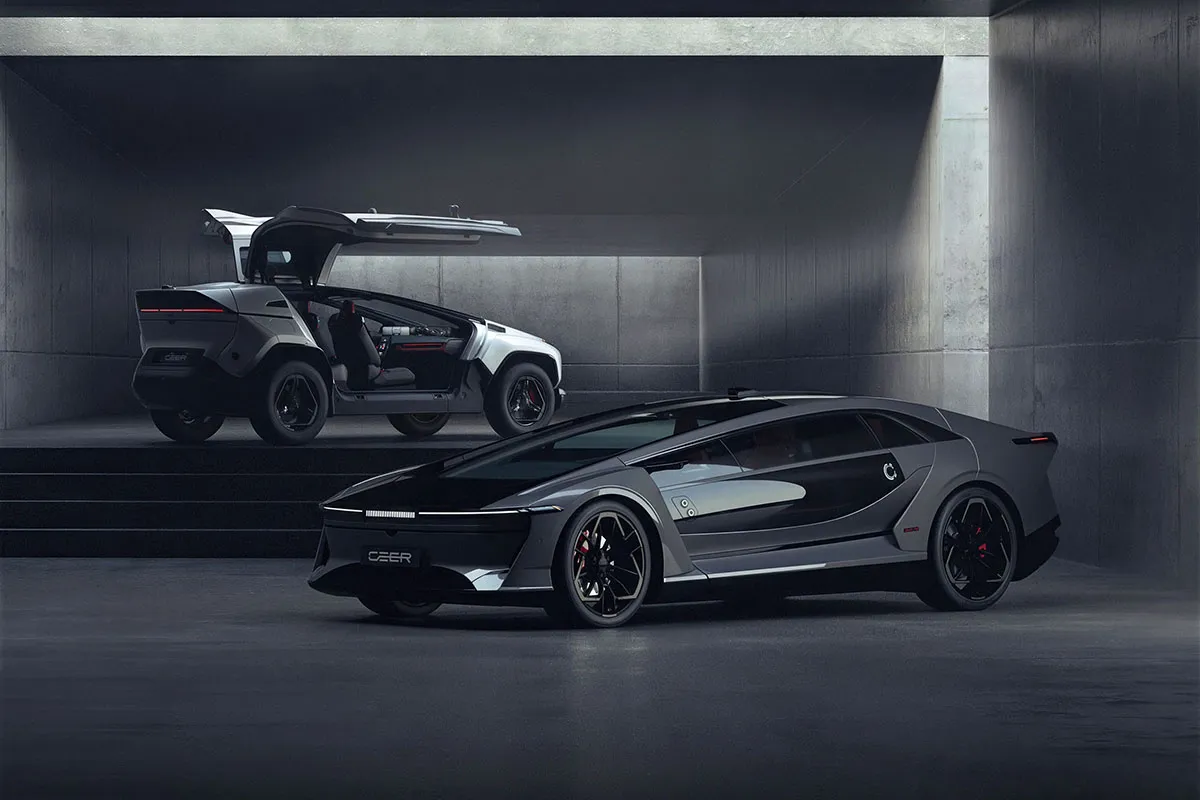
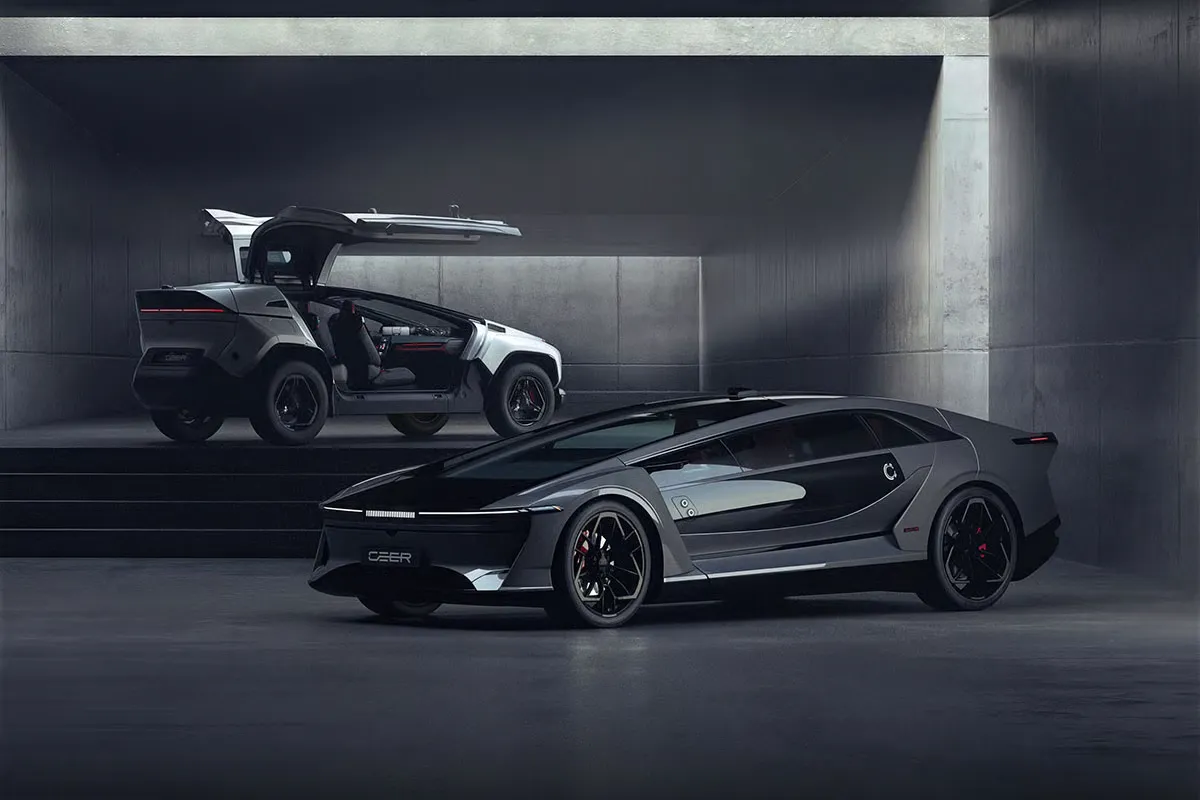
Saudi Arabia, the world’s top exporter of crude oil, has just launched its national brand Ceer with two vehicles… both 100% electric.
The future of mobility has given rise to numerous electric car manufacturers. There are countless new players emerging, such as those from China. But the market is also seeing the appearance of more unexpected manufacturers, like VinFast from Vietnam or the Turkish brand Togg. Now it’s Saudi Arabia’s turn to enter the market with Ceer, a brand born from a partnership between the Public Investment Fund (PIF) and Taiwan’s electronics giant Foxconn.
A reimagined wedge design
To make a statement, Ceer has just unveiled the Exobot, available as a giant sedan or a massive SUV. These two high-end models are clearly designed more to showcase the brand’s craftsmanship than to gain market share domestically.
In both cases, the design is impressive and bears strong similarities to the stylistic approaches of Bertone, Giugiaro, or Italdesign. This is evident in the sedan, which recalls the overall shape of the 2008 Quaranta Concept, while many design choices seem to draw from Bertone’s Nuccio Concept and Stratos Zero! It is particularly striking in the straight-line silhouette that extends all the way to the rear, where the hood ends abruptly.
Behind this drawn line, a 2.4-meter-long windshield is tilted at 15°. This is added to numerous other glass surfaces, extending all the way to the sides of the car. This might seem paradoxical for a vehicle designed for Saudi Arabia. However, the brand states that the material has been treated with a special silver coating to reflect heat as much as possible. This is part of the Halo Cooling technology, which includes various technical solutions to combat heat.
The aerodynamic performance of these cars is not yet known, with Ceer currently only disclosing their XXL dimensions. At 5.26 meters in length and just 1.43 meters in height, this sedan falls into the luxury sedan segment between the BMW i7 and Mercedes EQS. Slightly shorter at 5.02 meters in length, with a height of 1.69 meters and the same 2.1-meter width, this SUV is more akin to models like the BMW iX or Mercedes EQS SUV.
Concept-car-style doors for the Ceer Exobot
In both cases, the butterfly doors extend across the entire side of the body without a traditional B-pillar. This design is commonly used in concept studies but rarely seen in production vehicles. Structural reinforcements might add significant weight, though Ceer has not yet disclosed the mass of its vehicles.
The interior aboard is designed to be futuristic, featuring a large digital display that stretches from one pillar to another. Ceer does not provide overall dimensions, but specifies a size of 48 inches and an 8K resolution. In addition, there is a central display that allows for quicker access to controls, though the steering wheel still has some buttons on the center console or on the Yoke-style steering wheel.
This is where the climate control is managed, with the manufacturer emphasizing its ability to adjust the cabin temperature from 65 °C to 32 °C in 10 minutes. It’s difficult to draw conclusions due to various factors such as weather conditions, total glass area, and air volume inside the vehicle, but a Nissan Leaf can also reduce its temperature by 30 °C in 10 minutes under summer sun. As for the other built-in technologies, the Ceer Exobot keeps up with modern features like remote controls and updates, pre-conditioning, or a semi-autonomous driving system.
A 850 hp engine to get started
Technically, the brand has also kept up with modern standards by equipping it with a by-wire steering system (without mechanical linkage), adaptive pneumatic suspensions, and rear steering wheels to help the 3.20 m wheelbase turn. Several driving modes are available, including a Drift mode and an Off-Road mode specific to the SUV. Additionally, the vehicles feature a rear torque vectoring system.
To move forward, the Exobot models are powered by three electric motors. At the front is a motor supplied by Hyundai Transys. At the rear, a pair of motors from Rimac drive each wheel separately. Currently, Ceer reports a maximum power of 625 kW (850 horsepower) and 1,000 Nm of torque. This enables a 0 to 100 km/h acceleration time of 2.6 seconds, or 2.9 seconds for the SUV. The top speed is limited to 230 km/h.
The entire system is powered by an NMC battery with a capacity of 112 kWh, operating at what is referred to as an 800 V voltage. The brand does not specify whether this refers to gross or net capacity. AC charging is handled by an 11 kW charger, while the DC system can reach a peak of 250 kW. This is likely where the Ceer Exobot falls short compared to next-generation high-end electric vehicles: Ceer claims a 10-80% charge in less than 30 minutes. Assuming the battery has a usable capacity of 112 kWh, this translates to an average power of nearly 160 kW, making it one of the least efficient chargers in the 800 V class or similar systems.
In terms of range, the manufacturer claims an estimated driving distance of 670 km for the sedan and 560 km for the SUV… under the NEDC cycle. Under strict conditional assumptions, this would translate to WLTP values of around 540 km and 450 km respectively. The sedan is expected to have similar fuel efficiency to a Lotus Emeya.
Two domestic models first, then an international lineup
Ceer plans to launch the EXOBOT Sedan and SUV first, with production starting in January 2027 and deliveries beginning in March 2027. These will be followed by three models in the D-segment — a sedan, an SUV, and an SUV coupe — followed by more compact vehicles starting in 2028. In total, Ceer aims to have a lineup of seven models over five years, with the EXOBOT models serving primarily as showcase vehicles to establish the new brand’s image.
The strategy is first to focus on Saudi Arabia and other Gulf markets, rather than pursuing immediate global expansion. The five models that will follow the EXOBOT will still be developed to meet international certification standards, leaving the door open for future exports. Ceer also adopts a flexible approach regarding powertrains: the initial models will be 100% electric, but the platform can accommodate rechargeable hybrid or extended-range electric vehicle (EREV) options in the future if market demand justifies it.