
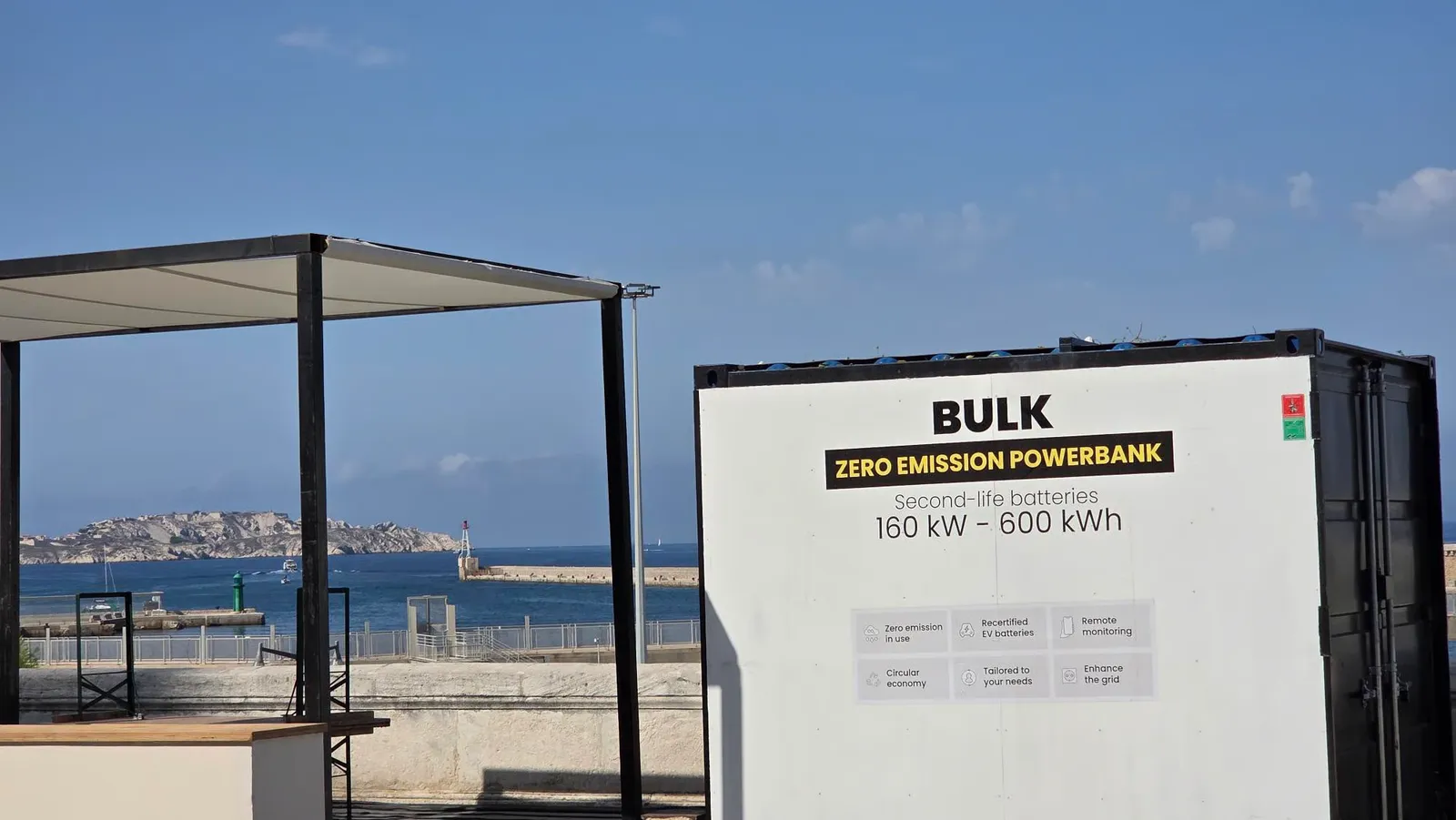
This container filled with old electric car batteries supplies electricity to festivals.
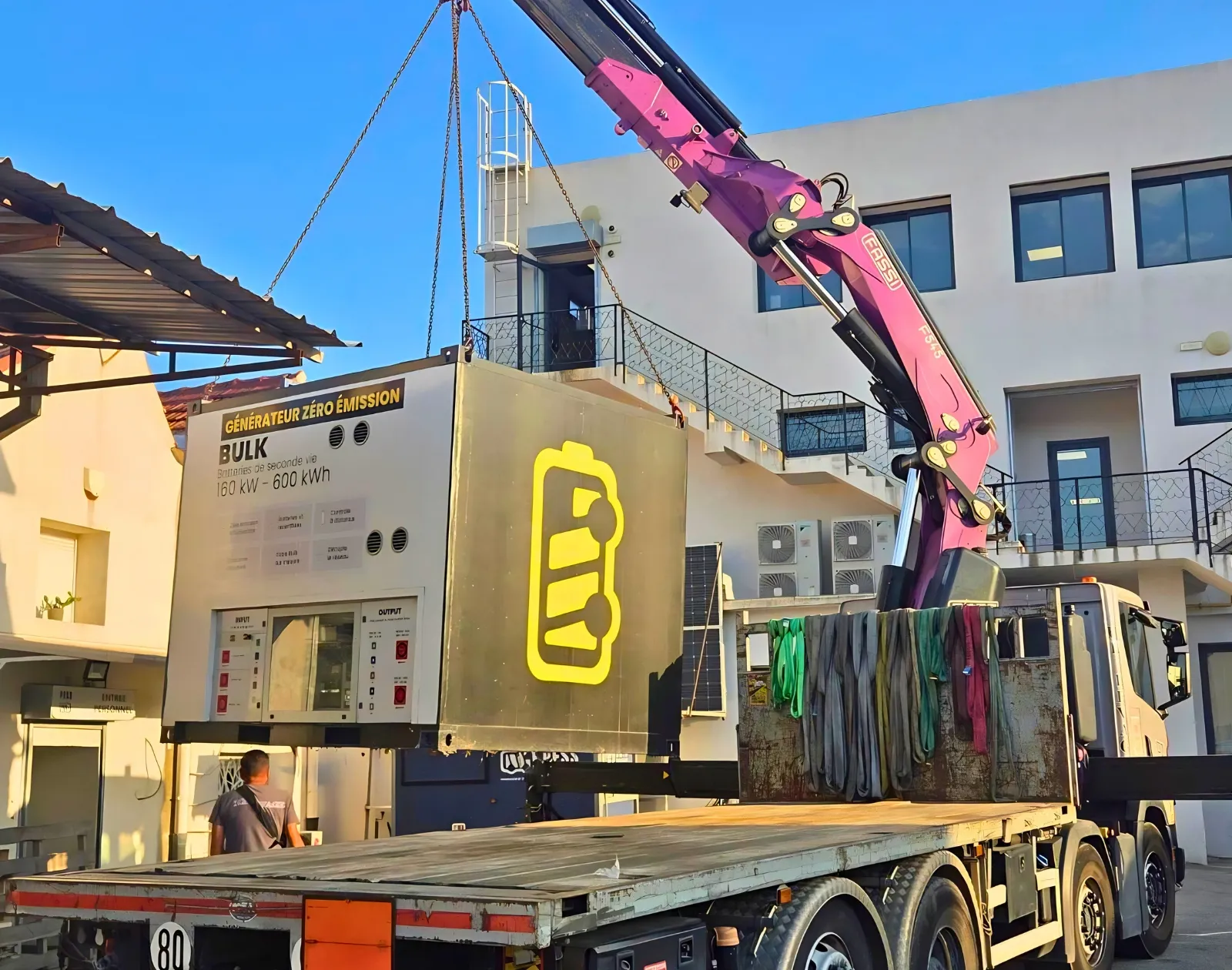
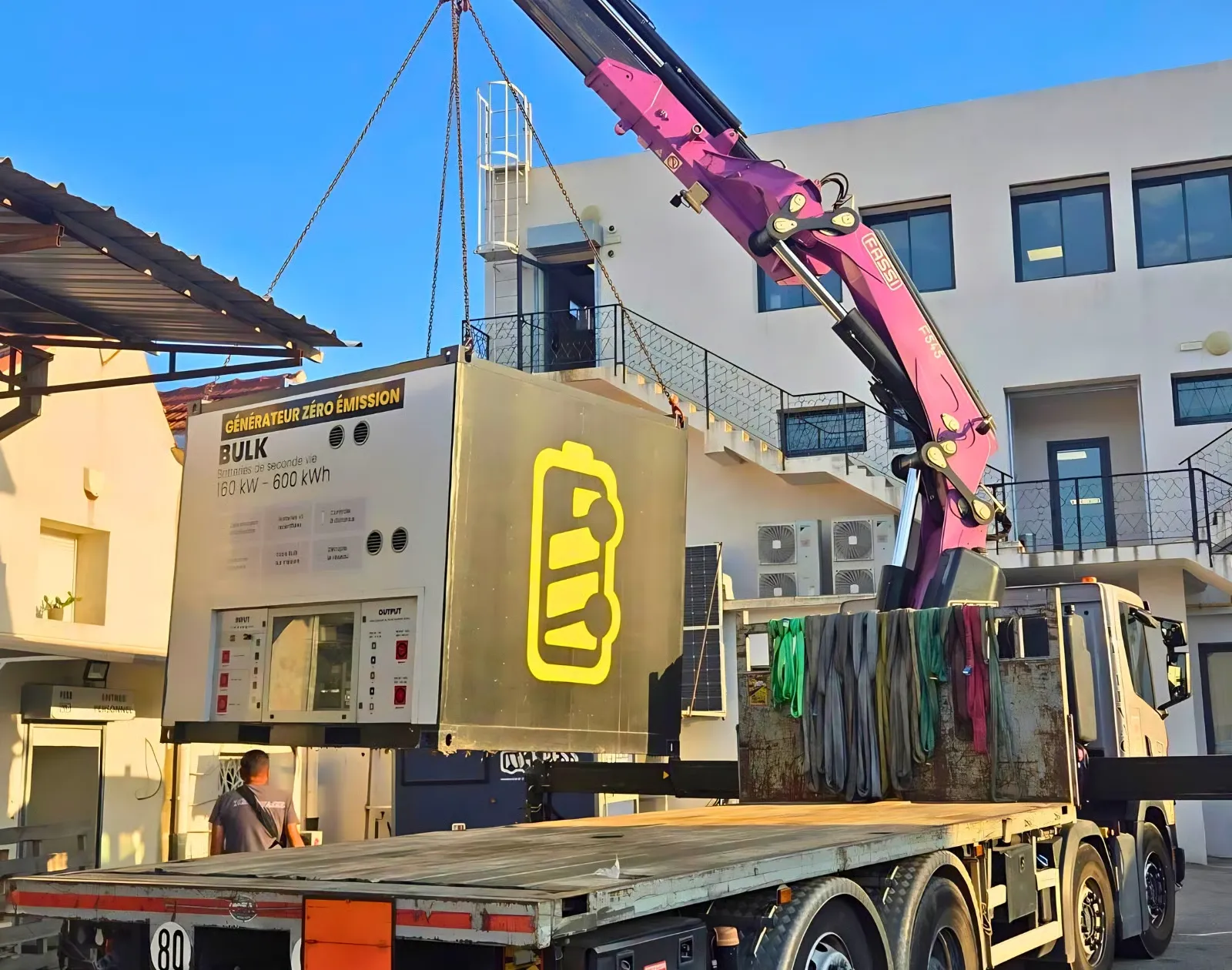
Generator sets are common at festivals, construction sites, and most outdoor events. Expensive to operate, noisy, polluting, and sometimes smelly, these diesel generators have many drawbacks. One alternative is to use portable batteries. Among the available solutions is that of PESS Energy, a French company that manufactures a large 600 kWh mobile storage system using second-hand batteries from the automotive industry.
Despite China’s overwhelming competition in the energy storage sector, a few rare French companies manage to stand out. This is the case with the Marseille-based startup PESS Energy, which offers a range of portable batteries designed to replace generators for events, the audiovisual industry, and construction sites. It assembles its products in a small factory located in the heart of Marseille, ranging from the “Bobine,” a small 5 kilowatt-hour (kWh) battery on wheels, to the “Bulk,” a 10-foot container that provides 600 kWh of power.
Also read
Battery recycling: our visit to a French factory
A portable battery, in industrial version
The Bulk is a true giant in storage: 3 meters long, 2.5 meters wide, and 2.6 meters high, it weighs 7 tons. Of course, this model doesn’t have wheels—it is transported by a crane truck to the event it needs to power, such as festivals, concerts, ceremonies, or construction sites. The unit has a capacity of 160 kW for both charging and discharging, in single-phase and three-phase configurations, and can be controlled remotely.
Its 600 kWh of useful storage capacity (out of a nominal 656 kWh) provides, for example, 24 hours of full operation at 25 kW and about 4 hours at maximum power. PESS Energy recently deployed it at the Street Food Festival in Marseille, where it reportedly replaced generators and helped avoid using 600 liters of diesel, according to the startup.
Technical specifications of PESS Energy Bulk 160 kW
Continuous rated power
160 kW
Capacity
656 kWh (600 kWh usable)
Second-life batteries
Inputs
P17 – 32 A (22 kW)
P17 – 63 A (43 kW)
P17 – 125 A (86 kW)
Powerlock 600 A (160 kW)
Outputs and protections
Powerlock 600 A (160 kW) (difference 0-5 A – circuit breaker 250 A)
P17 125 A three-phase (difference 0-5 A – circuit breaker 125 A)
Grounding connection
Charging time
(three-phase)
32 A (22 kW) = 30 hours
63 A (43 kW) = 15 hours
125 A (86 kW) = 7.5 hours
Powerlock 600 A (160 kW) = 4 hours
Battery life
2000 cycles (8 to 10 years)
Dimensions
10’ container
(3 x 2.50 x 2.60 m)
Weight
< 7 tons
Cooling and heating system
Reversible air conditioning 2 x 3000 W
Protection
Water and dust resistant
Noise level
< 20 dB
CE certification
BT Directive (2014/35/EU) and CEM Directive (2014/30/EU)
Second-life batteries certification (2023/1542/EU)
1400 € saved in diesel at a festival
For three consecutive nights, the Bulk unit powered half of the 42 food trucks, which were “too far from the distribution point,” explains Rémi Pillot, founder of PESS Energy. The only 30 kW portable power unit provided by the city was not powerful enough to meet the energy demands of these trucks, which were equipped with large fryers. Thus, the mega battery served as a buffer. “We charged at 30 kW on that unit 24/7, and from 5 p.m. to midnight during the festival, we supplied much more power to avoid overloading the grid. We didn’t have to worry about the battery’s charge level,” details the engineer.
In addition to “peak shading,” the battery would have provided independent power to the food trucks during power outages. “They tripped the circuit breakers three times, but those we were powering didn’t notice anything because we have a UPS inverter mode; everything continued to be powered despite the power outage,” says Rémi Pillot.
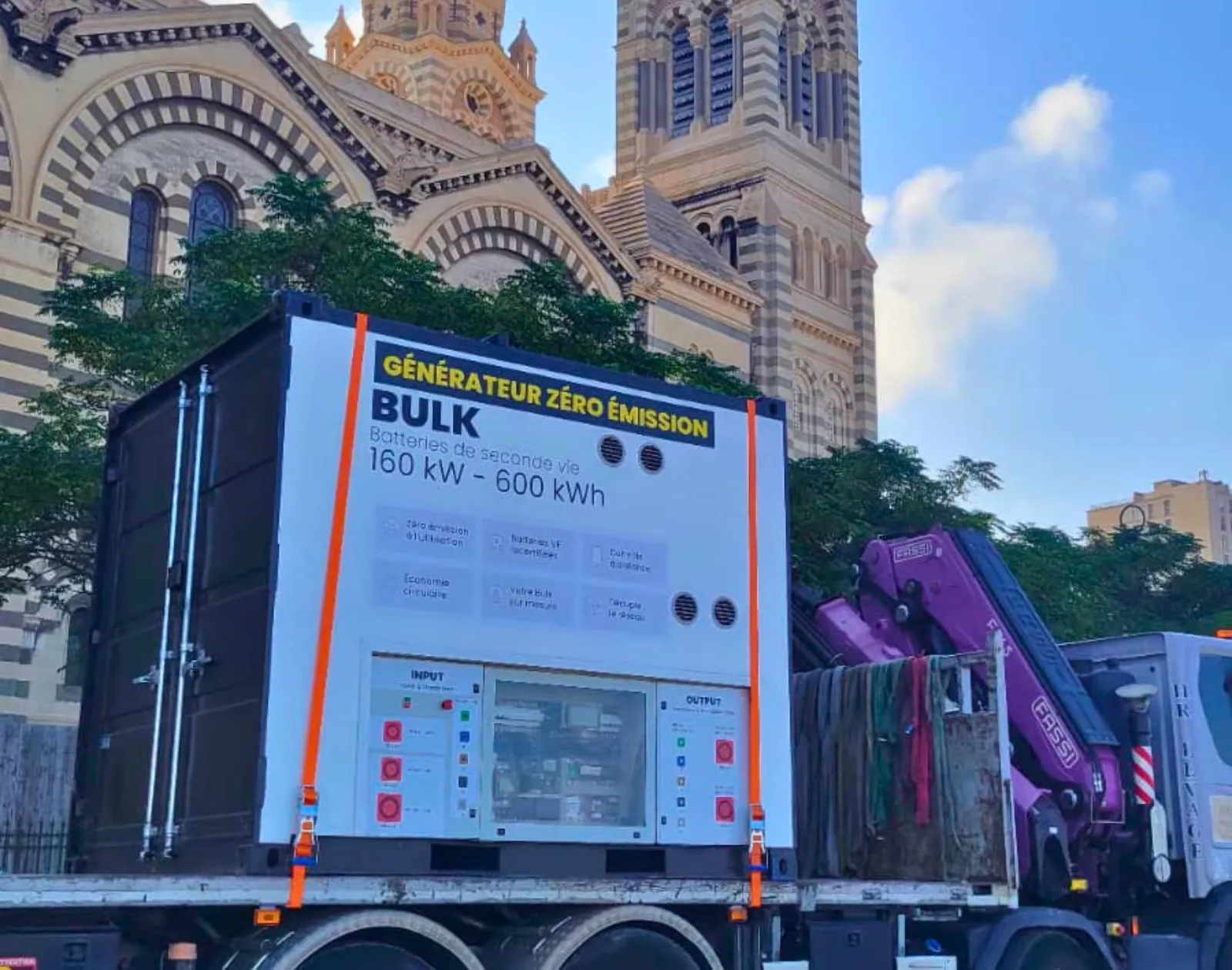

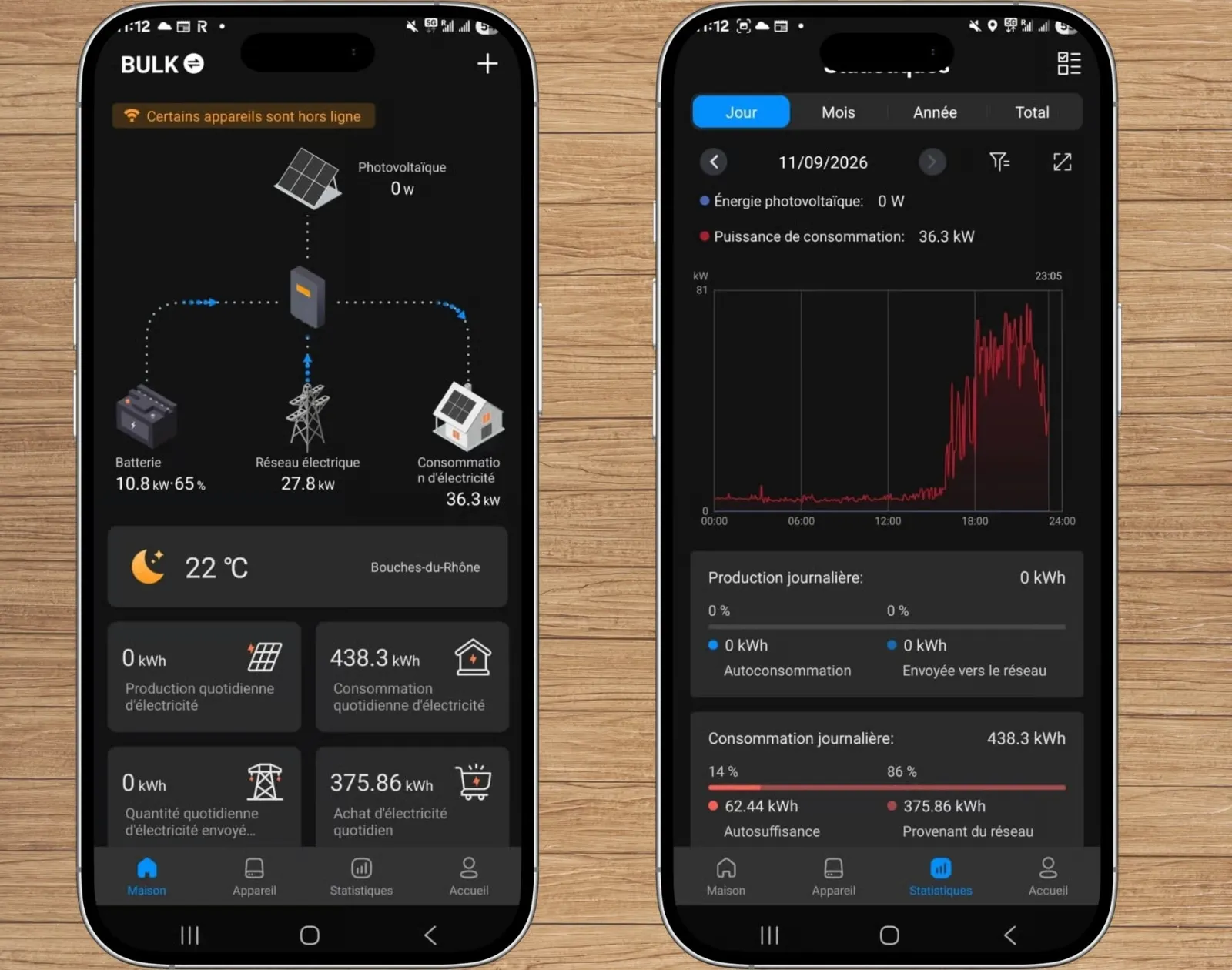
By the end of the festival, 1200 kWh of electricity was consumed, resulting in savings of 1400 euros in fuel costs and 1600 kg of CO₂, according to the manager. Of Bulk’s maximum capacity of 160 kW, only 80 kW was used at peak times, with an average power usage of 60 kW. This is significantly more than the capacity of a portable power distribution unit, which could not have powered the festival with so many consumers on its own.
Renting a mega battery costs as much as generators
For the organizer who rented the Bulk, the option seems attractive despite the cost being almost identical to that of a solution using generators. “For each quote, PESS analyzes the situation and ensures that, in the worst case, the cost is as much as using generators,” promises Rémi Pillot, who refuses to disclose a specific amount. There is no guaranteed financial savings, but improved comfort for event attendees. “For a food festival, it’s important not to have any odors.”
The Street Food Festival in Marseille is the third event to use the Bulk so far. The device has powered another similar festival in Aix-en-Provence as well as a ministerial ceremony “deep in the forest,” in a location completely without electrical access.
Also read
To increase its autonomy, he added a thermal generator to his Tesla Model Y.
The Bulk is equipped with batteries from used electric vehicles.
Beyond its quite impressive specifications, the Bulk stands out for using exclusively batteries from used electric vehicles collected in Europe. Inside the container, the batteries remain intact without any modifications. Eight packs are stacked one on top of another, like slices of cheese, according to Rémi Pillot’s description.
"It’s just reusing them; aside from reprogramming the BMS, nothing else is done," explains the engineer, who refuses to disclose the model of vehicle from which the batteries are sourced. Based on our estimates, however, they could belong to Volkswagen Group vehicles, as many models such as the ID4, ID5, Audi Q4, Cupra Tavascan, and Skoda Enyaq are equipped with batteries with a gross capacity of 82 kWh (82 x 8 = 656 kWh).
The packs used must exhibit a certain degree of consistency. Wear level, voltage, chemistry: not everything can be mixed together, as “it is the worst cell that determines the pack’s capacity.” The challenge therefore is to find batches suitable for bulk production, which is not always easy according to the executive. He is also working on creating a “hub” to utilize batteries from secondary use. “We need several stakeholders, each with a specific role: disassembly, testing, certification, and an aggregator to handle storage.”
Currently, sourcing batteries from secondary use can sometimes be a difficult task due to the wide variety of sources available.
Batteries that aren’t as worn out as one might think
"There are three types of used battery sources," explains Rémi Pillot, founder of PESS Energy. First, there are new batteries rejected by automakers even before they’re installed in a vehicle. It might be due to a simple aesthetic flaw, but the reasons can sometimes be surprising. "We had a case where a manufacturer ordered 100 battery packs, but changed the chassis design in the meantime," the engineer details. Since the batteries couldn’t fit into the cars anymore, they were discarded. "But these models are quite expensive; they don’t sell at second-hand prices."
Batteries from accidented cars
Next are batteries from accidented vehicles. The startup has acquired a nearly new battery pack from a car that had only 34 kilometers on the odometer and was scrapped after hitting a tree. “A few years ago, auto salvage yards didn’t know what to do with these battery packs. Now, some of them offer them for sale directly.”
Finally, the last source is batteries that have truly been used up after powering a vehicle throughout their lifespan. “This is the real second life,” explains Rémi Pillot. With this type of battery pack, “we don’t know the quality—whether the driver drove recklessly, if they did many fast charges, if the car came from a cold country, or what kind of impacts it endured. It’s a bit like playing poker.”
Overall, the health status (SOH) of the batteries used in Bulk is very good: “between 100% and 92% SOH for the lowest ones.” This is quite exceptional for second-life battery packs, as some fully functional used electric vehicles are sold with much lower SOH.
Also read
Recycling or second life: which is the best option for old electric batteries?
Despite used batteries, it’s hard to remain competitive against Chinese manufacturers
The use of second-life batteries reduces procurement costs slightly, by about 25%, but it doesn’t completely eliminate the bulk price. “When I buy a used battery pack, it’s much cheaper than new ones, but I’m not sure if they’re good quality; I might end up discarding one in four,” he explains. Additionally, the price of Chinese battery storage systems is so low that it’s increasingly difficult to compete with. “I’m not yet certain that a new finished product with second-life batteries is that much cheaper than an equivalent new one,” admits Rémi Pillot.
"We Europeans are fundamentally ahead because we manufacture here," he says, highlighting the advantages of made in Europe: "In terms of production, we guarantee a certain level of quality, oversight, implementation, and after-sales service that some Asians do not offer." Another significant argument is the environmental aspect. "In terms of carbon footprint, we save 75 to 80% less CO₂ compared to a new battery, which is important for customers who will be sensitive to regulations, Ademe subsidies, and ecological requirements."
Also read
Used electric cars: stop worrying about their battery condition
A 400 kW version of the Bulk in development
In addition to leasing, the Bulk is also available for purchase at a price that has not been disclosed. “It’s custom-made. We work with the client to develop the specifications, as it’s very specific,” explains Rémi Pillot. PESS Energy is also working on a second, much more powerful version of the Bulk, with the battery capable of delivering 400 kW.
This will enable them to satisfy more potential customers and strengthen their position, especially against competition other than Chinese batteries: the public grid. Enedis is increasing the number of connection points to the grid, particularly in urban areas, to power events directly and avoid using generators. This is the same goal PESS Energy has set for itself.