
CATL already sells its 587 Ah cell directly at a price of $65 per kWh.
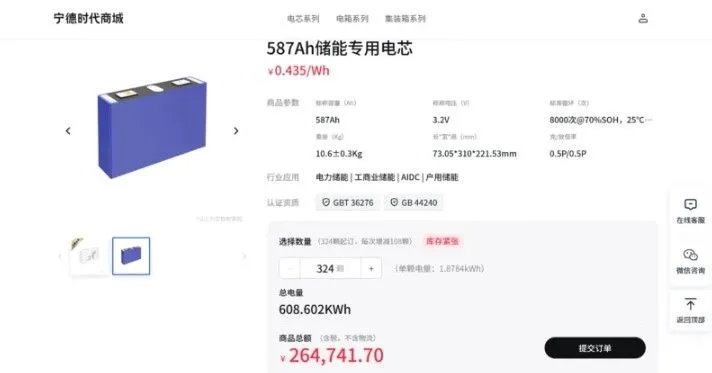
CATL has taken another step toward bringing its large energy storage cells to market by launching direct sales of its 587 Ah LFP cell—a high-capacity cell designed for stationary storage applications—through CATL Mall. The listed price is 435 yuan per kWh, which is approximately 65 dollars at current exchange rates.
The Chinese company began mass-producing and delivering this cell in 2025, but until now it was mainly available to large customers. With its inclusion in the CATL Mall catalog, small and medium-sized storage system integrators can access the product directly, reducing the need to rely on distributors. CATL also offers a five-year warranty and guarantees that orders are shipped within three to five days.
The price of $65 per kWh may seem particularly striking given the enormous size of this cell. Each unit has a capacity of 587 Ah and 1.88 kWh, with a volumetric energy density of 379 Wh/l. Its dimensions are 73.05 x 310 x 221.53 mm, and its weight is around 10.6 kilograms according to data published by CATL Mall.
However, there is an important detail: this cell is not designed for electric vehicles. CATL developed it specifically for stationary energy storage systems and it is limited to a charge and discharge rate of 0.5C. This is a fundamental difference from cells intended for cars, where large amounts of energy need to be delivered and retrieved in much shorter periods of time.
The 587 Ah battery has an announced service life of at least 8,000 cycles at 25 degrees with up to 70% capacity, while it can be discharged between -25 and 60 degrees. For charging, the temperature range is more limited, with CATL specifying operation between 0 and 60 degrees. The company classifies it as part of its second generation of large cells designed for storage, following the well-known 280 and 314 Ah units.
The size of this cell also allows for a reduction in the number of units required to build large storage systems. CATL officially introduced the 587 Ah in June 2025 after three years of development, stating that its goal was to reduce the number of components and simplify system integration. The company has used it as a basis for high-capacity storage solutions.
A minimum order of nearly $40,000
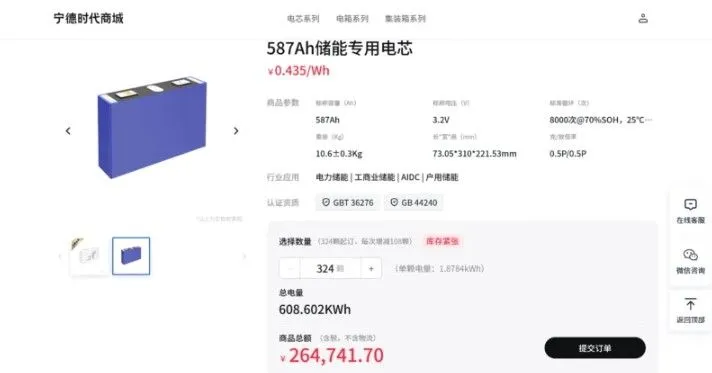
The direct sale comes with a condition that makes it clear this remains an industrial product. The minimum order is 324 batteries, resulting in a total energy capacity of about 608 kWh. At CATL’s listed price, the order amounts to around 265,000 yuan, or approximately $39,500.
To put that figure in context, those 608 kWh would roughly equal the combined capacity of about 20 residential battery packs, each with a capacity of 30 kWh. Clearly, this is not a product that can be purchased and installed individually in a home: it is designed for integrators who will then build complete storage systems.
This new sales channel was introduced following the launch of CATL Mall in 2026. The company has used this platform to sell cells and other storage products directly to businesses that previously faced difficulties meeting the minimum order volumes required by traditional channels. In August, CATL reported that over 1,800 companies had registered on the platform.
With this move, CATL is selling more than just a high-capacity cell. The company is currently the world’s largest manufacturer of batteries for electric vehicles, holding a 42.33% market share in China according to data from the Chinese industry association. Therefore, its strategy also involves transferring its manufacturing capacity and scale to the growing stationary storage market.
The arrival of the 587 Ah at CATL Mall also shows the direction in which energy storage is evolving. Higher-capacity cells allow for the construction of systems using fewer units and components, which is particularly important when dealing with installations of hundreds of MWh or several GWh. CATL is already using this generation of cells in large-scale storage systems, while simultaneously developing new solutions based on sodium batteries.