
CATL is losing customers and its stock price is falling. At the same time, it is selling LFP cells for $65 per kWh.
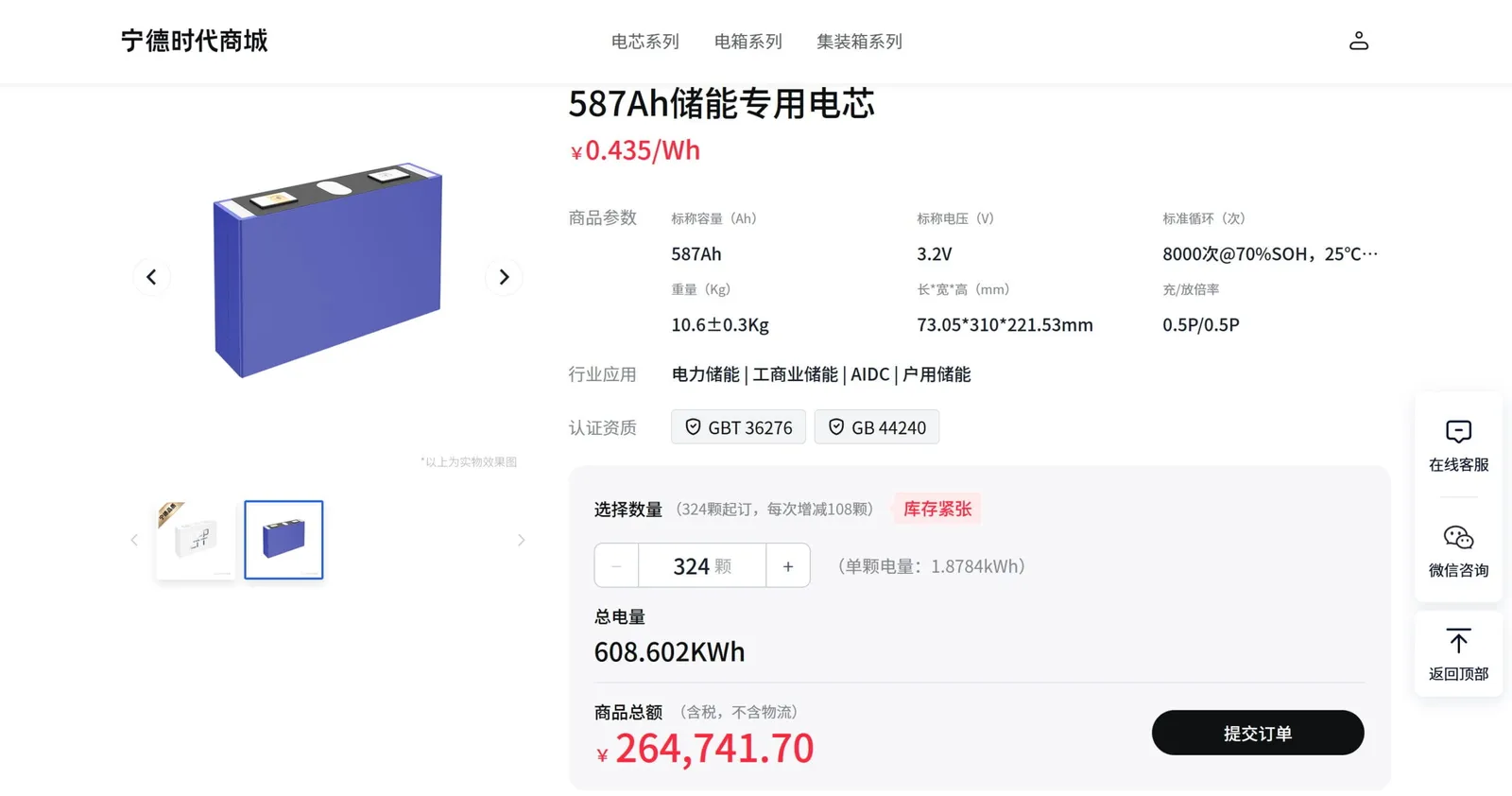
CATL received two strong signals from the market this week. On one hand, the company’s shares dropped to their lowest level in a year after Li Auto, Xiaomi, and other brands began placing larger orders for batteries. On the other hand, the company launched direct sales of large 587 Ah battery cells at 435 yuan per kWh, which is approximately 65 dollars per kWh.
Table of Contents
Show
Hide
On paper, this appears to be a clash between two different scenarios. In reality, both point to the same thing: CATL remains a giant, but the market increasingly wants to reduce its dependence on it.
CATL’s shares at a one-year low. The market fears one particular scenario
On Wednesday, CATL’s shares listed in Shenzhen dropped another 3.84% to 304.22 yuan. During trading, the price even fell below 300 yuan. The day before, the company had lost 6.16%, and this current level represents a decline of about 35% compared to its local peak at the beginning of May, when shares were trading at 467.35 yuan.
This isn’t just ordinary nervousness surrounding the entire sector. Some smaller battery manufacturers saw gains. Sunwoda rose by over 12% on Wednesday, with Gotion High-tech and Farasis Energy also climbing. So the market is reflecting less so a weakness in batteries as a business and more a shift in power dynamics between cell manufacturers and car makers.
For years in China, there has been a simple pattern: pricier and more prestigious electric vehicles often used CATL batteries. That standard is now breaking down.
Li Auto, Xiaomi and Aito are reducing their reliance on CATL
Li Auto made the most significant move. All versions of the new generation of the Li L8 model, unveiled in June, now use Sunwoda’s batteries, with the packs produced by a joint venture between the two companies. This means CATL is being excluded from this model’s supply chain.
That’s not all. Li Auto announced an investment of 2.65 billion yuan in Sunwoda Electric Vehicle Battery, allowing it to directly control 8.79% of the shares. Including affiliated entities, Li Auto’s group will hold 11.17%. In other words, it’s no longer just about purchases but also a capital investment.
In addition, the manufacturer has announced the gradual introduction of its own batteries across its entire lineup. The new generation of the Li Mega will switch from CATL batteries to those developed in-house. Chinese MIIT documents also indicate that the Li i6 electric SUV will use CALB batteries by 2026.
Xiaomi does similar things, but on a larger scale. The list of battery suppliers there has expanded to four companies: CATL, FinDreams, CALB, and Sunwoda. In the new Sky Nomad line, CATL is completely absent, as the batteries are supplied by Sunwoda and CALB.
The change is also evident among brands associated with Huawei. As part of the HIMA alliance, Aito shifted from relying solely on CATL to a multi-supplier model involving CALB and Gotion. Xpeng, on the other hand, made CALB its largest supplier several years ago.
This poses a greater threat to CATL than losing a single model. If top automakers start deliberately maintaining two, three, or four suppliers each, loyalty to the leader loses much of its value.
Money explains almost everything
The reason for this diversification is quite brutal. Profit margins in cars are much lower than those in batteries.
In the first half of 2026, CATL had a gross margin of 23.93%, with revenue reaching 276.9 billion yuan, an increase of 54.8% year-on-year. Net profit attributable to shareholders was 43.28 billion yuan, which was 41.98% higher than the previous year.
For comparison, Li Auto had a vehicle margin of only 9.4% in the second quarter, a decrease of 10 percentage points year-on-year.
The backdrop for the entire industry is even more striking. The total profit of China’s entire automotive industry from January to July 2026 was 20.9 billion yuan, representing a 28% decline year-on-year. The industry’s overall profit margin was just 2.4%.
In short, automakers looking at CATL’s results see a supplier that is doing far better than they are. Under such circumstances, pressure to shift the balance of power is natural.
The new consumption tax on lithium batteries in China also plays a role. Starting from September 1, 2026, the tax rate will be 2%, and it is set to rise to 4% by September 2027. Automakers that produce their own batteries and install them directly in vehicles can avoid this cost or deduct it. The incentive is simple: do it yourself or partner with cheaper and more flexible suppliers.
CATL still dominates. Operational data has not yet confirmed this.
The stock price suggests one thing, but current market data still shows CATL in strong position. In August, the company had 32.54 GWh of battery installation capacity in China and maintained its first-place position with a 41.45% market share. A month earlier, it was 42.33%, so the decline is still minor for now.
The entire Chinese traction battery market grew to 79.0 GWh in August. This represents a year-on-year increase of 26.3% and a 5.9% rise compared to July. It was the best month since the beginning of 2026.
In other words, CATL’s market share is slightly declining, but its business scale remains enormous. The issue now isn’t that the company has suddenly lost its position. The problem is that investors no longer believe this position will remain as secure in a year or two.
Meanwhile, CATL has started selling 587 Ah cells. However, they are not for use in cars.
The day before, CATL revealed another side of its business. On the CATL Mall platform, the company launched direct sales of large 587 Ah LFP cells intended for energy storage. The price is 435 yuan per kWh, which is approximately 65 dollars per kWh.
This is not a product for electric vehicles. The cell has a typically stationary characteristic, with charging and discharging at 0.5C. Smaller cells from CATL, such as the 280 Ah and 314 Ah versions, have a rate of 1C, making them more suitable for dynamic applications. For transportation use, the 587 Ah version is not appropriate.
Each cell has an energy capacity of 1.88 kWh, an energy density of 379 Wh/l, dimensions of 73.05 x 310 x 221.53 mm, and a weight of 10.6 kg with a tolerance of 0.3 kg. The declared lifespan is 8,000 cycles at 25 degrees Celsius down to a state of health of 70 percent. Discharging is possible between -25 and 60 degrees Celsius, while charging is feasible from 0 to 60 degrees Celsius.
The minimum order quantity is 324 cells, or three boxes. Such a purchase costs around 265,000 yuan, which is approximately 39,500 dollars, and provides a total capacity of 608 kWh. This is already at an industrial scale but still accessible to smaller energy storage system integrators.
The price seems good, but it’s not the lowest
CATL states that orders will be delivered within 3-5 days, with a 5-year warranty and no additional fees. This is important for small and medium-sized companies that were previously forced to rely on intermediaries or larger bulk contracts.
At the same time, the price alone doesn’t crush the market. According to data from the Chinese market, the average prices for 280 Ah and 314 Ah LFP cells in April 2026 were around 370 yuan and 395 yuan per kWh respectively. Thus, CATL’s new cell is more expensive.
What does the customer pay extra for? Probably the brand, predictable delivery, and reduced quality risks. It works similarly to the automotive industry. The leader doesn’t have to be the cheapest if customers believe it will deliver the product without unpleasant surprises.
CATL Mall reportedly already has over 1800 companies on its platform. However, there’s a catch. A valid Chinese business license is required to make purchases. Foreign customers must therefore use a local broker or establish a company in China. For Europe, this is currently more of a price signal than an actual purchasing channel.
For the Polish reader, something else is more interesting. If such price levels persist across energy storage markets, pressure to reduce costs for entire ESS systems will continue to rise. And this matters not only for China but also for the pace of energy development and charging infrastructure growth.
CATL today appears to be a company that uses one hand to defend its dominance in automotive batteries while using the other to move into more mass-market battery sales. Which front will be harder for it in 2027: the battle over margins with automakers or price competition in energy storage markets?