
CATL is testing 20 Ah solid-state cells. The goal is 500 Wh/kg, with a release planned for 2030.
CATL has begun trial production of solid sulfide electrolyte cells with a capacity of 20 Ah. In response to investors’ questions on Tuesday, the company confirmed plans for low-volume production in 2027 and mass production around 2030. CATL aims for an energy density of 500 Wh/kg.
For now, however, this is a laboratory scaled up to pilot levels, not a new product ready for market release.
Sulfides, 20 Ah, and Grade 4 out of 9
CATL is focusing on solid sulfide electrolytes. They offer high ionic conductivity and good deformability, but maintaining stable contact between the solid cell components remains a challenge. This is one of the main obstacles to achieving mass-produced all-solid-state batteries, as in liquid electrolyte cells, the electrolyte itself fills any gaps.
The company’s CEO is calming the tensions. Robin Zeng said at the Summer Davos Forum in June that on a scale of 1 to 9, all-solid-state batteries have only reached level 4. Initial production is expected to be limited. CATL continues to invest in sodium-ion cells as well, and its position is strong: according to SNE Research, it held 39.9% of the global electric vehicle battery market in the first half of 2026.
Toyota, Samsung SDI, and BYD Also Aim for 2027
2027 is a magic date in this industry.
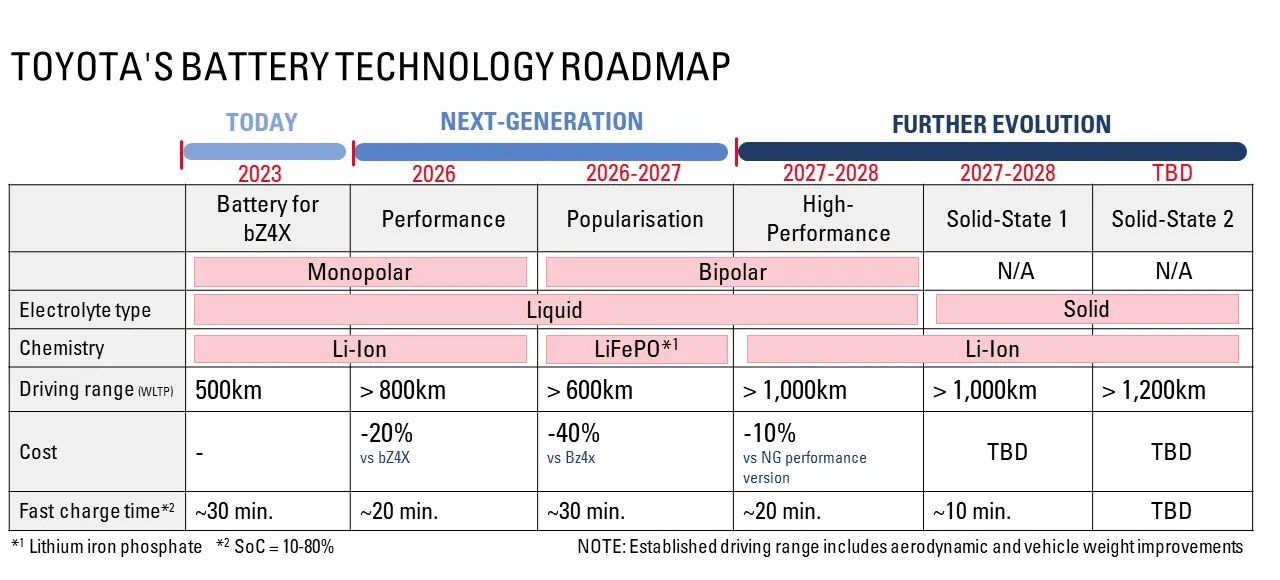
Toyota aims to release the first vehicle with an all-solid-state battery in 2027 or 2028. The prototype is expected to offer a range of 745 miles (1200 km) and charge in less than 10 minutes, according to the Japanese automaker. Toyota has been promising solid-state batteries for nearly a decade, with initial production expected to be small, similar to CATL’s approach. Last October, it also highlighted a “highly durable cathode material” developed in collaboration with Sumitomo Metal Mining.
Samsung SDI plans to begin mass production of SolidStack batteries in the second half of 2027.
BYD, the world’s second-largest battery seller, also intends to unveil its first vehicle with a solid-state cell in 2027. Its FinDreams division plans to produce sulfide cells in limited batches by 2027, with mass production starting around 2030.
Stella Li, BYD’s executive vice president, said in an interview with Carwow.es that BYD is in a “leading position” in solid-state technology and will “prove it” next year. This is a statement, not a result. For now, we only see timelines, not cars available for purchase.
All three companies say the same thing: a small series before 2030, with mass market availability coming later. For drivers in Poland, this means solid-state batteries in affordable cars are more likely to appear in the second half of the decade rather than in the near future.
In the meantime, LFP technology is making progress. BYD’s second-generation Blade already achieves over 1000 km in the CLTC cycle, meaning long range isn’t solely dependent on solid electrolytes.
LovEV Newsletter
Want more content like this?
Sign up — we’ll send you a weekly summary once the newsletter starts.