
CATL holds 39.9% of the EV battery market as of 7 months into 2026. The Chinese are leaving the rest of the world behind
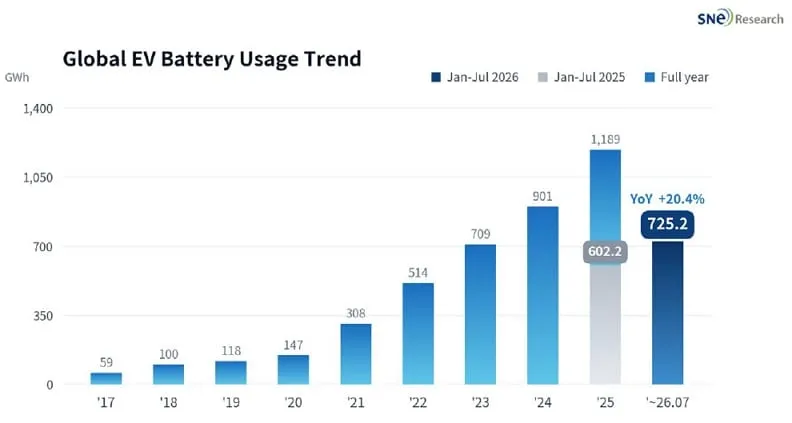
The global consumption of traction batteries in EV, PHEV, and HEV vehicles reached 725.2 GWh from January to July 2026, representing a 20.4% year-on-year increase. According to SNE Research data, CATL alone accounted for 39.9% of this consumption, with seven Chinese companies in the top ten controlling 72.8% of the market.
Table of Contents
Show
Hide
For drivers, this isn’t just a table for industry insiders. It’s a clear indicator of who holds the power over prices, battery chemistry, and availability of batteries for new models.
CATL Grows Faster Than the Entire Market, BYD Slows Down Significantly
CATL remains the leader with 289.6 GWh in consumption, showing a 26.6% year-on-year growth rate. This pace exceeds that of the overall market, pushing its share from 38.0% to 39.9%. In other words, CATL is already very close to the symbolic 40% threshold in the global market.
BYD is in second place. The company has supplied or used 106.7 GWh of batteries in its own vehicles, but it only grew by 4.7 percent year on year. As a result, its market share dropped from 16.9 percent to 14.7 percent.
This is a fairly clear signal. BYD remains a giant, but its battery business is heavily tied to its own vehicle sales. If sales momentum weakens, so does growth in battery installations. In contrast, CATL benefits from a much wider customer base and can better absorb fluctuations from any single manufacturer.
Together, CATL and BYD account for 396.3 GWh and 54.6 percent of the market share. This is slightly lower than a year ago when it was 54.9 percent, but it still means over half of the world’s market is in the hands of these two Chinese companies. Strong.
China’s second tier is also accelerating
The most interesting thing about these figures isn’t even that CATL is number one. That we already know. What’s more interesting is that Chinese players in lower positions are also growing faster than their competitors from Korea and Japan.
CALB occupies fourth place with 37.3 GWh, representing a 34.3 percent increase and a 5.1 percent market share. Gotion is in fifth place with 34.0 GWh, a 44.2 percent increase, and a 4.7 percent market share.
Eve Energy is growing even faster. The company reached 25.0 GWh, an increase of 53.1 percent year-on-year, and holds a 3.5 percent market share. Svolt added 18.9 GWh, showing a 39.1 percent increase.
However, the biggest jump was made by Rept. The manufacturer increased its capacity by 118.5 percent, reaching 16.9 GWh, and entered the global Top 10 for the first time. Sunwoda dropped out of the rankings, having previously been part of the top ten.
This shows one thing: the Chinese battery market is no longer based on just two companies. Behind CATL and BYD, a large group of competitors is emerging, taking market share not only locally but globally as well.
Korea and Japan are still in the game, but losing ground
LG Energy Solution remained in third place with 60.3 GWh of production. The problem is that its growth rate was only 4.5%, causing its market share to drop from 9.6% to 8.3%
LGES continues to supply batteries to Tesla, Hyundai, GM, and Volkswagen. On paper, this seems like a secure position. In reality, however, the market is growing faster than LG’s, so its share continues to decline.
Panasonic finished in sixth place. The company produced 26.2 GWh, with a 7.6% growth rate, but its market share fell from 4.0% to 3.6%. Its performance was largely driven by sales to Tesla in North America.
SK On is in a worse situation. It is the only company in the Top 10 that experienced a decline in volume. Its installations dropped by 9.8 percent to 22.3 GWh, while its market share shrank from 4.1 percent to 3.1 percent.
In total, LGES, Panasonic, and SK On combined generated 108.8 GWh. Last year, they held 17.7 percent of the market together; today it is 15.0 percent. The decline may not seem dramatic, but the trend is clear. They are growing more slowly than the market, so they become smaller month by month.
72.8 percent for seven Chinese companies. This is no longer an isolated case.
The seven Chinese companies in the global Top 10 are responsible for 528.4 GWh of installations and 72.8 percent of the market. Last year, this figure was 3.1 percentage points lower.
This is no longer a temporary cost advantage or the effect of a strong domestic market in China. It appears to be a lasting shift in the balance of power across the entire industry. Chinese manufacturers possess scale, their own supply chains, aggressive pricing strategies, and an increasingly strong presence outside China.
For Europe, this presents a simple dilemma. Either local battery producers start growing faster and reducing costs, or they remain as a more expensive alternative to brands that will ultimately purchase chemicals or ready-made packages in Asia.
Regions are growing unevenly, with North America declining after subsidy cuts
SNE Research also provides regional data, revealing an interesting disparity. Europe grew by 29.3% year-on-year, China by 16.6%, other Asian markets by a staggering 77.1%, while South America grew by 192.6%
The only major region showing a decline is North America. There, battery installations dropped by 20.2 percent year on year.
The reason is quite simple. After the expiration of federal tax incentives for EVs in the U.S., the share of battery-powered vehicles in new car sales fell to around 6 percent. This is a clear warning for those who claim the electric vehicle market is already “self-sufficient” and that policy doesn’t matter. It does matter — and quite significantly.
In July 2026 alone, global installations reached 116.0–116.7 GWh according to published figures, which is about 22 percent higher than the previous year but roughly 16 percent lower than in June. Monthly fluctuations are normal. What’s more important is the seven-month trend, and that trend is clear-cut.
In the end, the question is not whether Chinese companies dominate the battery market, but how much longer the rest of the world will pretend that this can be caught up with through mere announcements. Which manufacturer outside China do you think has a real chance of narrowing the gap with CATL today?