
CATL is acquiring a 24.87% stake in a truck battery swapping operator. It is also building 100 stations for passenger cars simultaneously.
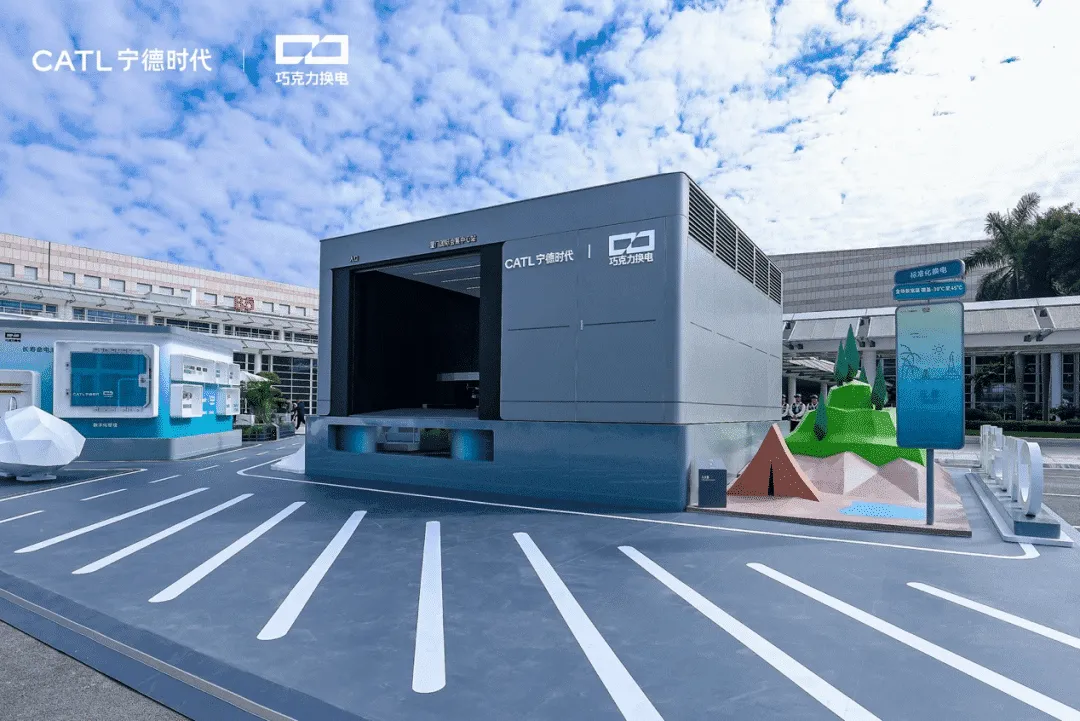
CATL is accelerating its battery swapping efforts in China significantly. The company acquired a 24.87% stake in Qiyuan Green Power for 2.56 billion yuan, and a few days later announced the construction of 100 Choco-Swap stations in Kunming, with 10 set to open this year. This no longer appears to be a side experiment by a battery cell manufacturer but rather a bid for control over infrastructure.
Table of Contents
Show
Hide
In practice, CATL is building two parallel worlds—one for heavy trucks and long-distance logistics, and another for passenger cars. And that’s what makes this particularly interesting.
CATL acquires China’s largest e-truck battery swapping network
The biggest activity lies in heavy transportation. CATL is taking a minority but substantial stake in Qiyuan Green Power, the operator regarded as China’s largest network of charging and battery swapping stations for trucks.
The transaction price is 2.56 billion yuan, or about 330 million euros. The entire company was valued at around 10.275 billion yuan, indicating a valuation roughly 120 percent above its book value. In short, CATL is paying for future growth rather than what is already in the assets today.
Upon completion of the transaction, CATL is set to become the largest shareholder in the company. This is significant because Qiyuan Green Power is not a startup based on slides and promises. It is a company affiliated with China Power, which belongs to the state-owned State Power Investment Corporation. In other words, CATL is leveraging the political and infrastructural support of a major state player alongside its own technology.
Two technologies under one roof
Techinally, this move is more interesting than the amount involved. After the transaction, two different battery swapping standards for trucks will fall under CATL’s umbrella.
Qiyuan Green Power uses a solution in which the replaceable pack is mounted at the back of the vehicle. This system is designed to be compatible with over 80 percent of existing battery-swappable trucks in China. It is best suited for use in enclosed or semi-enclosed environments such as mines, ports, steel mills, or urban construction sites.
CATL, on the other hand, is developing its own Qiji system, in which batteries are installed within the chassis. For trucks, the company uses the Choco-SEB solution with module #75. This is a 171 kWh capacity module made up of LFP cells. The name SEB stands for Swapping Electric Blocks, while “Choco” refers to the batteries being divided into modules that resemble chocolate bars.
The difference is simple. The rear package fits better with the majority of the current fleet, while the CATL chassis system seems more like an attempt to establish a standard for the future. One model aims at compatibility, while the other focuses on standardization. If both are brought under one player’s control, CATL could start holding the cards.
The scale is impressive, but trucks aren’t cars
Qiyuan Green Power is expected to have around 1,600 charging and battery swapping stations in 208 prefecture-level cities by the end of 2025. This is a large network, especially for the heavy-duty segment, where each location requires significant traffic flow and predictable logistics.
CATL’s Qiji network is smaller. It aims to have around 300 stations by the end of 2025, with a plan to reach 900 stations in 2026. The company states that it intends to cover approximately 80 percent of China’s freight transport on major routes by 2030 in the long term.
It sounds ambitious. And it probably should be. However, one caveat must be added: trucks operating on fixed routes, in ports, or mines are ideal candidates for battery swapping. They are far more suitable than private cars that travel everywhere without needing to return to a single base. That’s why battery swapping has better economic viability in the heavy-duty segment.
According to industry figures, nearly 30,000 trucks equipped with swapable batteries were registered in China alone in 2024. This is no longer a niche market for investor presentations.
Kunming to Get 100 Choco-Swap Stations for Passenger Cars
Meanwhile, CATL is focusing on another area: passenger cars. On August 24, its subsidiary Contemporary Amperex Energy Service Technology signed a contract with Kunming Development New Energy. The plan calls for building 100 Choco-Swap stations in Kunming, with 10 of them set to be established this year.
The role division is straightforward. The local state-owned company will handle investment, own the stations, and provide land, infrastructure, as well as connections with government agencies and businesses. CATL will supply the standardized Choco-Swap system, operational support, and system services.
To achieve this, both parties aim to standardize the station branding, battery configurations, pricing, marketing, and service standards. In the initial phase, the focus is on building the network itself and deploying vehicles capable of battery swapping. Later, the collaboration is expected to extend to battery asset management, photovoltaics, urban energy storage, and related energy businesses.
This is the first such joint operational project between CATL and a local state-owned energy company. The model is quite clear: CATL does not need to finance everything on its own, while the local partner provides the land, connections, and political support within the administrative system. NIO has done similar things through its partnership program. The difference lies in the fact that NIO’s network is primarily designed for NIO vehicles, whereas CATL’s system is intended to be open to a wider range of manufacturers.
EVOGO is Growing Faster Than European Discussions on Standards
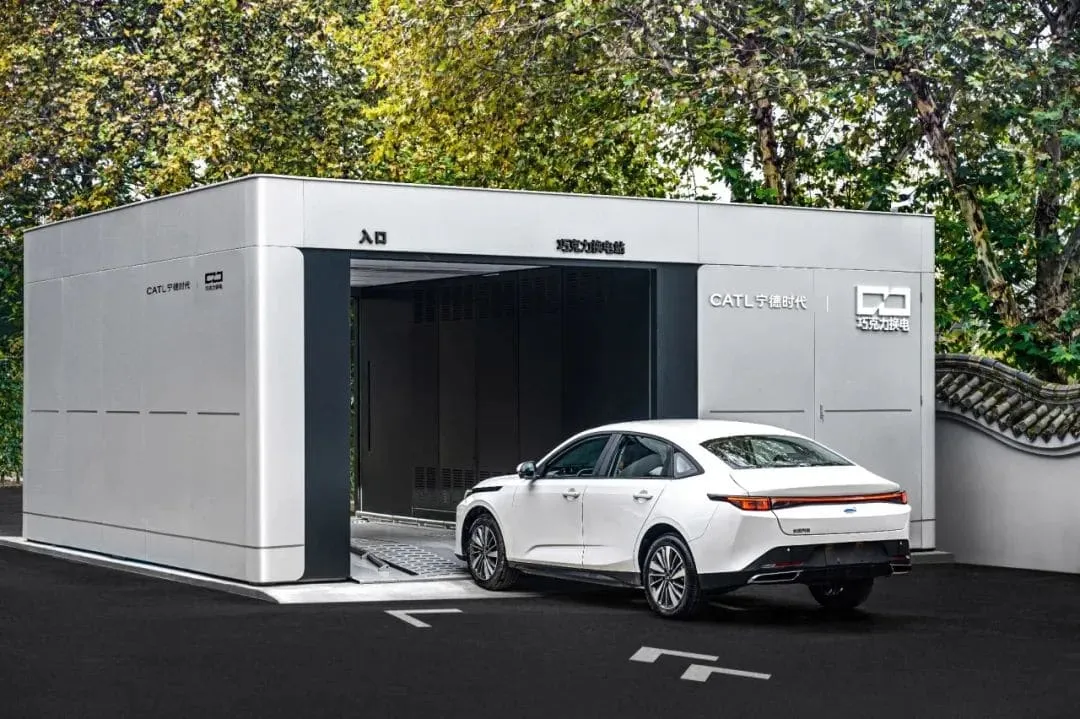
As of the end of June, the EVOGO Choco-Swap CATL network had around 2,000 stations in 180 cities across China. The plan is to exceed 3,000 locations by the end of 2026.
Here again, we can see the difference in approach between China and Europe. In China, scale is established first, with the market then adapting business models. In Europe, we usually start by asking whether everyone has agreed on standards, rules, and responsibility allocation. This can be sensible, but the pace is different.
Is this model viable outside of China? For now, it seems more like a niche solution for fleets, delivery vehicles, or heavy transport on repetitive routes. For private cars in Europe, fast charging has won out due to its simplicity and widespread adoption. On the other hand, if anyone really has a chance of pushing through an open standard for battery swapping, it’s CATL, as they are involved in both the cells, the system, and the infrastructure.
One thing is particularly important here. CATL is no longer just a battery supplier. It increasingly aims to manage the entire energy chain for vehicles, from the battery pack to the charging stations and subscription model. In that case, the car manufacturer might be reduced to the role of an integrator for someone else’s platform. This is convenient for some brands but somewhat risky for others.
The Chinese are currently testing whether battery swapping can be established not as a novelty, but as a mass-scale infrastructure. What do you think? In Europe, would this model make sense first for trucks and vans, or rather for passenger cars?