
Electric trucks: Global sales surged by 75% in just six months
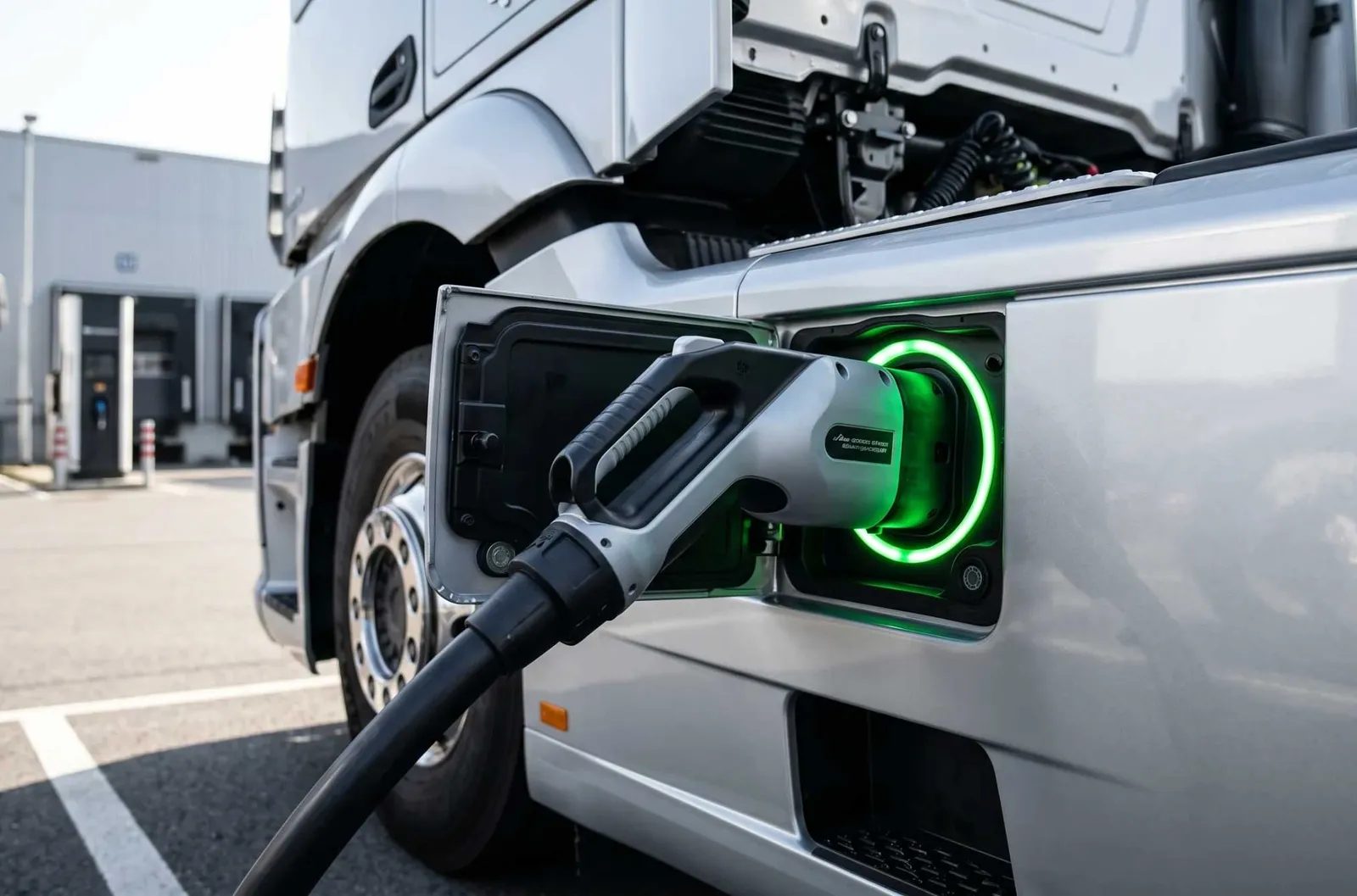
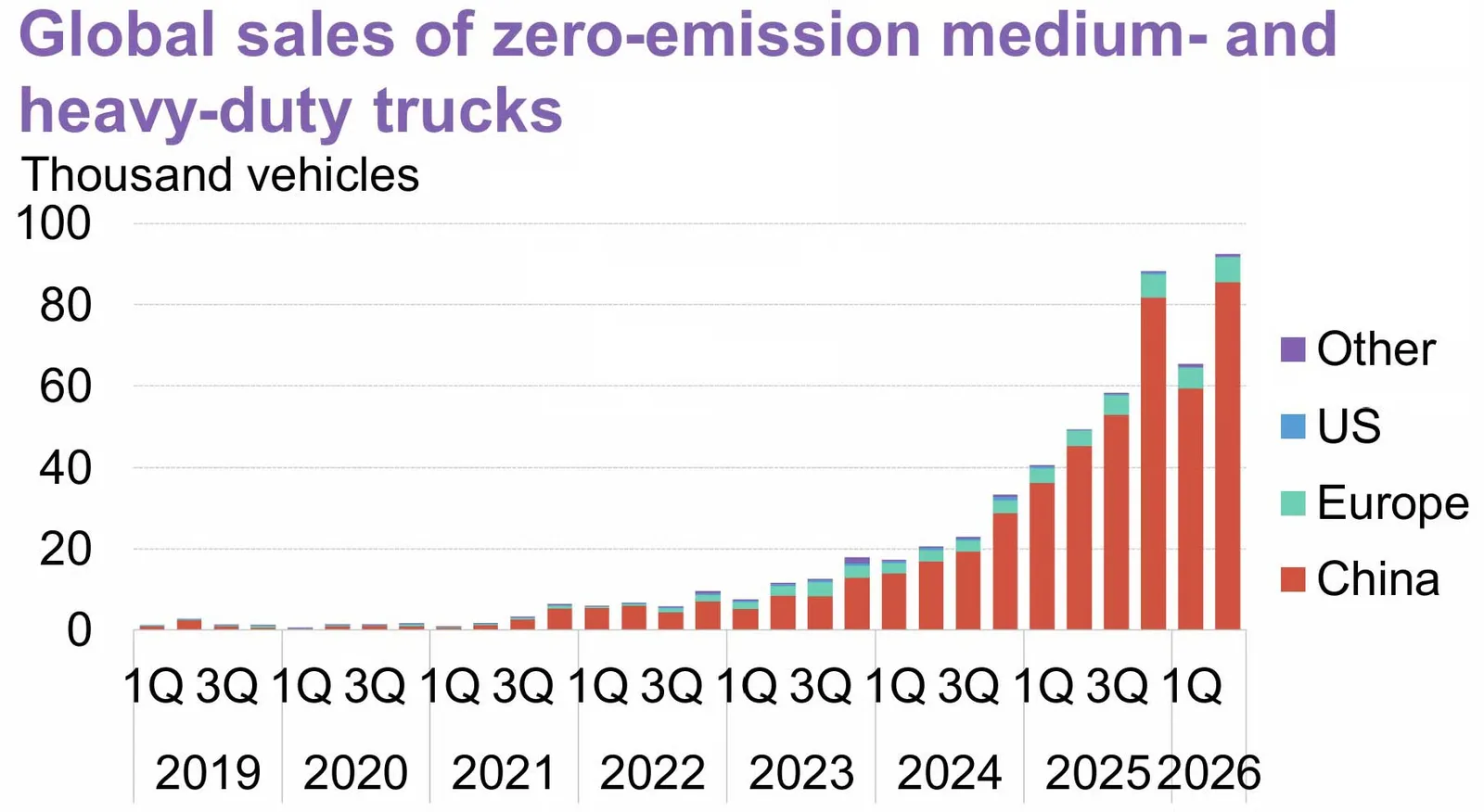
The electric truck industry is accelerating rapidly. In just six months, its global sales jumped by 75%. According to the latest edition of BloombergNEF’s Commercial ZEV Factbook, nearly 158,000 zero-emission trucks and medium vehicles were sold worldwide in the first half of 2026. This is more than eight times the figure recorded in the first half of 2023.
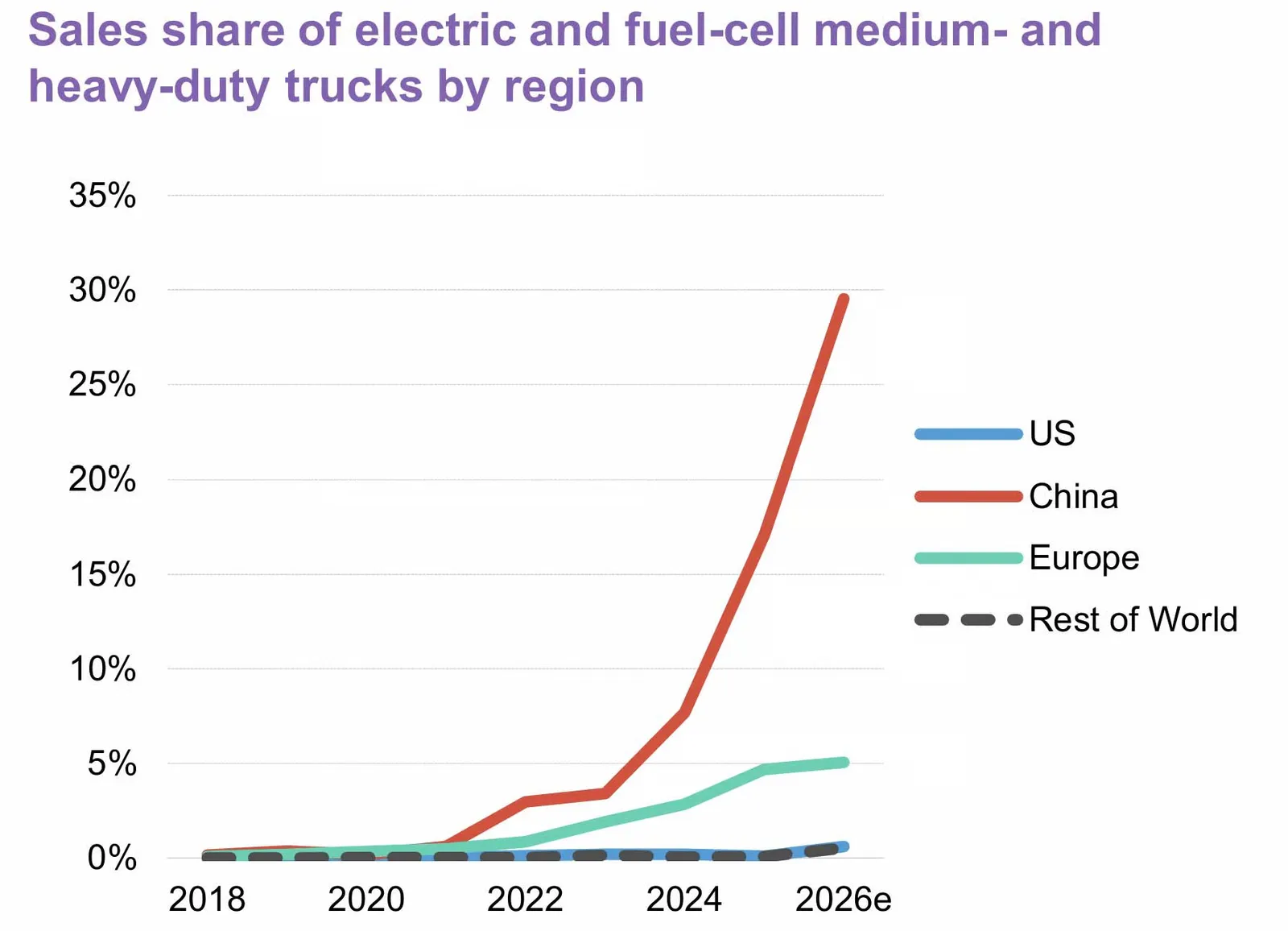
The trend could accelerate further. BloombergNEF estimates that zero-emission trucks should account for over 9% of global truck sales by the end of 2026.
Produced in collaboration with the Smart Freight Centre, the Dutch Ministry of Infrastructure, and Traton, the parent company of MAN and Scania, the report also shows that this transition relies almost entirely on batteries. From January to June, nearly all zero-emission trucks sold worldwide were battery-electric. Fuel cells remain marginal, with only about 530 units sold, representing just 0.3% of the market.
China, the driving force behind electric trucks
The growth of electric trucks is highly uneven. China alone sold nearly 145,000 electric trucks in the first half of the year, representing a 78% increase. The country accounts for over nine out of ten global sales.
The adoption rate there has quadrupled since 2024. After accounting for about 17% of truck sales in 2025, electric trucks are expected to make up nearly 30% of the Chinese market by 2026.
Several factors explain this lead. China’s 2026 end-of-life vehicle subsidy program, in particular, allows drivers to receive up to 140,000 yuan, or about 18,000 euros, for replacing an old truck with an electric model. China also benefits from particularly low battery costs, which helps bring the cost of an electric truck to roughly half that of a diesel model. BloombergNEF estimates these costs at 108 dollars per kWh for batteries used in commercial vehicles, compared to 182 dollars elsewhere in the world.
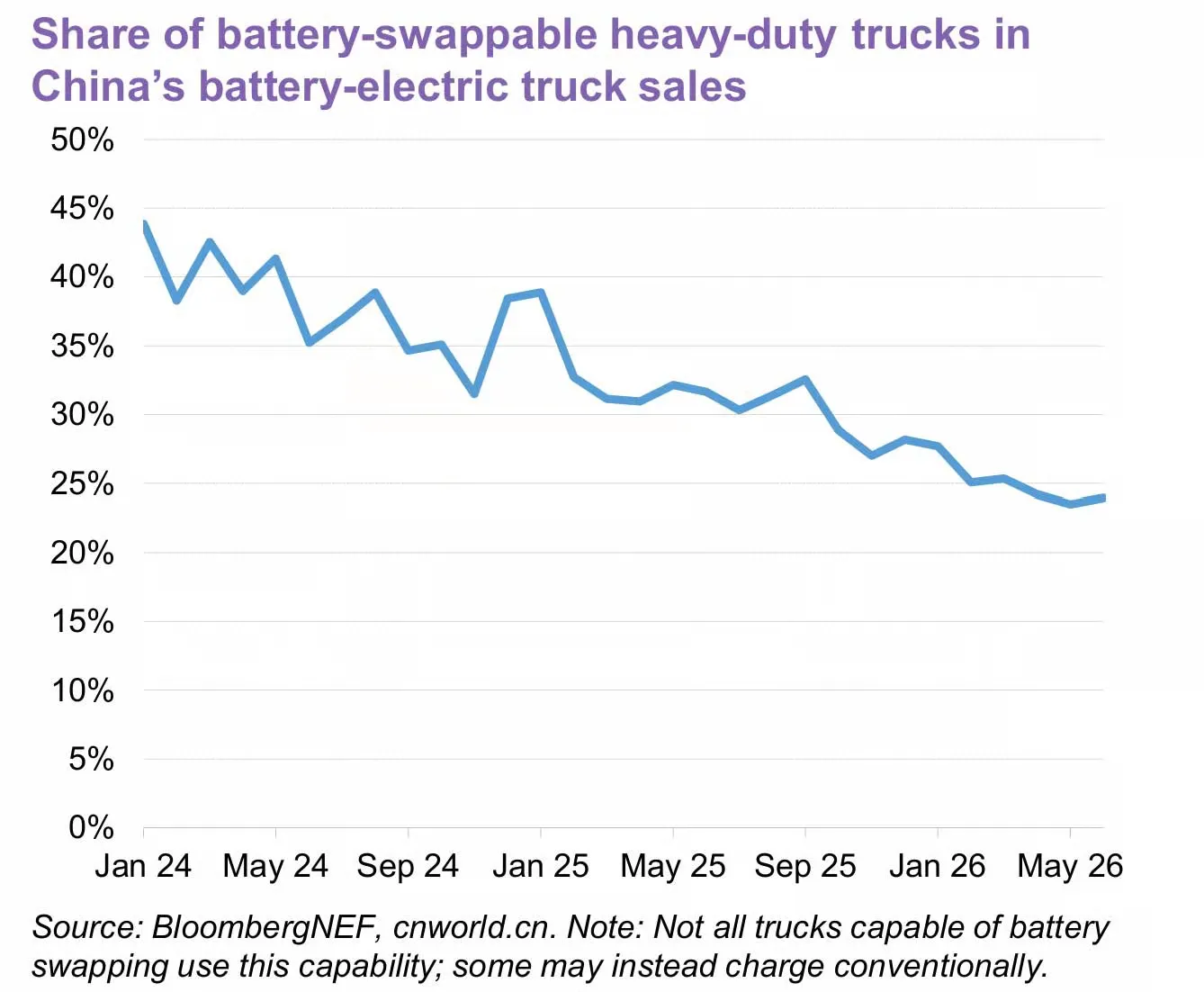
Another notable aspect is that battery swapping still accounts for a significant portion of China’s truck sales. CATL had already deployed over 300 QIJI stations dedicated to trucks by April. The company plans to install more than 900 such stations this year, particularly in partnership with energy giant Sinopec and several logistics firms. As of June, models compatible with battery swapping still made up nearly a quarter of China’s electric truck sales.
Europe Makes Slow Progress
Europe is also making progress, but much more slowly. Electric truck sales there increased by just over 50% in the first half of the year, exceeding 11,200 units.
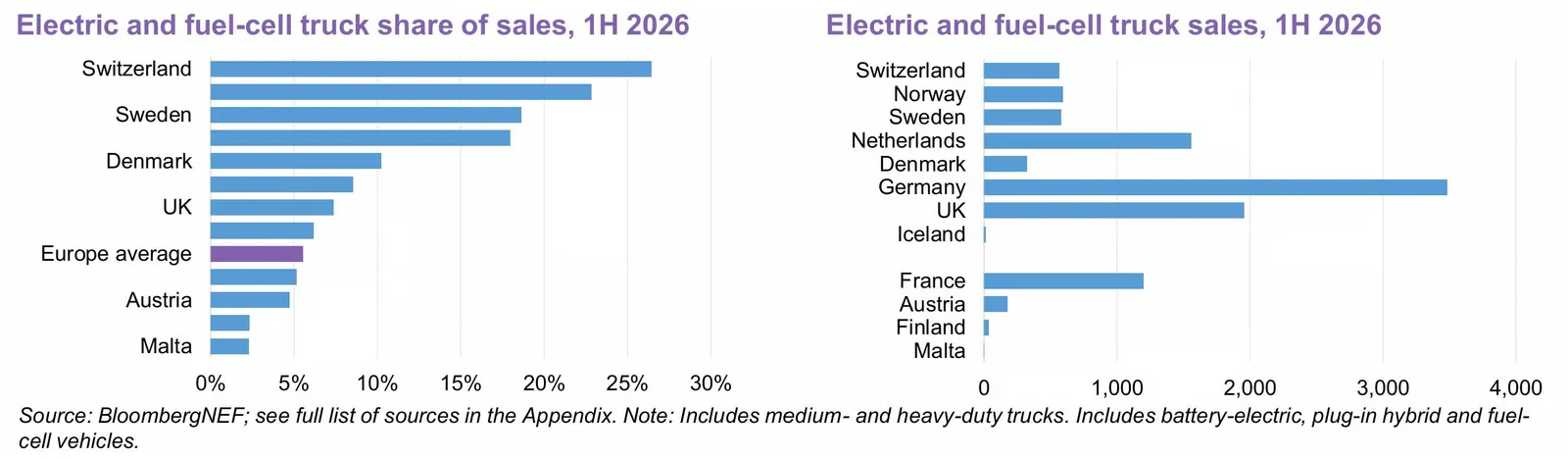
Germany is the largest market by volume. Nearly 3,500 electric trucks were sold there in the first half of the year, ahead of the United Kingdom with around 2,000 units and the Netherlands with 1,600. However, the ranking changes completely when looking at market share. Electric trucks account for over 26% of truck sales in Switzerland. This figure reaches 23% in Norway, 18.6% in Sweden, and 18% in the Netherlands.
Five European countries now exceed 10% in electric truck sales. Yet the average across Europe remains at 5.5%, and France is not part of this leading group.
Also read
We boarded the Tesla Semi, the electric truck aiming to disrupt Europe
The main challenge: charging along transport corridors
If electric trucks are struggling to gain traction in Europe, it is also because the infrastructure has not kept up. As of June 2026, less than 2.5% of heavy vehicle rest areas in Europe were located within a kilometer of a charging station designed for trucks capable of delivering at least 350 kW. An additional 9% were situated near high-power stations shared with cars. Yet there remains a significant gap between Europe’s ambitions and the reality on the ground.
Infrastructure compliant with the European AFIR regulation is primarily concentrated in Central and Northern Europe, especially in Germany and Scandinavia. In contrast, certain sections of the TEN-T network in Spain, Italy, or Greece may still be more than 300 kilometers away from a station that meets the criteria. European regulations, however, call for rapid transformation of this network.
By 2030, AFIR requires full coverage with stations installed every 60 to 100 kilometers in each direction, and a total capacity ranging from 1.5 to 3.6 MW depending on their location within the network. Sweden and Norway have already exceeded their targets. Germany, France, Poland, and Spain, on the other hand, are still far from meeting them.
The United States falls behind
The situation in the United States contrasts sharply with that in China and Europe. Electric truck sales there dropped by 63% in the first half of the year, falling to just a few hundred units. Their market share remains well below 1%.
The report highlights three political developments to explain this decline: the expiration of the federal tax credit for clean commercial vehicles, the cancellation of California’s Advanced Clean Trucks exemption, and the weakening of federal emission standards.
American operators have not completely given up on their projects, however. The deployment of charging stations for heavy trucks continues, particularly in anticipation of future deliveries of the Tesla Semi and increased production volumes. The market also offers several economic advantages. Relatively low electricity costs and high annual mileage can enhance the profitability of an electric truck when operating conditions are favorable.
Already competitive in certain applications
Despite an purchase price that is often higher than that of a diesel model, electric trucks are already economically competitive for some freight carriers according to BloombergNEF.
Heavy trucks travel many kilometers, and their intensive use allows the initial higher cost to be offset more quickly. Depending on energy and capital costs, the proportion of applications where electric trucks can become cost-effective could approach 50% of the total fleet.
Two major uncertainties remain, however:
The cost of charging. The expense can vary significantly between charging at a company depot and using a public station. In some cases, this difference can offset part of the economic advantage of electric vehicles.
The residual value of trucks after three to five years of use remains difficult to predict. In some cases, estimates range only from 0 to 20%, while vehicles with a more developed used market can retain 25 to 50% of their value. This is far from trivial for transportation professionals: the expected resale value directly affects the rental rates offered to shipping companies. It could therefore play a decisive role in determining how quickly European fleets will switch to electric vehicles.