
Electric trucks: Will they be more competitive than diesel trucks in Germany by 2030?

Electric trucks could become economically more advantageous than diesel vehicles on most of Germany’s freight routes by 2030. This is the main finding of a study by the Potsdam Institute for Climate Impact Research, which analyzed four million trucks and thousands of real-world usage profiles in Europe.
However, the outcome depends heavily on the availability of adequate fast-charging infrastructure.
The study, titled “Cost competitiveness of alternative heavy-duty truck technologies under real-world utilisation profiles,” aims to overcome one of the limitations of traditional analyses on electric heavy-duty trucks: relying on average truck usage rather than their actual operating patterns.
The researchers combined usage data from about four million commercial vehicles with various scenarios for the evolution of costs related to batteries, vehicles, and energy. They present electric trucks not as an automatically competitive solution for every mission. Instead, they highlight how important factors such as usage patterns, battery size, energy prices, and charging availability are.
The economic advantage emerges sooner than expected
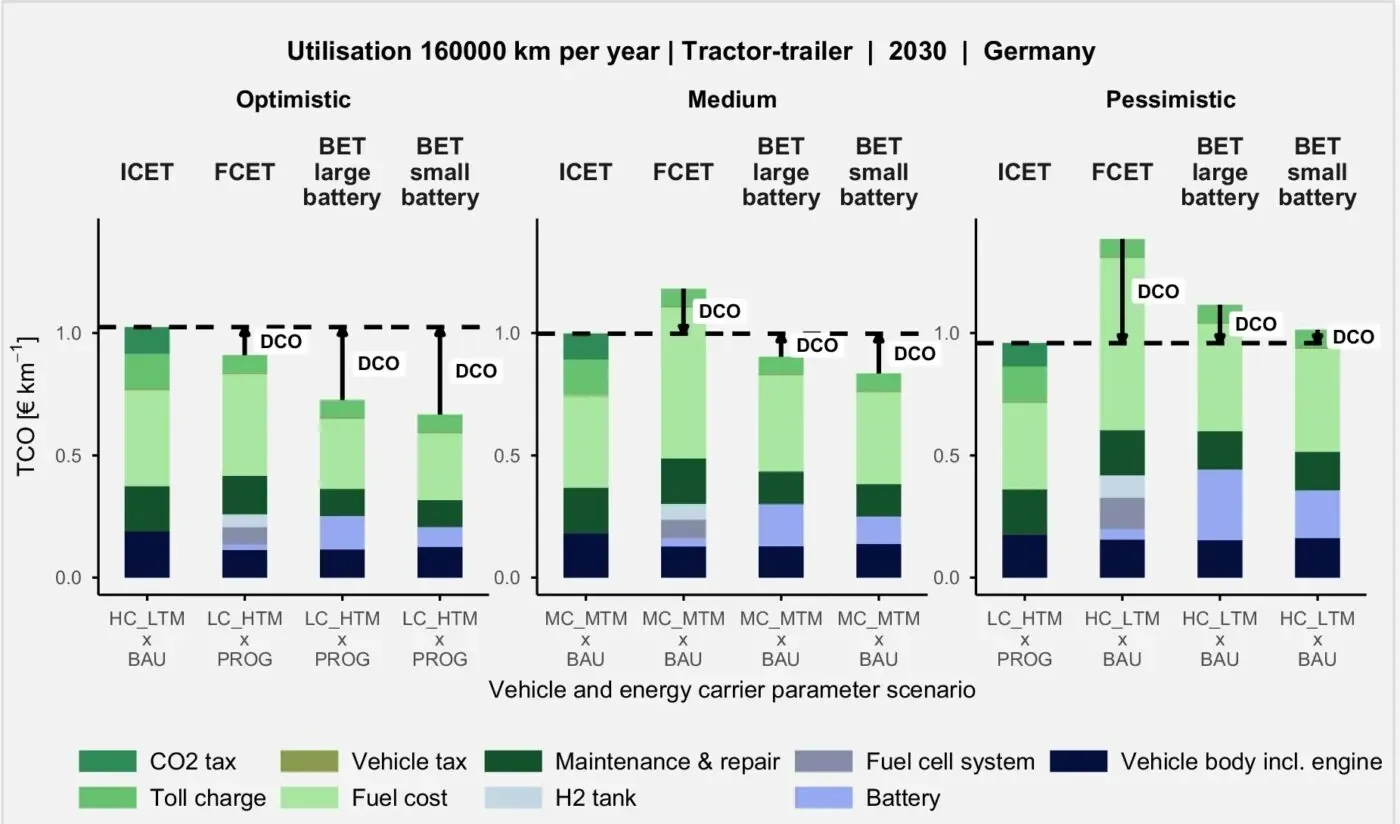
In a so-called “intermediate” scenario, an electric truck with a smaller battery would achieve competitiveness in terms of total cost of ownership (TCO) for 91% of road freight transportation by 2030. For models with larger batteries, this figure would drop to 69%.
The difference mainly stems from the fact that a larger battery increases the vehicle’s initial cost, yet it is not always necessary for daily operations. On the other hand, when a truck travels many kilometers per year, the advantages of electric trucks tend to increase due to higher powertrain efficiency and potentially lower energy costs.
India has a plan: 100,000 electric heavy vehicles within 5 years
In the most favorable scenario, virtually all of the usage profiles analyzed would become economically viable with electric trucks by 2030, offering savings on TCO of up to 0.50 euros per kilometer.
The situation changes drastically in the most unfavorable scenario: competitiveness over diesel would be limited to 14% of operations for trucks with small batteries and only 3% for those with large batteries.
The real limitation isn’t just range
The most interesting finding of the study emerges when researchers stop focusing solely on TCO and introduce a practical factor: the ability to actually complete daily missions.
Trucks that cover the most kilometers each year tend to be more economically favorable for electric vehicles, but they are also those that may require daily distances exceeding the available range. If the fast-charging network is insufficient, this theoretical economic advantage does not automatically translate into an operationally feasible solution.
Given the limited range and infrastructure availability, in the intermediate scenario, the proportion of activities truly compatible with electric trucks by 2030 drops to around 21-25%.
This represents a huge difference compared to the 69-91% calculated based solely on economic competitiveness, and it illustrates why, for heavy transportation, focusing only on “cost per kilometer” is not sufficient.
China faces the challenge of electric trucks: will they account for 40% by 2030?
Adequate charging can change the landscape
The expansion of high-power charging networks could significantly alter the situation. According to the study, by combining greater infrastructure availability with improvements in battery range, the share of economic and technically feasible activities suitable for battery-powered trucks could reach 63-77% by 2035.
This has important implications for battery size as well. A widespread fast-charging network allows it to be avoided using oversized batteries just to cover occasional particularly long distances.
To achieve real and efficient adoption of electric trucks, a coordinated charging network along major logistics routes will be necessary, with capacities appropriate to the available downtime.
Hydrogen? Competitive only in specific scenarios
The study also considers fuel cell trucks. Their main advantage over BEVs is greater operational flexibility for long distances, thanks to refueling times and range.
Economically, however, the situation is less favorable. By 2030, hydrogen trucks are only competitive with diesel trucks under the most advantageous conditions, covering about 79% of transportation activities, but with economic advantages that are less than half those of battery electric trucks.
The outcome could change only with a particularly favorable combination of factors: batteries that are more expensive or less performant than expected, persistently high electricity costs, and hydrogen at exceptionally low prices.
The role of European policies
In short, according to the study, the transition for trucks will not be determined by a single technically superior technology. It will be TCO and infrastructure, along with the operational profiles of fleets, that determine where electric vehicles can already replace diesel and where different solutions are still needed.
In this scenario, European policies can help shift the balance. Researchers cite standards for CO₂ emissions in heavy vehicles, incentives tied to tolls, and AFIR, which supports the development of charging networks, as useful tools.
READ ALSO: “Sterilizing the energy costs of electric fleets? With industrialized charging” and watch the VIDEO