
BYD has ordered 10 more ships, each capable of carrying 9,200 cars. It is building its own export route to Europe.
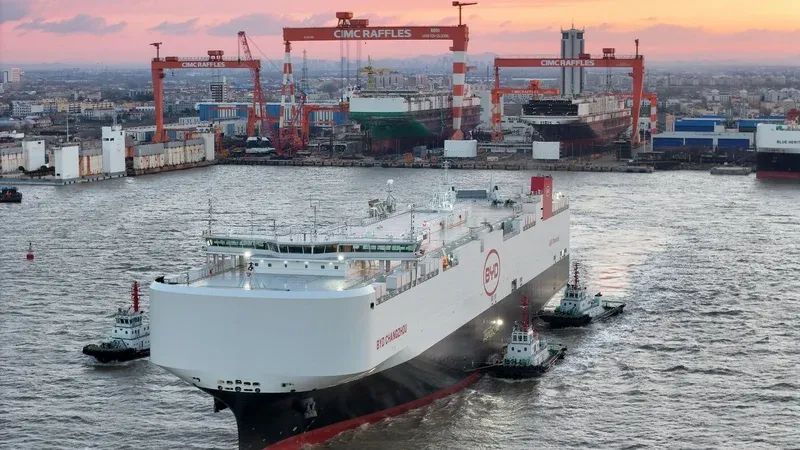
BYD already had eight car carriers, and now, according to industry publications, it has ordered 10 more units at 9,200 CEU each. Deliveries are scheduled for 2027–2029, which would raise the fleet to 18 ships with a total capacity of over 130,000 CEU.
For drivers in Europe, the implication is clear: the Chinese no longer want to just produce in large quantities but also control logistics themselves. And with tariffs in the EU, this is no trivial matter.
10 new PCTC ships, totaling over 130,000 CEU
The new vessels will be built by Jinling and Haimen shipyards, which are part of China Merchants Industry. They are PCTC-type ships, or pure car and truck carriers, designed for transporting cars and other wheeled vehicles. These are classic RoRo ships, so the vehicles can load and unload on their own without containers.
An important detail: capacity is measured in CEU, or car equivalent units, rather than a fixed number of vehicles. In other words, 9,200 CEU does not always mean exactly 9,200 cars of the same size.
The new order alone would add 92,000 CEU. Combined with BYD’s current fleet, this would bring the total to 18 units and over 130,000 CEU of capacity. It’s worth noting right away that this refers to the one-time transport capacity, not the annual number of cars exported.
BYD completed its first fleet of eight ships in September 2025, when the BYD Jinan was put into service. Earlier, the Explorer No. 1, Hefei, Changzhou, Shenzhen, Xi’an, Changsha, and Zhengzhou had already been deployed. All of these were built in less than two years, starting from the delivery of Explorer No. 1 in January 2024. Fast—even by BYD standards.
CarNewsChina estimates that the original fleet of eight RoRo vessels had the potential to export 1 million cars per year, and with the addition of 10 more BYD vessels, this figure could rise to as much as 2.5 million cars per year. This amount seems more like the capacity of a national exporter’s infrastructure rather than just an addition to existing business operations.
Exports are rising as space gets tight in China
In August, BYD exported 184,000 passenger cars from China, a 131% increase year-on-year and 6% more than in July. It accounted for 35.4% of China’s exports of NEV passenger cars, namely battery-powered and plug-in hybrid vehicles. From January to August, the total was 1.127 million vehicles, representing an 88% year-on-year increase.
Meanwhile, at home, the BYD brand is facing difficulties. In China alone, it sold 184,000 vehicles in August, but that represents a 35% year-on-year decline. After eight months of 2026, the brand’s domestic sales totaled 1.15 million vehicles, which is 43% less than the previous year.
This clearly explains why BYD needs its own fleet. Abroad, profit margins are higher, while in China there is an endless price war. According to CPCA, the profit margin for China’s automotive industry dropped to 3.2% in the first quarter of 2026. Additionally, 78% of passenger vehicle sales in China in August went to domestic brands. In 2020, this figure was around 35%.
There’s another European detail. In September 2025, BYD Zhengzhou transported right-hand drive cars from a factory in Thailand to the UK. This was the first export from that facility. It matters because Thailand is exempt from EU’s countervailing duties on Chinese electric vehicles, while BYD cars from China face an additional 17% tariff on top of the previous 10%.
So BYD isn’t just building ships. It’s creating a way to escape China’s price war and, to some extent, European tariffs as well. Here’s the question for you: will BYD’s own fleet help the brand flood Europe faster and cheaper, or will tariffs still undermine that effect?
LovEV Newsletter
Want more content like this?
Sign up — we’ll send you a weekly summary once the newsletter starts.