
The BYD Yangwang U7 covered 30,000 km in 9 days, with its battery losing 1.3 percent after 350 charges.
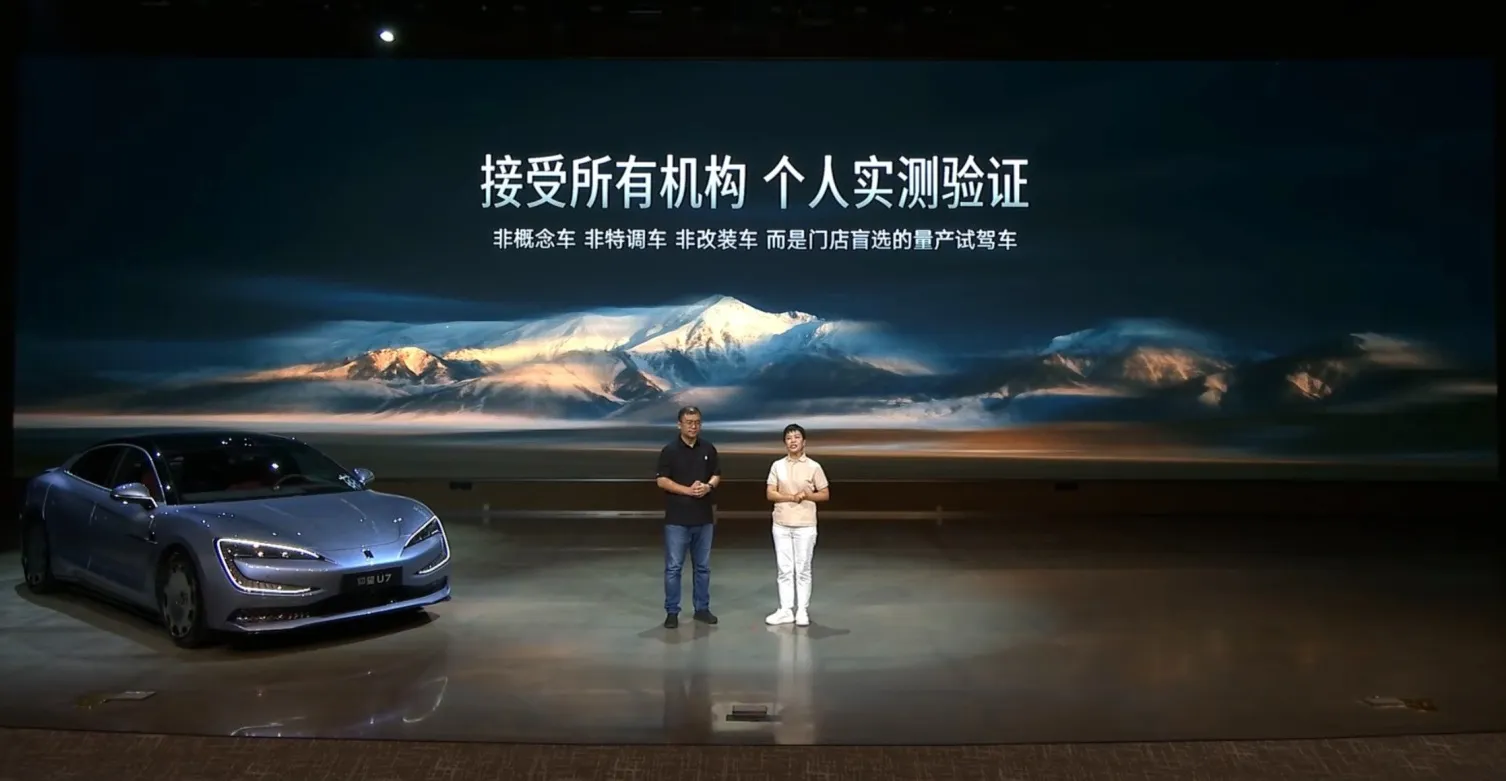
BYD announced on August 25 that the production model of the Yangwang U7 completed a 30,000 km long-distance test in 8 days, 19 hours, and 58 minutes. The vehicle underwent over 350 fast charging sessions, and after the test, its battery capacity dropped to 98.7% of its initial level.
This refers to the premium electric sedan from Yangwang, which starts at $95,400 in China, or around 349,000 zł. On paper, this seems impressive. The real question is how much of this can be replicated outside of the company’s demonstration.
30,000 km at 240 km/h with the AC set to 24 degrees
The test took place in Nanning in southern China. The manufacturer states that the average temperature exceeded 36 degrees Celsius, humidity reached 80%, and the car maintained a constant speed of 240 km/h. The air conditioning was kept set at 24 degrees Celsius throughout the test.
This is an important detail, as BYD tried to preempt the simplest accusation: that the car was being conservatively tested. Yangwang’s CEO, Hu Xiaoqing, explicitly stated that a regular vehicle randomly selected from the showroom was used, not a concept car, prototype, or specially prepared unit. She added, “Yangwang welcomes verification and testing from all independent institutions and individuals.”
After the test, the battery was supposed to retain 98.7% of its capacity, meaning a 1.3% decline after over 350 fast charges. The manufacturer did not provide a laboratory-grade measurement methodology, so it’s wise to remain cautious. Yet the scale of the stress test is impressive.
BYD also cites figures from the U7 development program. Before its market launch, the brand planned to use 758 test vehicles that collectively traveled 10.49 million kilometers under real-world conditions.
Chinese regulations are moving toward 30,000 km for EVs
The second topic is perhaps even more interesting than the BYD demonstration itself. On January 21, 2026, China’s Ministry of Industry and Information Technology, or MIIT, issued Announcement No. 1 for 2026, which changes the homologation requirements for manufacturers and vehicles. The new rules are set to take effect on January 1, 2027.
Under these rules, conventional passenger cars, buses, and trucks must undergo reliability tests over a distance of at least 30,000 km. In July, China’s Automotive Standardization Committee also began consultations on three changes to national standards for electric vehicles.
The proposals set the same threshold for BEVs, requiring a minimum of 30,000 kilometers of reliability testing. Plug-in hybrids are also required to cover 30,000 kilometers, with at least 10,000 kilometers in electric mode. Hydrogen vehicles would need to complete 30,000 kilometers in hybrid mode as well.
Yan Jinghui from the expert committee of the China Automobile Dealers Association told NBD that tightening the requirements demonstrates progress in China’s low-emission vehicles and shows that battery range and durability are no longer the main barriers. It’s a strong argument—definitely convenient for manufacturers who want to show that the technology is already mature.
Yangwang remains a niche brand. It sold 485 vehicles in July. Perhaps that’s why it needs such tests more than BYD, which targets the mass market.
If these 98.7% figures turn out to be repeatable results outside of real-world testing and demonstrations, premium competitors gain an uncomfortable benchmark. Do you think such demonstrations convince you more than WLTP’s catalogued figures?
LovEV Newsletter
Want more content like this?
Sign up — we’ll send you a weekly summary once the newsletter starts.