
BYD is preparing an MPV from its Ocean series for 2026. It is intended to be a more competitive response to the poor sales of the Xia model.
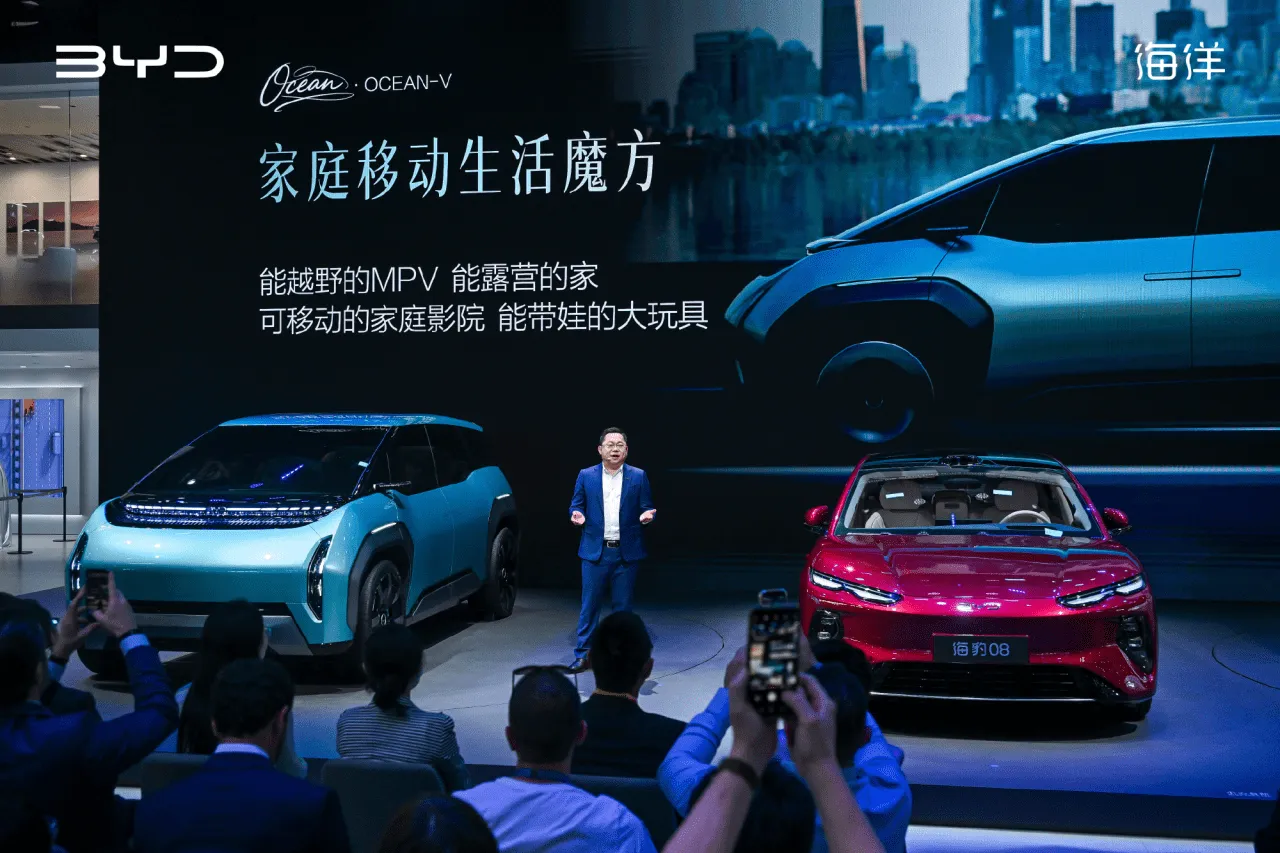
BYD aims to bring the first van from its Ocean lineup to market by the end of 2026. This announcement was made during a discussion with the head of Ocean series sales, driven by one simple fact: the company’s current MPVs sell very unevenly, ranging from the clearly weaker Xia to the more powerful Denza D9.
Table of Contents
Show
Hide
The new model could show whether BYD can sell family MPVs in a different way than before, focusing more on lifestyle rather than just specifications.
Ocean to Get Its Own MPV This Year
Zhang Zhuo, responsible for Ocean series sales, said the first MPV in this series could debut by the end of 2026. He did not reveal the name, price, or specifications. He only stated that it will be a “one-of-a-kind” offering.
It sounds marketing-driven. But the logic behind it is sound. BYD already offers MPVs through several sales channels and brands, just not under the Ocean series. If the plan goes ahead, the group will have such vehicles in four lines: Dynasty, Ocean, Denza, and Linghui.
The nearest preview of this vehicle remains the BYD Ocean-V concept, shown in April 2026 at the Beijing auto show. The company hasn’t explicitly confirmed that the production model will be its commercial version, but it’s hard to consider this a coincidence.
Ocean-V showed the direction, but not yet a finished product
The Ocean-V was conceived as an MPV for various scenarios. It’s not just a family van but also a car for camping, a mobile cinema, and something with a slight off-road twist. On paper, it seems like a mix of the ID. Buzz, Xpeng X9, and China’s penchant for gadgets.
Inside, there are no traditional buttons. The central screen can slide sideways. In movie mode, the steering wheel retracts, and a large projection screen emerges from the dashboard. In camping mode, the two rows of seats can be arranged face to face or folded flat to create a bed.
These are impressive concept ideas. The question is how much of this will make it to production and at what price. BYD has only said that some of the features and design elements from the Ocean-V will be gradually introduced into the series Ocean’s production models.
Chinese leaks also mentioned the name Whale, meaning “Whale.” For now, this is just a preliminary lead. There have also been suggestions that the vehicle might come with a plug-in hybrid powertrain rather than a purely electric one. This is important because in China’s family and business MPV segment, PHEVs still offer manufacturers higher sales volumes than fully electric vehicles.
The issue is called Xia
The most interesting aspect of this story isn’t the new car itself, but rather why BYD needs it. It relates to the performance of the BYD Xia model from the Dynasty series.
Xia was launched as a mid-to-large MPV with a plug-in hybrid powertrain. Its price ranged from 249,800 to 309,800 yuan, or about $37,200 to $46,100. Later, BYD reduced the prices. After official incentives, the range dropped to 196,800 to 259,800 yuan, or around $29,300 to $38,600.
And it didn’t make much of a difference.
According to one set of data, Xia sold 27,288 units in 2025. In a more recent set of figures, deliveries in the first 7 months of 2026 amounted to 10,922 units, with July alone reporting 1,300 cars, indicating a year-on-year decline of 76.7%. Even though there are methodological differences across various reports, the picture remains the same: the model has not become a hit.
The BYD Xia uses a PHEV system with a 1.5 turbo engine and an electric front motor. The declared electric range according to CLTC is 100 or 218 kilometers, depending on the version. On paper, this doesn’t seem bad. However, the MPV segment in China has become highly competitive, and just price and branding are no longer sufficient.
The competition is fierce. The Wey Gaoshan sold 59,449 cars, the regular Buick GL8 sold 56,853, and the Buick GL8 PHEV sold 55,281 during the same period. Not good numbers at all.
The Denza D9 shows that BYD can sell MPVs, but in a higher-priced segment
The poor performance of the Xia doesn’t mean BYD’s entire MPV concept is flawed. Just look at the Denza D9.
The second generation of this model hit the market on April 28, 2026, with a starting price of 359,800 yuan, or about $53,040. This is already in the premium segment. And it’s here that BYD performs much better.
In July 2026 alone, the Denza D9 found 7,678 buyers. From January to July 2026, sales totaled 39,402 units. Monthly figures rose from 3,457 cars in January to 8,253 in June, before slightly declining in July. Still, these numbers are incomparable to those of the Xia.
BYD also has the Linghui M9 model, launched in June and based on the Xia, but it targets transportation services and business customers more closely. The vehicle uses fifth-generation DM hybrid technology and claims a total range of 1,105 km with a full tank and a full charge.
This leads to a simple conclusion. BYD’s problem isn’t the MPV segment itself. The issue lies in getting the product positioning right.
What to Expect from BYD’s New MPV
The new MPV in the Ocean series is likely to be similar in size and segment to the Xia, but with a different character. In China, the Ocean series is marketed in a more youthful, lifestyle-oriented manner and less conservatively than the Dynasty series. For BYD, it’s an attempt to sell a similar type of vehicle to a different customer base.
Leaks suggest the possibility of using second-generation Blade batteries and the Megawatt Charging system. If confirmed, this would be an interesting move, as fast charging is truly valuable in a family van—especially for longer trips. For now, however, it remains speculative. The company has not provided any official specifications for the powertrain or electrical architecture.
This vehicle is also set to enter a market where there are increasingly more experiments with the MPV format. Chinese manufacturers are trying to combine a family car, a mobile showroom, a business vehicle, and an electronic gadget. Sometimes it results in something practical, other times just a large tablet with seats.
For BYD, the stakes are clear. If the Ocean MPV turns out to be just “Xia in a different package,” the market will quickly verify that. However, if the brand adds better design, a reasonable price, and truly strong charging capabilities, it could become a serious competitor to the Wey Gaoshan, Leapmotor D99, or other more family-oriented Chinese PHEV vans.
From a Polish perspective, this is currently more of a topic for observation than purchase, as BYD has not announced an European debut for this model. But given the brand’s expansion pace, I wouldn’t be surprised if some features from this car make their way to models aimed at Europe later on. In your opinion, does BYD still have room for more MPVs, or is the segment already overcrowded with too many similar vehicles?