
The BYD Sealion 08 received 12,000 orders in 24 hours. A large SUV that can charge from 10% to 70% in 5 minutes.
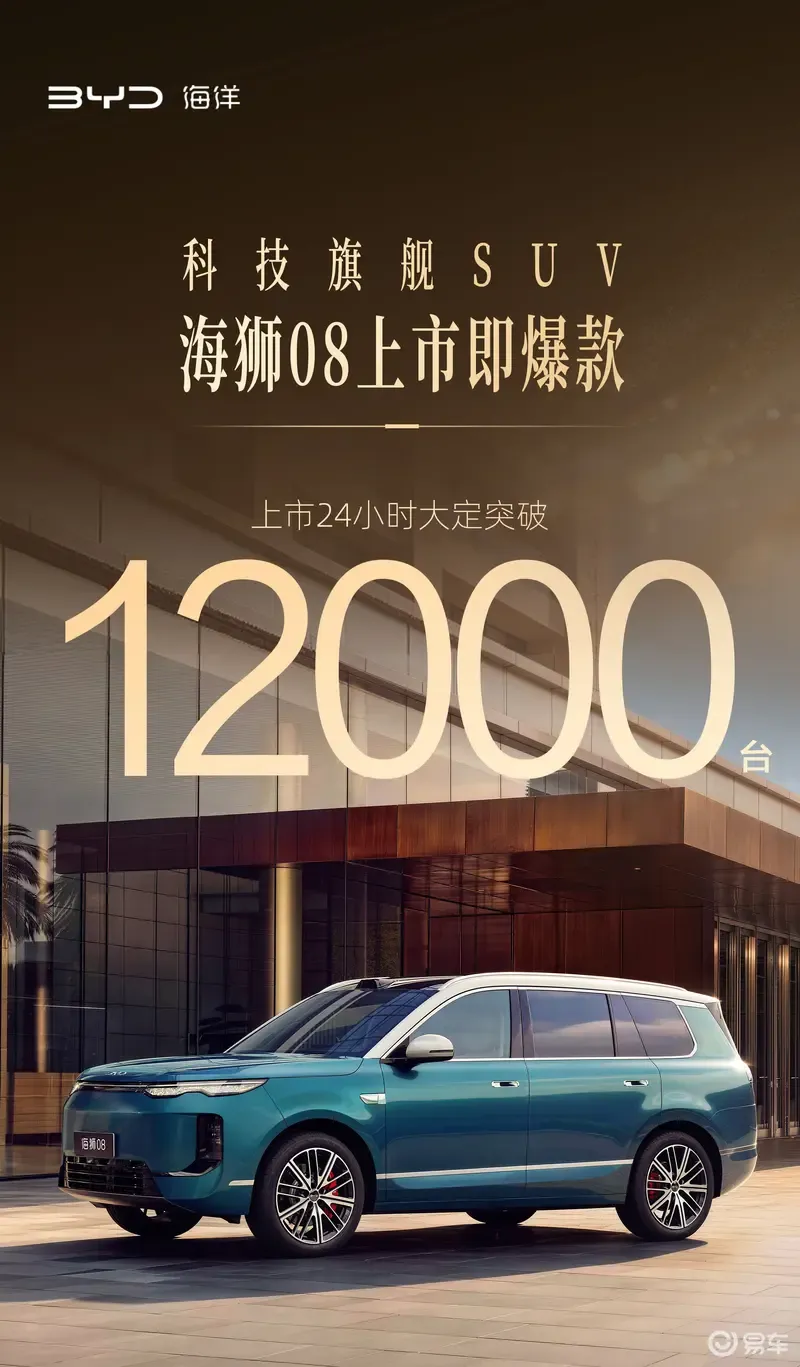
BYD began selling the Sealion 08 in China on September 2, 2026, and received over 12,000 orders within a single day. It is the new flagship SUV in the Ocean series, available as an electric and plug-in hybrid model, with prices ranging from 229,900 to 279,900 yuan. For European readers, what’s most interesting here isn’t just the sales figures but rather the suite of technologies, as BYD has equipped this vehicle with practically everything it wants to showcase today.
Table of Contents
Show
Hide
One model, two powertrains, eight versions
The Sealion 08 is available in eight variants. Customers can choose between a BEV or PHEV version, rear-wheel drive or 4×4, along with either a 5-seater or 6-seater layout. So rather than just one showcase configuration, we’re looking at a wide range of model options from the very beginning.
The price starts at 229,900 yuan, which is around $33,800. Electric versions begin at 239,900 yuan. The upper limit is 279,900 yuan, or about $41,200. For a car over 5.1 meters long with air suspension and a lidar on the roof, this seems quite competitive. That’s exactly the standard BYD sets in China today.
The car itself is 5,115 mm long, 1,999 mm wide, and 1,800 mm tall, with a wheelbase of 3,030 mm. In terms of size, it’s comparable to the Hyundai Ioniq 9, though the Korean vehicle has a slightly longer wheelbase. In short, it’s not a competitor to the Tesla Model Y—it’s in a higher price segment.
Electric range of up to 900 km CLTC, hybrid range totaling up to 1,650 km
The all-electric version uses two battery capacities: 92.093 kWh or 115.072 kWh. BYD claims a range of 800 km or 900 km in the CLTC cycle, depending on the configuration. Of course, the CLTC figures should be taken with caution. In actual European driving conditions, these numbers will be significantly lower, but even after accounting for the typical “Chinese hill” effect, we’re still talking about a large vehicle with an extremely large battery.
The BEV is available as:
single motor 320 kW
single motor 370 kW
dual motor 215 kW at the front + 370 kW at the rear
This results in a range from strong to very strong for a large SUV. Especially the top-tier AWD version seems like overpowered equipment for an average family.
The plug-in hybrid version uses the fifth-generation DM system. At its core is a 1.5 turbo engine with 115 kW of power, working in conjunction with an electric drive. The PHEV options include:
with one electric motor 200 kW
with two electric motors, each at 200 kW
However, what sounds most impressive isn’t the power but rather the practical specifications. The PHEV features a battery with a capacity of 55.843 kWh, which the manufacturer claims is sufficient for up to 400 km of electric driving in CLTC conditions. The total range with a full battery and a full fuel tank is up to 1650 km, while BYD states that fuel consumption after the battery is depleted is 4.6 l/100 km.
Yes, 55.8 kWh in a plug-in hybrid is an absurdly high figure for a PHEV these days. In practice, it functions more like an electric vehicle with a combustion engine as a backup rather than a traditional plug-in hybrid as seen in Europe.
Flash Charging and Blade Battery 2.0. Sounds great, but with a caveat
Every version of the Sealion 08 is expected to come equipped with the Blade Battery 2.0 battery and Flash Charging technology. BYD claims that the car can charge from 10% to 70% in 5 minutes and from 10% to 97% in 9 minutes.
On paper, these are parameters of the “can the station handle it?” type. And here’s the catch: such results require proper infrastructure, conditions, and a well-prepared battery. The manufacturer’s claims alone do not mean that a driver in Europe can stop at the first HPC charger they find and get identical results. The same applies to China, although BYD is building an increasingly extensive ecosystem around its own technologies there.
There’s another issue as well. There are already signs in the industry that BYD faces production constraints related to the Blade Battery 2.0. If this is indeed the case, rapid sales start is one thing, but scaling up deliveries is another. With 12,000 orders per day, this could become a problem sooner than the manufacturer would like.
Lidar, God’s Eye B, and high-end suspension
The Sealion 08 is equipped with a lidar on its roof and comes standard with the God’s Eye B package along with the God’s Eye 5.0 platform. BYD mentions support for automated parking and urban navigation with driving assistance features. This is important because Chinese manufacturers are increasingly competing not only in terms of batteries and price but also in ADAS capabilities.
However, it’s necessary to keep a cool head. “Intelligent driving” in its Chinese version often implies more than what’s actually possible when the vehicle is introduced to other markets. Regulations in Europe are different, homologation can be more difficult, and marketing tends to exaggerate reality.
The chassis also looks ambitious. The car features DiSus-A, an intelligent chassis control system, along with a two-chamber pneumatic suspension that provides road view assistance and a steerable rear axle. In this segment, such equipment usually drives prices significantly higher. BYD includes it as standard or in widely available configurations, and this is what helps it gain market share in China today.
Premium cabin, but no overkill with “digital features”
Inside, BYD uses a setup familiar from the brand’s higher-end models, just enhanced. It includes the following:
a 17.3-inch central screen
a 12.3-inch instrument cluster
a 26-inch AR-HUD display
a 21.4-inch ceiling screen for the rear passengers
In addition, there are zero-gravity seats, a built-in refrigerator, and a Devialet audio system with 25 speakers. The 6-seater versions feature two separate captain’s seats in the second row with electric adjustment and leg support.
It’s good that BYD also retained some physical buttons for the most frequently used functions. With this many screens, it’s a sensible decision rather than a step backward.
What the pre-orders say and how it compares to other BYD launches
Over 12,000 pre-orders in 24 hours seems impressive, but in the world of BYD, it’s not yet an all-time record. For comparison, the flagship SUV in the Dynasty series, the Great Tang, was expected to collect over 30,000 pre-orders in its first day.
This positions the Sealion 08 in an interesting market segment. Its performance is very good, but not knockout-level like the brand’s biggest hits. The price might be a factor, customers could be split between the electric version and the PHEV, or it’s possible that large premium SUVs are no longer an easy market to penetrate in China just with the BYD logo.
From a European perspective, another signal is more important. BYD demonstrates its ability to combine a large battery, fast charging, advanced suspension, and extensive features in a vehicle priced significantly lower than most Western counterparts. If such a package reaches Europe without a sharp increase in price due to tariffs and homologation requirements, competitors will face difficulties.
For now, the Sealion 08 is available in the Chinese market, with no confirmation of its arrival in Poland. But the trend is clear. Large Chinese SUVs are no longer just “cheap and slightly inferior.” They increasingly come equipped with more features on paper.
The most interesting question isn’t whether the Sealion 08 is fast and well-equipped, but rather how much of these promises BYD can deliver outside China. Could a vehicle with such specifications and a realistic European price have a better chance of disrupting the market in Poland than the Kia EV9 or Hyundai Ioniq 9?