
The BYD Sealion 08 is available for sale in China at prices ranging from 229,900 to 279,900 yuan. The flagship Ocean SUV aims to compete in a higher price segment without the Denza brand.
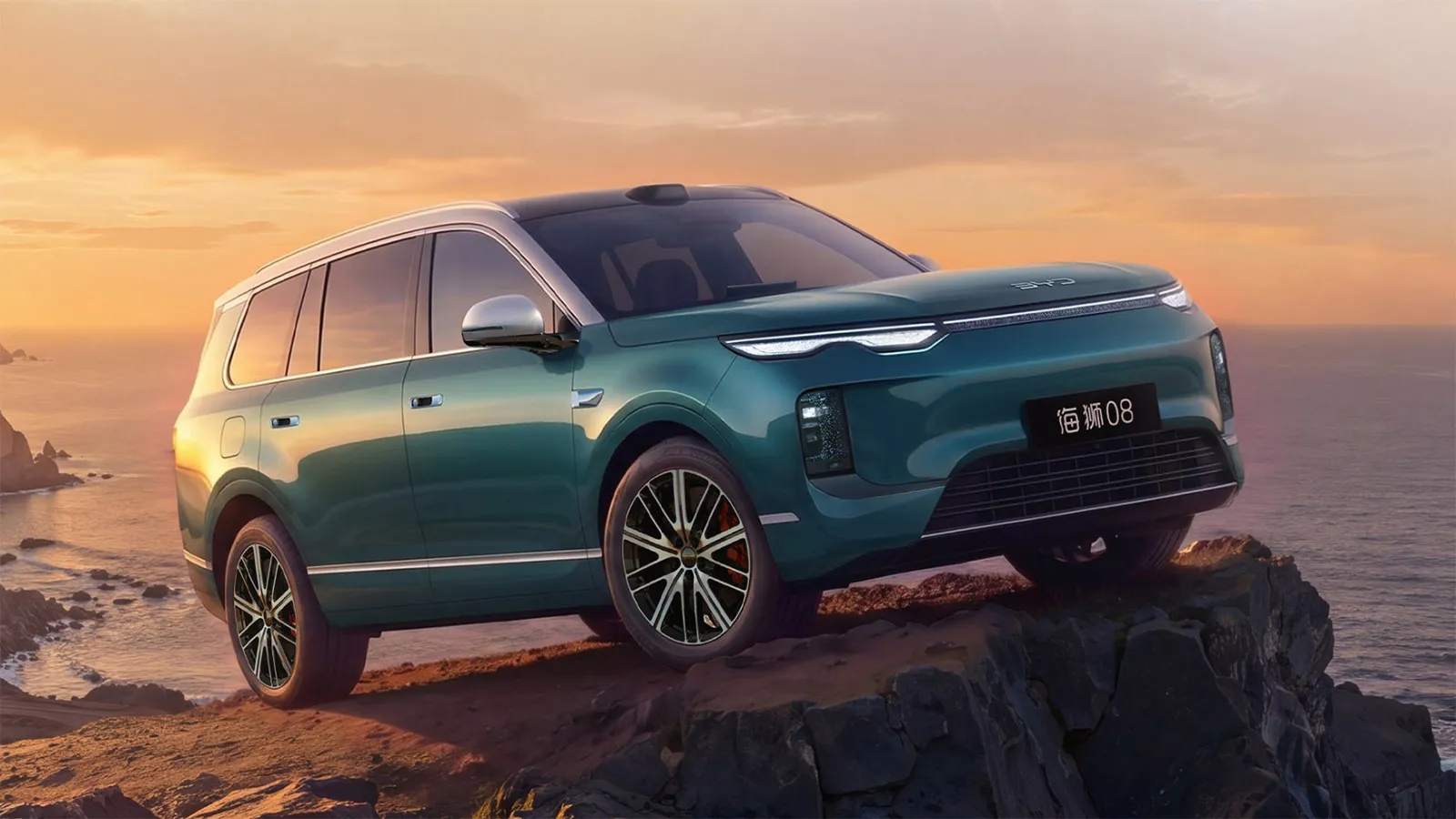
BYD has introduced the Sealion 08 in China, a large SUV available as an electric and plug-in hybrid model. The vehicle costs between 229,900 and 279,900 yuan, measures 5.115 meters in length, and the top-tier BEV version promises an impressive CLTC range of up to 900 kilometers.
Table of Contents
Show
Hide
The most interesting aspect here isn’t just the equipment but BYD’s strategy. The company is trying to sell this pricier family-oriented model under its main brand rather than through Denza or Fang Cheng Bao.
BYD Sealion 08: Prices, Versions, and Positioning
The Sealion 08 is the new flagship SUV in BYD’s Ocean series. There are eight versions available, featuring either PHEV or BEV powertrains along with 5- or 6-seater configurations.
The pricing in China is as follows:
Version
Price
PHEV 400 km 6-seat Honor
229,900 yuan
BEV 900 km 6-seat Honor
239,900 yuan
PHEV 350 km 5-seat AWD Flagship
249,900 yuan
BEV 900 km 5-seat Honor
249,900 yuan
BEV 800 km 5-seat AWD Flagship
259,900 yuan
BEV 900 km 6-seat Honor
259,900 yuan
PHEV 350 km 6-seat AWD Flagship
269,900 yuan
BEV 800 km 6-seat AWD Flagship
279,900 yuan
In terms of conversion, this is roughly 33,800–41,200 dollars, so we’re talking about a price range where the Chinese market becomes quite competitive. Competitors include Xpeng G9L, Li Auto i6, as well as Great Wall’s larger hybrids and electric vehicles.
BYD doesn’t hide its goal of elevating the Ocean brand. The Seal 08, a sedan in the same segment, was launched earlier at 196,900 yuan. Now it’s time for SUVs, as that’s where families are and where higher margins lie.
Dimensions and Interior: More of a luxury sedan than a typical family SUV
The Sealion 08 measures 5,115 mm in length, 1,999 mm in width, 1,800 mm in height, and has a wheelbase of 3,030 mm. It is no longer a competitor to the Tesla Model Y but rather falls in a higher size category. It is more similar to large Chinese family SUVs than to traditional European mid-size SUVs.
Inside, BYD focuses on large screens and comfort. The vehicle is equipped with the following:
A 17.3-inch central screen
12.3-inch dash displays
A 26-inch AR-HUD
A 21.4-inch ceiling screen for rear passengers
A 7.3-liter onboard refrigerator
Devialet audio system with 25 speakers and Dolby Atmos
In the 6-seater version, there are zero-gravity seats for the driver and the right-seat passenger in the second row. The latter seat can also be moved sideways. It might sound like PR hype, but in this segment, Chinese consumers really buy cars based on their equipment, not just the brand name.
The trunk also looks good. The 5-seater version has 943 liters in the back and 201 liters in the front trunk. The 6-seater version offers 317 liters in the back plus the same front trunk space, and with the seats folded down, the capacity increases to 1,173 liters.
PHEV and BEV with 2nd generation Blade battery
The strongest point of this launch is the powertrain. All versions are expected to feature the 2nd generation Blade battery, both for hybrid and electric models. This is important because BYD is starting to treat its newer cells as a stepping stone to higher-tier vehicles, rather than just a cheap foundation for mass-market cars.
PHEV: large battery for a plug-in hybrid
The PHEV version uses a 1.5 turbo engine with 115 kW of power. The variant with one electric motor offers 200 kW, while the AWD version adds a second motor with the same power output.
The key parameter is the battery. BYD has installed a pack with a capacity of 55,843 kWh here. For a PHEV, this is quite large, making it more of a small electric vehicle than a traditional plug-in hybrid. The claimed electric range is 350-400 km according to CLTC standards, with a total range of up to 1,650 km when the battery and tank are fully charged.
There is also fuel consumption after the battery is depleted: 4.6 l/100 km according to NEDC standards. Here, marketing claims need to be taken with a grain of salt. Both NEDC and CLTC tests can be highly optimistic, so actual results will likely be significantly lower. Nevertheless, the size of the battery is impressive.
BEV: Up to 900 km CLTC and even 585 kW in AWD
The electric versions come equipped with a battery of 115,072 kWh. The rear-wheel-drive version has 370 kW of power, while the AWD version combines 215 kW at the front and 370 kW at the rear.
The acceleration from 0 to 100 km/h is expected to take between 5.9 and 3.9 seconds, depending on the version. The claimed range is 800-900 km according to CLTC standards.
Again, a star rating is necessary. 900 km of CLTC range in a large SUV sounds great on paper, but in European conditions and with faster driving, this figure drops significantly. Even after adjustments, it can still be a very impressive result, as long as weight and aerodynamics don’t undermine efficiency.
Flash charging: 10-70% in 5 minutes, 10-97% in 9 minutes
BYD adds its Flash Charging technology to the Sealion 08. According to the manufacturer, the car can charge from 10% to 70% in 5 minutes and from 10% to 97% in 9 minutes.
These are figures that sound almost absurdly good. And that’s exactly why it’s important to stay cautious. Without a full charging curve, information on peak power, battery temperature, and specific test conditions, it’s hard to assess how much of this performance will be maintained outside the laboratory or with non-BYD chargers.
The fact that PHEVs and BEVs are supposed to support such fast charging is interesting nonetheless. Especially in a plug-in hybrid with such a large battery. If BYD can deliver consistent performance, this could be one of the few hybrids that people actually want to charge rather than just refuel.
Suspension, Rear Axle Steering, and ADAS
With dimensions over 5.1 meters, BYD had to address maneuverability issues. The Sealion 08 features DiSus-A, which is an intelligent body control system with a two-chamber pneumatic suspension, along with active rear axle steering.
According to the manufacturer, this results in a turning radius of 4.95 meters. If this figure is achievable in practice, it would be an excellent result for a vehicle of this size. The manufacturer also mentions road view functionality, crab walk mode, and features that reduce the risk of rollover.
The assistance systems are handled by God’s Eye B in the God’s Eye 5.0 architecture. These include assisted urban navigation, highway assistant, and several automatic parking modes. It sounds like BYD’s response to what Huawei, Xpeng, or Li Auto have been offering for a long time. The question remains as usual: how does it work outside of the promotional materials?
BYD aims to sell its main brand at a higher price
This is probably the most interesting aspect of this launch. BYD already has sub-brands like Denza or Fang Cheng Bao for higher-end products, but the Sealion 08 falls under the standard BYD brand. The company is testing whether customers will accept a higher price without the premium associated with a separate brand.
This makes business sense because the Sealion series began to slow down slightly. In August 2026, it sold 48,559 vehicles, which is an 8.86% decrease year-on-year and a 1.02% drop from July. On the other hand, it delivered 275,974 units in the first eight months of the year, still representing a 25.91% increase compared to the previous year.
The entire Ocean line sold 193,109 vehicles in August, and 1,167,552 units from January to August. BYD thus has the scale to experiment with different positioning strategies. The question is whether consumers will see a more expensive BYD as still a good deal or as a time to switch to competitors.
For Europe and Poland, this model is currently more of a signal than an indication of an imminent launch. However, if BYD intends to raise average prices here as well, it will be vehicles like these that show whether the brand can move beyond its role as a “cheaper alternative” manufacturer.
The Sealion 08 looks like a car through which BYD is testing the limits of its own brand. My question to you: would you buy such a large BYD with the main logo, or given the price, would you expect it to have a premium brand label?