
The BYD Seagull is 42.5 cm longer and can be charged in 5 minutes. It costs between $9,810 in China.
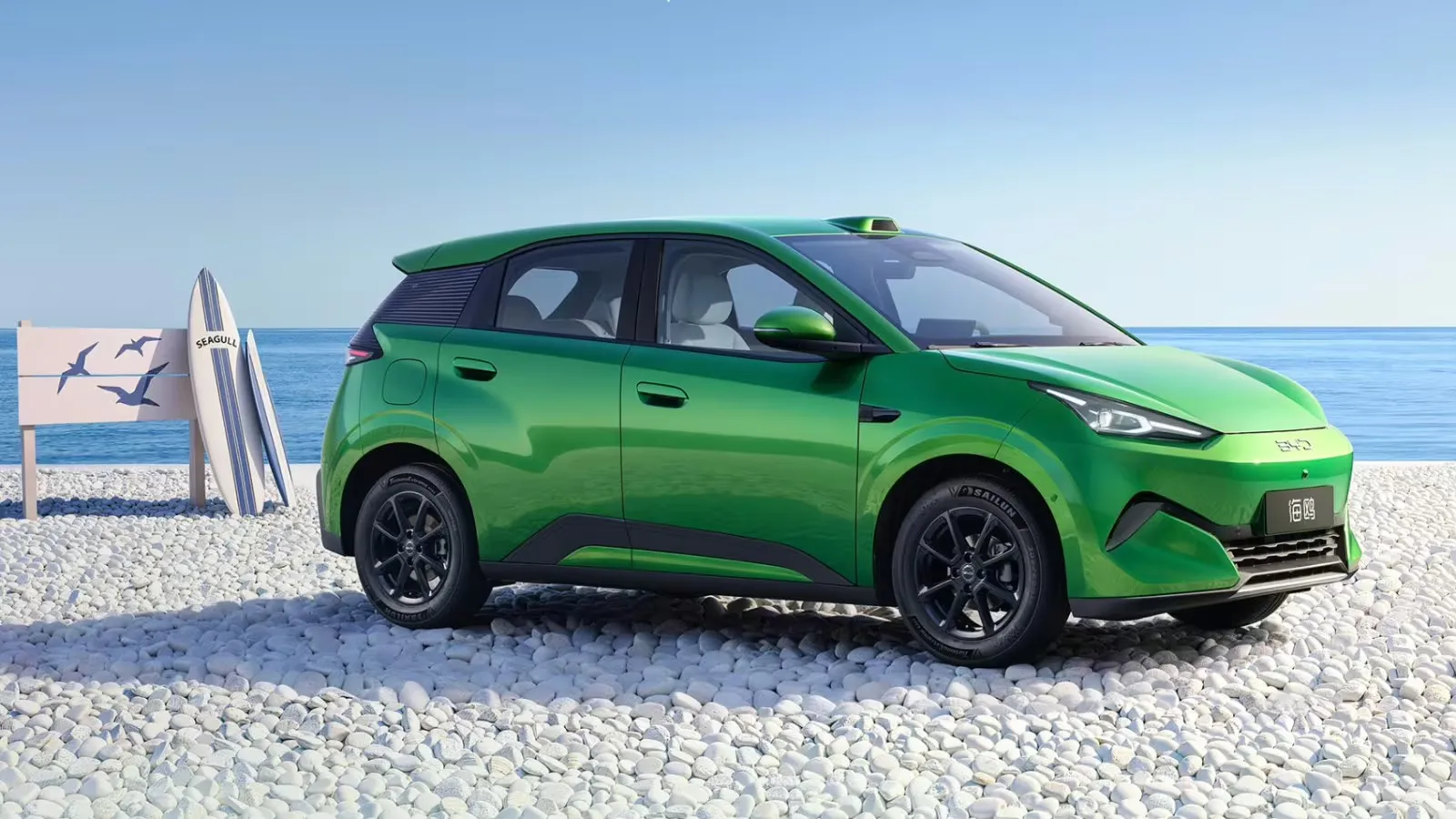
BYD launched the second generation of its electric Seagull in China on October 20, 2026. The vehicle is significantly larger, features five seats, rear-wheel drive, and a battery that can charge from 10% to 70% in 5 minutes in selected versions. The base model costs 65,900 yuan, which is approximately 38,500 zł.
Table of Contents
Show
Hide
The Seagull is no longer a typical compact electric car. The new generation measures 4.21 meters in length, comes with advanced features and an optional LiDAR, making it compete in size and technology with the larger BYD Dolphin.
The new Seagull is cheaper but much bigger
BYD has prepared five variants. The official price starts at 65,900 yuan, while the previous generation from 2026 costed 69,900 yuan. The company also offers a discount for trading in an old car, which reduces each price by 3,000 yuan. In that case, the base Seagull model costs 62,900 yuan, approximately 9,500 dollars.
Version
Price in China
Battery
CLTC Range
Flash Charging
Vitality
65,900 yuan
30.1 kWh
320 km
No
Freedom
72,900 yuan
30.1 kWh
320 km
No
Comfort
75,900 yuan
39.2 kWh
420 km
Yes
Flying
82,900 yuan
39.2 kWh
420 km
Yes
Smart
99,900 yuan
39.2 kWh
420 km
Yes
The biggest change isn’t in the pricing. The body now measures 4,205 mm in length, 1,810 mm in width, and 1,570 mm in height. The wheelbase is 2,650 mm. Compared to the previous model, the car has grown by 425 mm in length, with the wheelbase increasing by 150 mm.
The additional centimeters have allowed the Seagull to be transformed from a 4-seater into a 5-seater. There’s also a front trunk with a capacity of 94 liters, and when the rear seat is folded down, the backspace can hold up to 1,380 liters. It remains a city hatchback, but it’s no longer as small as its position in the lineup would suggest.
Rear-wheel drive and faster loading than a coffee break
The previous Seagull had an engine in the front that powered the front wheels. The second generation features an engine placed at the rear, rear-wheel drive, and independent multi-link suspension on the rear axle instead of a torsion beam.
The two cheapest versions come equipped with an engine producing 85 kW, or 114 horsepower. The three more expensive models use a unit of 95 kW, equivalent to 127 horsepower. In both cases, the maximum torque is 130 Nm. For comparison, the predecessor model had a power output of 55 kW, or 75 horsepower.
The batteries have capacities of 30.1 or 39.2 kWh. They are second-generation Blade Battery LFP packs. The smaller one offers a claimed range of 320 km, while the larger one provides 420 km, but these figures are based on China’s CLTC testing cycle. They should not be directly compared to Europe’s WLTP standard, which typically yields lower values.
The most interesting option is the larger battery with Flash Charging technology. According to BYD, charging from 10% to 70% takes 5 minutes, and from 10% to 97% takes 9 minutes. At a temperature of minus 30 degrees Celsius, charging from 20% to 97% should take 12 minutes.
It sounds great, but there’s a catch. Such results require compatible, specialized BYD chargers. The manufacturer didn’t specify the typical charging power for regular public DC chargers in the materials provided. Chinese buyers of the three more expensive versions will receive one year of free charging via Flash Charging, provided the car isn’t used for commercial purposes.
The small BYD gets LiDAR and seat massage
The cabin also no longer looks like that of the cheapest car in the lineup. The central screen has a 15.6-inch diagonal, and the DiLink 150 system uses DeepSeek AI solutions. BYD retained some physical buttons, added a 50 W induction charger, 127-color ambient lighting, and an audio system with eight speakers.
The front seats can have three-stage heating and ventilation, while the driver’s seat also includes massage functions. These are features that were difficult to find even in much more expensive Chinese electric vehicles just a short time ago.
At the top of the lineup is the DiPilot 300 system, also known as God’s Eye B. It uses a LiDAR mounted on the roof and is designed to handle city and highway navigation, traffic signal recognition, and automatic parking. It remains a driver-assistance system rather than an autonomous vehicle. However, every version includes a stability system to keep the car under control in case of a tire blowout at speeds up to 140 km/h.
A major overhaul came as sales of the Seagull faced pressure. From January to September 2026, BYD sold 265,901 units, 33.22% fewer than the previous year. In September, sales improved to 38,650 vehicles, representing a 11.75% year-on-year increase. Since its launch in April 2023, the model’s total sales have reached around 1.55 million units.
In China, the issue lies with the Geely Xingyuan, also known as EX2. In the first nine months of 2026, it attracted 310,000 buyers and became the best-selling car in that market, even surpassing the Tesla Model Y with 277,000 units sold.
Outside of China, the Seagull is available under the names Dolphin Surf, Dolphin Mini, or Atto 1, depending on the market. The second generation is also expected to be exported, but BYD has not yet announced a release date or European prices. Only then will it become clear how much of the car’s appeal in China, especially its 5-minute charging time, can be carried over to Europe.