
BYD is converting gas stations into 1,500 kW hubs. Sinopec is focusing on electricity instead of gasoline.
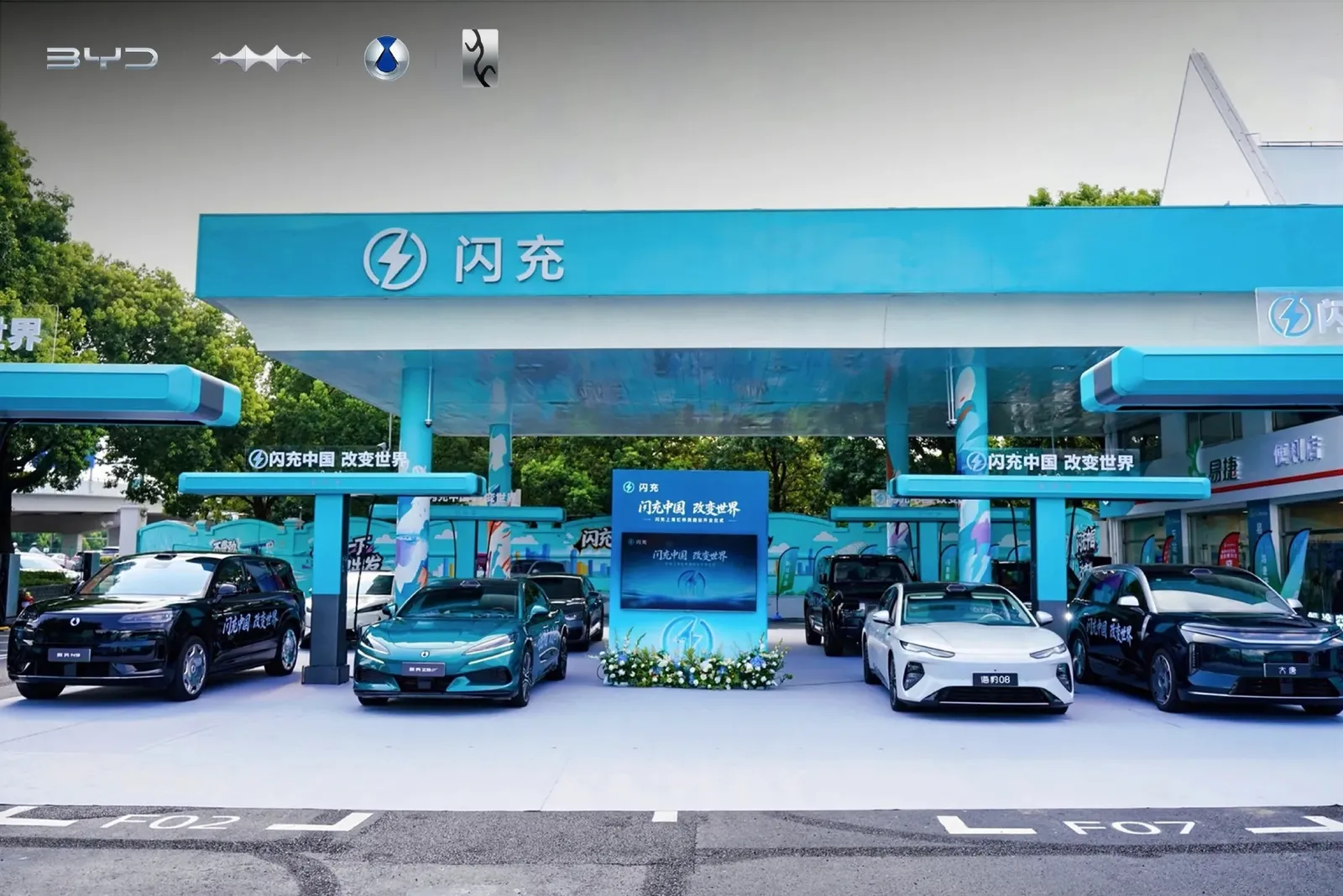
BYD and Sinopec have launched the first joint charging hub in Shanghai, built on the site of an old gas station. The Chinese companies unveiled the facility featuring 12 charging stations equipped with BYD Flash Charging units capable of delivering up to 1,500 kW of power, with more such conversions planned according to their statements.
Table of Contents
Show
Hide
This is a more interesting development than yet another “world’s fastest charger.” It’s not just about power output, but about a shift in infrastructure model: the gas station is no longer a place for gasoline vehicles, but rather a ready-made location for ultra-fast charging.
What Was Built in Shanghai
The new facility is located at the Hongqiao interchange in Shanghai, right next to the airport, high-speed rail station, and subway lines. The location is no coincidence: if anyone wants to demonstrate that charging should work like refueling, it’s best to do so where traffic is heavy and car turnover is fast.
There are 6 T-shaped chargers on site, each with two cables, totaling 12 charging stations. The layout resembles a traditional gas station more than a typical Chinese DC hub in a parking lot. And that’s exactly the idea: drive up, connect, and drive away.
What gas stations already have is also retained: a convenience store and a relaxation area. Inside, there are chairs, tables, and a lounge for drivers. Sinopec has also kept its Easy Joy store, which operates 24/7 with self-service options.
The key isn’t just the 1,500 kW
Paper allows for everything, so just the number 1,500 kW isn’t enough to declare an end to charging issues. In this case, it’s more interesting to see how BYD tries to bypass grid limitations.
Each Flash Charging charger has its own energy buffer made up of four Blade batteries. The total capacity of such a storage system is 169 kWh or 185 kWh, depending on the configuration. BYD claims that the nominal power requirement from the grid is only 100 kW, and the batteries charge when the charger isn’t operating at full load.
This means that high instantaneous power doesn’t have to be supplied directly from the grid in real time. In other words, BYD not only builds powerful chargers but also includes its own energy storage system in them. Given current connection limitations, this makes more sense than marketing claims about “megawatt charging.”
BYD’s claims are very strong, but with a caveat
BYD states that cars compatible with Flash Charging can charge from 10% to 70% in 5 minutes and from 10% to 97% in 9 minutes. The company also adds that at -30 degrees Celsius, the charging time should only increase by 3 minutes.
It sounds impressive, but as usual, the real-world conditions need to be considered. Such results require a compatible car, a properly prepared battery, optimal cell temperatures, and of course, an available charging station. Just because the charger can deliver 1,500 kW doesn’t mean every BYD or Denza car can absorb that much power, even for a short time.
Nevertheless, the direction is clear: the Chinese manufacturers have stopped asking whether charging can be accelerated. They are trying to turn it into a service that is just as fast and straightforward as refueling.
An old gas station, new operating logic
According to Chinese industry media, the station has had its fuel tanks removed to make space for battery chargers. It has not been publicly disclosed whether the energy storage systems are placed underground or above ground, but the decision itself is both symbolic and practical: infrastructure for gasoline is giving way to infrastructure for electricity.
This is important for another reason as well. Building a new hub from scratch usually involves battling over land, permits, retail spaces, restrooms, support facilities, and staffing. Sinopec already has all of this in place. Thus, BYD receives not only a location but also a ready-made business model.
From the perspective of the fuel operator, this is also a defensive move. In China, the growth rate of EVs and PHEVs is so rapid that the oil company cannot afford to wait for traffic at gas stations to decline further.
This might be a more important move than the technology itself
The partnership between BYD and Sinopec has been in place since mid-2024. At that time, the companies discussed jointly expanding charging networks, retail services, and collaboration in the energy chain. Shanghai is the first tangible outcome of this agreement.
And that’s where things get interesting. If the state-owned energy giant begins converting its stations into charging hubs on a large scale, it means the transformation is no longer happening at the periphery of the market. It’s entering infrastructure that has been a symbol of internal combustion engines for decades.
An additional detail is even better: in case of a power outage, the chargers are supposed to use backup Blade batteries to recharge compatible BYD and PHEV vehicles. This means that even a network failure doesn’t have to completely shut down the facility. While this remains a solution limited by battery capacity, it shows BYD’s mindset: a charger should be an energy system, not just a pole with cables.
BYD has long argued that charging can rival refueling. Now it’s taking more drastic action against the fuel industry: it’s seizing its addresses. Do you think this model—a gas station transformed into a charging hub with energy storage—makes more sense than traditional chargers placed in parking lots?