
BYD unveiled the ETT 44 with a range of 600 km. The truck can be charged at over 1.5 MW.
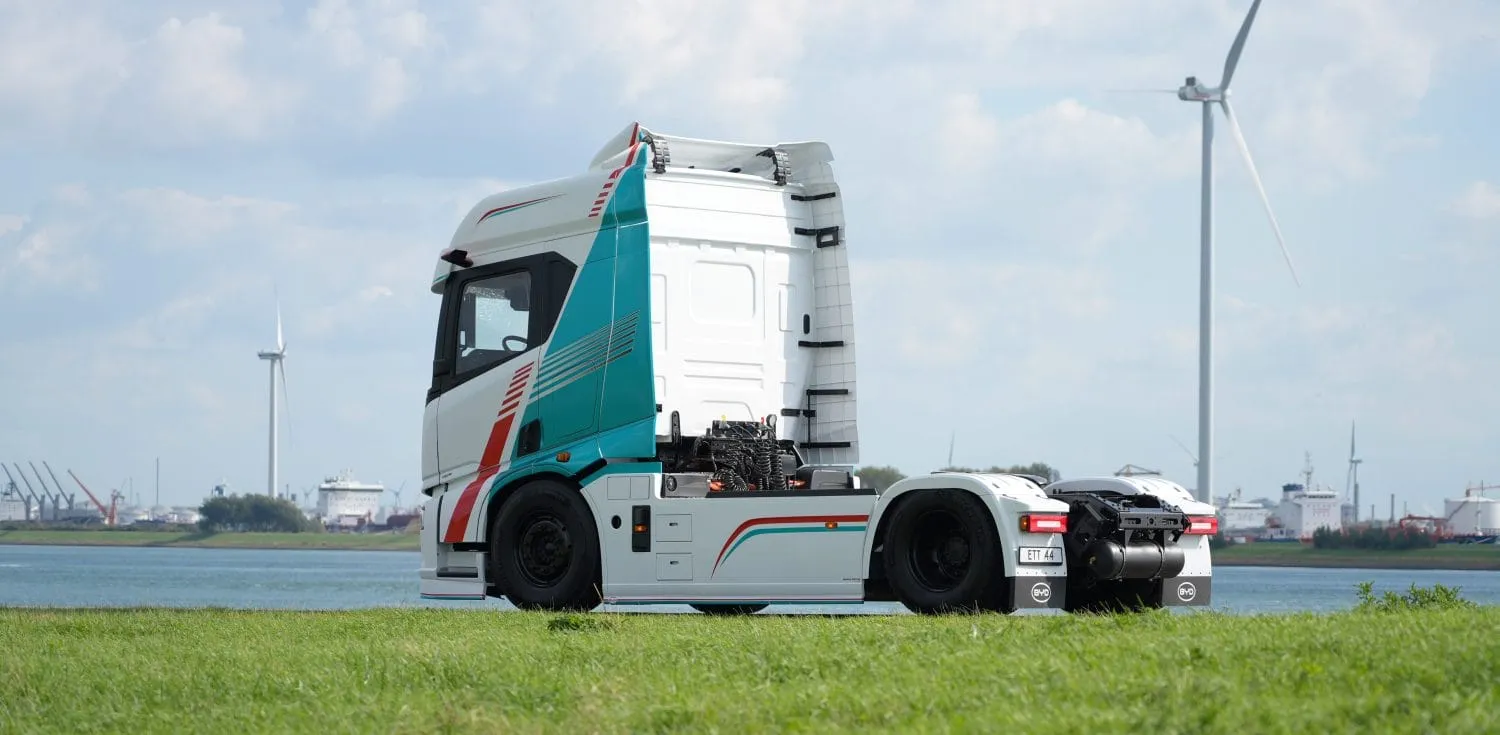
BYD entered Europe with its new electric truck, the ETT 44, which was unveiled at the IAA Transportation 2026 in Hanover. It is a 4×2 tractor unit designed for loads up to 44 tons, equipped with a 651 kWh battery, a claimed range of up to 600 km, and an MCS charging capability of over 1.5 MW.
Table of Contents
Show
Hide
On paper, this looks extremely powerful. The question is no longer just whether BYD can build an electric truck, but whether Europe will allow it to develop its own charging infrastructure and energy supply around it.
ETT 44: 44 tons, 651 kWh, and 20 minutes to reach 80% charge
The new BYD ETT 44 is the flagship model in the manufacturer’s European lineup. It is an electric 4×2 tractor unit designed to work with load combinations having a DMC of up to 44 tons.
The heart of the vehicle is the Blade Battery with a capacity of 651 kWh using LFP chemistry, operating on an 851 V architecture. BYD claims a continuous power output of 743 HP and a peak power of up to 1,000 HP. The vehicle’s weight ranges from 10.95 to 11.14 tons depending on the configuration.
The manufacturer promises a range of up to 600 km but does not specify the testing conditions. This is where a caveat is necessary. In trucks, such a figure depends more on load, speed, route profile, temperature, and trailer aerodynamics than in passenger vehicles. 600 km sounds good on a slide, but without a clear methodology, it is merely the manufacturer’s figure.
Charging is the most notable aspect. Using a standard CCS2 DC ETT 44 connector, it can accept up to 420 kW, with a 20-80% charge taking around 60 minutes. When connected to the Megawatt Charging System, or MCS, BYD claims a power output of over 1.5 MW, reducing the same 20-80% charge time to about 20 minutes.
That would mean gaining almost 400 kilometers of range in a single short break. For long-distance transportation, that’s exactly what matters—not the sprint to 100 km/h, but rather the downtime.
BYD ETT 44 Specifications
Parameter
BYD ETT 44
Vehicle Type
4×2 electric tractor unit
DMC Capacity
up to 44 tons
Battery
651 kWh Blade Battery
Cell Chemistry
LFP
Architecture
851 V
Nominal Power
743 HP
Maximum Power
up to 1,000 HP
Declared Range
up to 600 kilometers
CCS2 Charging
up to 420 kW
CCS2 20-80% Charging Time
about 60 minutes
MCS Charging
over 1.5 MW
MCS 20-80% Charging Time
about 20 minutes
Weight
10.95–11.14 tons
Battery Warranty
10 years or 1.2 million kilometers
BYD also adds a suite of driver assistance and safety systems. Standard features include adaptive cruise control, automatic emergency braking, lane keeping, and blind spot monitoring. In the fleet segment, these are no longer luxuries but mandatory requirements for bids.
BYD didn’t arrive with just one model, but an entire system
The ETT 44 itself is important, but what’s more interesting is how BYD structures its offering. The company presents the truck not as a standalone product but as part of a larger system.
In addition to the tractor, new 4×2 and 6×2 rigid trucks were also unveiled, including a 26-ton version with a swapable chassis and a model equipped with a container hook. There’s also the E-Vali, a lightweight electric delivery vehicle, and the EYT 2.0, an electric terminal tractor for warehouses and logistics centers.
In the end, BYD’s European portfolio is set to include vehicles ranging from 3.5 to 44 tons. This covers a large portion of the market, from last-mile delivery to distribution and heavy regional transport.
Something even more important is at play. BYD aims to sell not only vehicles but also megawatt chargers, energy storage systems, energy management solutions, and financing services. The company calls this a total cost of mobility model. It sounds smooth from a marketing perspective, but the real advantage here is concrete: carriers purchase not just a vehicle but an entire ready-made ecosystem.
Here, BYD has an advantage that European manufacturers usually do not possess on such a scale. It produces its own batteries, develops its own fast charging technology, and is capable of building infrastructure on a large scale. In the passenger vehicle segment, the company has boasted about deploying 1,500 kW chargers in China at a very rapid pace. If it applies a similar approach to heavy transportation, this could be a strong advantage for large fleets.
Europe already has competitors, and BYD’s numbers need to be interpreted carefully
BYD is not entering a market with no competition. The European electric truck sector is growing rapidly and already features strong players.
Daimler Truck is developing the eActros 600, Volvo focuses on the electric FH and FH Aero Electric, while MAN and Scania are also showcasing their own models. In addition, there are other players from China such as Sany, Sinotruk, and Skyworth, who are also seeking a foothold on the Old Continent.
At the ETT 44 folder level, it appears to be highly competitive. With a range of 600 km and a charging capacity of over 1.5 MW, it sits among the very best. However, comparing trucks based solely on manufacturers’ claims is risky. One provides range figures with a light trailer, another for regional routes, and yet another under different weather conditions. In heavy transport, figures without a standardized test scenario are even less reliable than WLTP for passenger vehicles.
Still, one thing is already a reality today. Megawatt-level charging is becoming a standard without which long-distance electric transportation will simply struggle. A stop every few hundred kilometers can still be justified in some applications, but two hours is much worse.
BYD recognized the timing well. If the ETT 44 can indeed maintain high charging power for a significant portion of the charging session, it could be attractive not only in presentations but also in fleet managers’ spreadsheets.
The biggest unknown isn’t in the battery, but in Brussels
Technology is one thing. Regulation is another.
BYD enters Europe as a Chinese manufacturer that wants to sell not only trucks but also some of the infrastructure needed for them to operate. This falls right within the area where the European Union is becoming increasingly anxious.
With tariffs on Chinese electric vehicles, it’s hard to assume that heavy transport will remain completely outside industrial and trade policy. Especially if a Chinese company offers a more integrated product than many local manufacturers. This is an advantage for carriers. It’s not necessarily so for officials in Brussels.
This could actually be a real test for the European market. If carriers receive trucks, batteries, chargers, and energy infrastructure from a single company, some of them may not want to wait for public consortia and infrastructure operators to deliver MCS at an adequate scale.
From a Polish perspective, this topic is still quite distant, as there are practically no megawatt-scale hubs for trucks. But if BYD starts building such infrastructure in Europe, pressure on local players will rise quickly.
BYD thus showed not only a new truck but also a simple thesis: in electric transportation, it won’t be those with more attractive brochures who will succeed, but rather those who can reduce downtime. Will European fleets opt for greater range or the manufacturer’s own chargers?