
BYD orders another 10 ships to export its cars: fleet to exceed 130,000 vehicles

BYD is said to have ordered another 10 car carriers, further strengthening its maritime fleet designed to support international expansion. If the order is confirmed, BYD’s fleet capacity will exceed 130,000 vehicles in total.
The news comes from industry-specific publications and shipping platforms, but it has not been accompanied by an official announcement from BYD or the shipbuilder.
The ships ordered are reportedly Pure Car and Truck Carriers, designed for large-scale vehicle transport. They are expected to be delivered between 2027 and 2029.
BYD is building its own logistics network
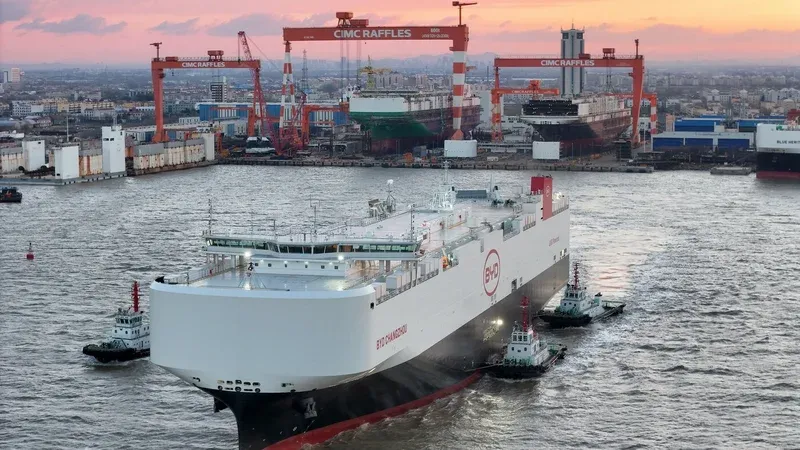
BYD’s strategy in maritime transportation is now an integral part of its international expansion. RoRo ships allow cars to be loaded and unloaded directly on their wheels, without the need for containers, making this approach particularly suitable for automobile exports.
The initial fleet was completed in 2025 and consists of eight ships, with a capacity ranging approximately between 7,200 and 9,000 cars. With 10 new ships set to arrive, the additional nominal capacity will be around 92,000 vehicles.
The surge in exports
The need for enhanced logistics capacity becomes clear when looking at export figures. According to internal data, BYD alone exported 184,000 vehicles from China in August, a 131% increase compared to the same month in 2025.
In the first eight months of the year, exports reached approximately 1.127 million vehicles, marking an 88% year-on-year growth. Overseas markets are thus becoming increasingly important for this Shenzhen-based manufacturer, which is not experiencing similar success at home.
China: Rising car exports but a shortage of ships. Logistics is being reinvented
A network to overcome trade barriers
The expansion of BYD’s RoRo fleet clearly indicates that the company does not view exports as a temporary phase. On the contrary, it is investing in a true global infrastructure for distributing its vehicles.
An interesting aspect is that these car carriers are not used solely by China to transport vehicles to other continents. For example, in September 2025, the BYD Zhengzhou transported right-hand drive vehicles produced at BYD’s factory in Thailand to the United Kingdom.
Maritime transportation thus becomes an important part of BYD’s international strategy. The Chinese giant is in fact building a production network that includes facilities outside China, such as the one in Thailand, because vehicles produced locally are not subject to the specific compensation measures (tariffs) imposed by the European Union on electric vehicles manufactured directly in China.
For BYD, this means being able to build an international network that does not rely solely on Chinese factories and that, in certain cases, allows for reducing the impact of trade barriers.
Previous Article
Cogeser adds 30 charging stations
Next Article
The German company ZF launches over 100 kits for repairing electric motors