
The BYD Great Seagull has grown to 4.21 meters. LiDAR and megawatt charging remain unconfirmed.
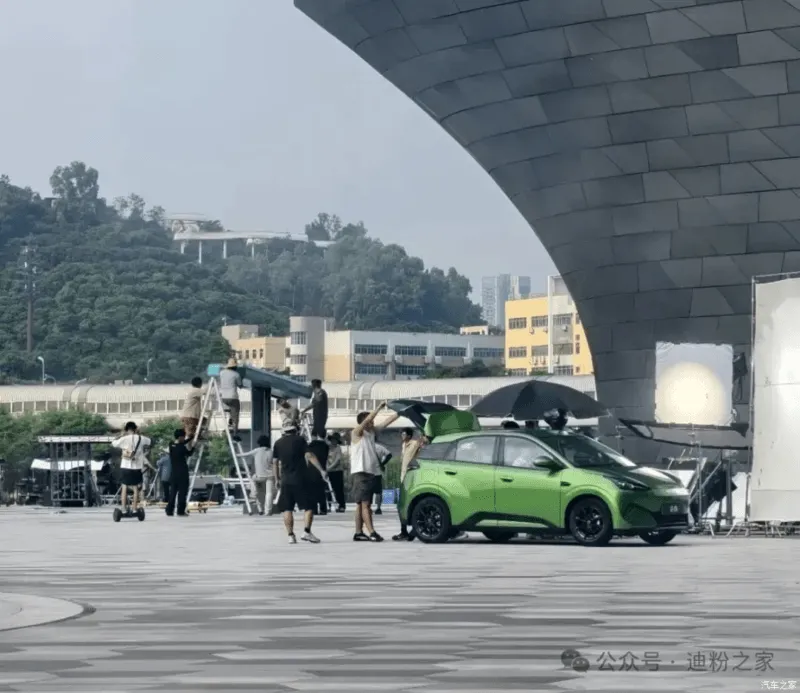
BYD is developing a larger version of the Seagull in China, tentatively named Great Seagull or Da Haiou. The vehicle features a wheelbase of 2,650 mm, an engine with 95 kW of power, and LFP batteries with a capacity of up to 39.23 kWh, but the photo showing a megawatt charger is not yet part of the vehicle’s specifications.
Table of Contents
Show
Hide
The photos from the promotional shoot show a nearly finished car along with the BYD Megawatt Flash-Charger. However, the manufacturer has not disclosed either the maximum charging power of the Great Seagull or the time required to recharge it.
Larger than the Seagull, similar to the Dolphin
The new hatchback measures 4,205 mm in length, 1,810 mm in width, and 1,570 mm in height. Its wheelbase is 150 mm longer than that of the current Seagull, at 2,650 mm. This dimension brings it closer in size to the BYD Dolphin, although the Great Seagull is intended to be positioned below it in terms of class.
BYD has not completely changed the car’s character. It will still remain a small, five-door electric vehicle for urban use, but it is no longer a very basic budget model. A larger cabin and longer floorpan can provide significantly more rear space, which is the biggest drawback of the current Seagull for family use.
The body features a closed front end, sharp bumpers with embossed designs, and polygonal headlights. New Ink Green paint is also shown in the images. However, the more important element on the roof is the LiDAR.
Specifications
BYD Great Seagull
—
—:
Length
4,205 mm
Width
1,810 mm
Height
1,570 mm
Wheelbase
2,650 mm
Engine power
95 kW
Top speed
150 km/h
Battery
LFP FinDreams, 29.99 or 39.23 kWh
CLTC range
320 or 420 km
LiDAR and God’s Eye B in a car for less than 100,000 yuan?
The LiDAR is set to work alongside the God’s Eye B system, also known as DiPilot 300. In its Chinese version, the system is intended to handle urban and highway driving assistance, lane changing, traffic light recognition, and automatic parking.
This would be an unusual configuration for a car in this price segment. The current Seagull costs between 69,800 and 69,900 yuan in China, which is around $10,300 to $10,400. The LiDAR, more powerful engine, and larger body size will almost certainly raise the price of the Great Seagull, though it remains unclear whether BYD will keep it below 100,000 yuan.
It’s important to stay calm about this. Having LiDAR alone does not mean autonomous driving. God’s Eye B is an advanced driver assistance system, and its range of functions may depend on the car model, software version, and local regulations. In Europe, such a package, even if it were available for sale, might not work exactly the same way as in China.
Inside the BYD, it moves away from the traditional gauge cluster. The driver will have a simple two-spoke steering wheel and a larger central screen. The photos also show a redesigned center console with more storage compartments. This is a direction already seen in the brand’s newer models.
The megawatt charger shown in the photos is not a guarantee yet
The biggest excitement comes from the presence of the Megawatt Flash-Charger during the promotional event. BYD is developing a charging system with a capacity of up to 1 MW for its latest vehicles based on high-voltage architecture. Today, the brand’s cheapest Chinese models associated with this technology, the Qin MAX EV and Seal 06 EV, start at around 110,000 yuan.
Great Seagull might therefore offer a version with this technology at a lower tier. However, just an image of the car next to the charger isn’t enough to confirm that the hatchback will indeed support megawatt-level charging power. BYD has not specified the charging capacity, the voltage of the installation, or the claimed charging time.
This is particularly important for batteries with a capacity of 30 or 39.2 kWh. Even very high peak power would only be available for a short time, and what matters most to drivers is the charging curve and the time it takes to reach 10 to 80 percent charge. The marketing term “megawatt” here may describe the station’s capabilities rather than the actual performance of a small car.
The LFP batteries will be supplied by FinDreams, BYD’s battery division. The base model has 29.99 kWh and a CLTC range of 320 km, while the larger version has 39.23 kWh and a CLTC range of 420 km. Converting this directly to WLTP values would be risky, but in practice, lower figures than the Chinese claims can be expected.
95 kW instead of 55 kW and a problem for the Dolphin
The permanent magnet synchronous motor is expected to deliver 95 kW, or 127 horsepower. The current Seagull uses a 55 kW engine. The difference is significant, and the top speed will increase to 150 km/h. This should improve the car’s performance outside urban areas, where basic versions of small electric cars quickly reach their limitations.
However, BYD must be careful not to steal customers away from the Dolphin. Sales figures from China show the scale of both models: the Seagull recorded 10,103 registrations in one of the recent months, while the Dolphin had 16,829. The Dolphin still sells well, so a quick withdrawal isn’t an option.
In Europe, the current Seagull is offered as the BYD Dolphin Surf. The manufacturer has not confirmed whether the Great Seagull will enter our market or under what name. However, if it arrives with LiDAR and a much more powerful drive system, it will no longer be an electric vehicle “for as little money as possible.” It will rather be a cheaper alternative to the Dolphin, but equipped like a car from a higher class.
The most interesting aspect of the Great Seagull isn’t just the larger body size, but whether BYD can maintain a reasonable price after adding LiDAR, 95 kW of power, and fast charging. Do you prefer a small electric vehicle with a large battery, or shorter range in exchange for faster charging and better support systems?