
BYD Da Han is available for pre-order at 249,900 yuan. This large sedan with a 1,008 km range targets a higher-end market than the Han.
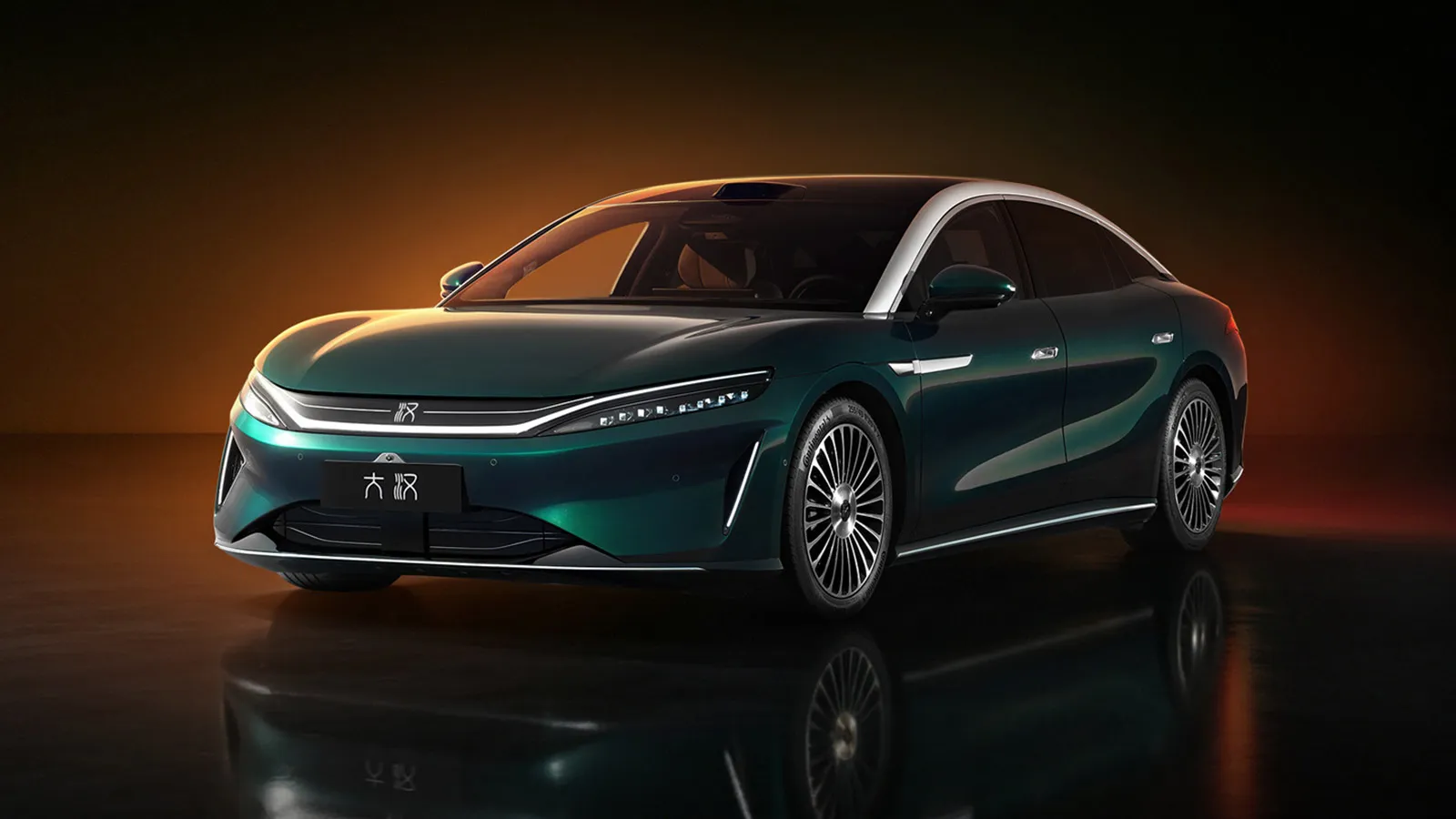
BYD unveiled the new Da Han EV in Chengdu, the flagship sedan of its Dynasty line, positioned above the existing Han model. It starts at 249,900 yuan in China, has a CLTC range of up to 1,008 km, and offers 570 kW of power in its top AWD version.
Table of Contents
Show
Hide
This is another move by BYD toward the premium segment. But here it’s not just about a large screen and wood trim; it also features specifications that, on paper, appear to be a blend of a luxury limousine and a very fast EV.
BYD Da Han EV: Prices, Versions, and Positioning
The Da Han is the first sedan in the “9 Series” of the Dynasty family. BYD positions it as a large, higher-end model above the current Han, alongside the previously unveiled Da Tang SUV. In short, the Chinese company is creating its own flagship model lineup for customers who have previously turned to brands like Denza, NIO, or the German trio.
Three electric versions are available in pre-sale:
Version
Price in China
Powertrain
CLTC Range
Da Han EV RWD LiDAR Premium
249,900 yuan
Rear-wheel drive, 1 engine
1,008 km
Da Han EV RWD LiDAR Flagship
269,900 yuan
Rear-wheel drive, 1 engine
1,008 km
Da Han EV AWD LiDAR Flagship
299,900 yuan
4×4, 2 engines
880 km
At today’s exchange rate, this is roughly $37,200–$44,600, indicating a very aggressive pricing level in China for a vehicle of these dimensions and features. If this car were to make its way to Europe someday, the price would obviously be significantly higher after adding transportation, tariffs, and homologation costs. But the benchmark is already clear.
The car has a length of 5,256 mm, width of 1,999 mm, height of 1,510 mm, and wheelbase of 3,130 mm. This falls into the category of large limousines. The comparison to the Mercedes S-Class isn’t unfounded, even though the BYD is much cheaper.
1,008 km of CLTC range and 570 kW of power. The specifications may seem high on paper, but the numbers are still impressive.
The strongest marketing asset is its range. In rear-wheel-drive versions, the Da Han EV features a battery with a capacity of 102.326 kWh, offering a claimed range of 1,008 km according to CLTC standards. A caveat is necessary here—CLTC range isn’t representative of actual road conditions, especially for a vehicle of this size and weight. In Europe, WLTP standards would result in significantly lower figures, and even less in normal highway driving.
Nevertheless, the number still works. A four-digit range figure in the specifications continues to attract attention and reinforces its image as a technological leader.
The RWD version is equipped with one engine delivering a peak power of 370 kW, or about 496 horsepower. This is already more than many sports sedans, let alone traditional limousines.
The top AWD variant adds a front engine with 200 kW of power, resulting in a total of 570 kW, or around 764 horsepower. BYD claims a 0-100 km/h acceleration time of 3.8 seconds, a top speed of 270 km/h, and a 100-150 km/h acceleration time of 3.2 seconds. This last figure speaks volumes—the car can not only accelerate well from a stop but also maintain strong performance at higher speeds.
In one description, the AWD version’s 0-100 km/h time is listed as 3.3 seconds, while another states 3.8 seconds. For now, it’s safer to stick with the officially announced 3.8 seconds from pre-sales figures. The difference isn’t small, so it’s worth verifying the final numbers at the full market launch.
BYD also lists a braking distance of 32.83 meters from 100 km/h. If this figure holds up in independent tests, it will be very good for such a large vehicle.
Suspension, Adjustable Rear Axle, and “Flash Charging”
The Da Han isn’t built around just its powertrain specs. It’s standard to come equipped with 15 features that BYD considers essential for its entire lineup. These include a two-chamber DiSus-A pneumatic suspension, an adjustable rear axle, fast charging, and zero-gravity seats in the front.
An adjustable rear axle makes sense in a vehicle like this. BYD claims a turning radius of 4.95 meters, which sounds suspiciously good given its length of over 5.2 meters. If this figure represents the actual turning radius rather than the manufacturer’s more favorable methodology, maneuvering in city traffic could be surprisingly easy.
The DiSus-A suspension is also supposed to increase ground clearance by 100 mm. This sounds more like a feature for special occasions rather than something drivers will use daily, but such solutions are well-received in the premium segment in China.
The most interesting claim is regarding charging. BYD mentions a “flash charging” technology that allows the battery to go from 10% to 97% in just 9 minutes. This figure is so impressive that it almost requires a very small print disclaimer. Without specifying the charging power, voltage curve, battery temperature, or test conditions, this currently seems more like a demonstration of the system’s capabilities rather than a concrete promise for everyday use. In other words: it sounds great, but real-world tests are needed.
Interior and equipment. BYD focuses on the rear passenger
The Da Hana cabin is clearly designed for a customer who doesn’t always sit behind the wheel. The front layout is typical of new Chinese flagship models: digital clocks, a central screen, a passenger screen, and an HUD display. The materials are said to include real wood and metallic accents.
However, the real focus is in the back. With a wheelbase of 3,130 mm, BYD emphasizes the second-row amenities heavily. There are footrests, ventilation, heating, massage functions, and a separate control screen in the armrest. The Da Hana also features a ceiling screen for rear passengers, which is still not standard in sedans.
This is complemented by intelligently tinted glass at the back, adjustable with a single touch. BYD claims that practically only the Yangwang U8 previously offered a similar feature. There are also closing doors and a Devialet audio system with up to 31 speakers, though the standard version is said to include 25 speakers.
In short: this car isn’t trying to be a “sports Han.” It’s aiming to be a lower-priced premium Chinese limousine.
LiDAR and God’s Eye B. Driving assistance is standard, but autonomy is not.
All versions shown in pre-sales come equipped with a LiDAR and the God’s Eye B driver assistance system on the roof, which is also referred to as DiPilot 300 in some markets. The manufacturer talks about the NOA feature, which refers to driver-supervised point-to-point driving.
This needs to be read carefully. We’re talking about an advanced ADAS system here, not full autonomy. The driver remains responsible for the vehicle and must be ready to take control. There have been a lot of such claims in China recently. Only independent tests will show whether it performs closer to the level of NIO and Huawei or more like marketing hype.
There will also be a plug-in hybrid, but the electric drive plays the leading role
BYD has also announced a PHEV version, but pre-sales have not yet started. It is known to feature a 1.5 turbo engine with 115 kW of power and at least one electric motor with 200 kW of power.
The specifications also include a larger battery of 54,489 kWh LFP and an electric range of up to 470 km. Yes, for a plug-in hybrid, this figure is absurdly high by European standards. In China, the PHEV segment has long surpassed what we see in Europe. Here, the battery is almost as large as that of a small BEV.
An AWD PHEV variant with a total power output of 400 kW is also set to appear. But today, the electric version takes center stage at the launch.
BYD actually has a specific reason for pushing out such models. In July 2026, the company sold 411,072 vehicles globally, a 20.5% increase year-on-year, but it experienced a 30.9% decline in deliveries in the Chinese market, to 172,449 units. Its flagship, more expensive models are intended to help improve margins and brand image. The question is whether this large sedan can succeed in China against the current SUV trend. It won’t be easy.
The Da Han seems like an attempt to create its own “Chinese EQE or steroid-enhanced 5-series,” but at a price point closer to upper mid-range rather than true premium. Whether such a setup will succeed depends less on specs and more on how the car drives and how many of its promises hold up beyond the showroom. What do you think? Would a large BYD sedan make sense in Europe, or have SUVs already taken over that segment from the start?