
BYD wants to bring the Racco technology to Europe. The small EVs will come with the X-PACK package and local production.
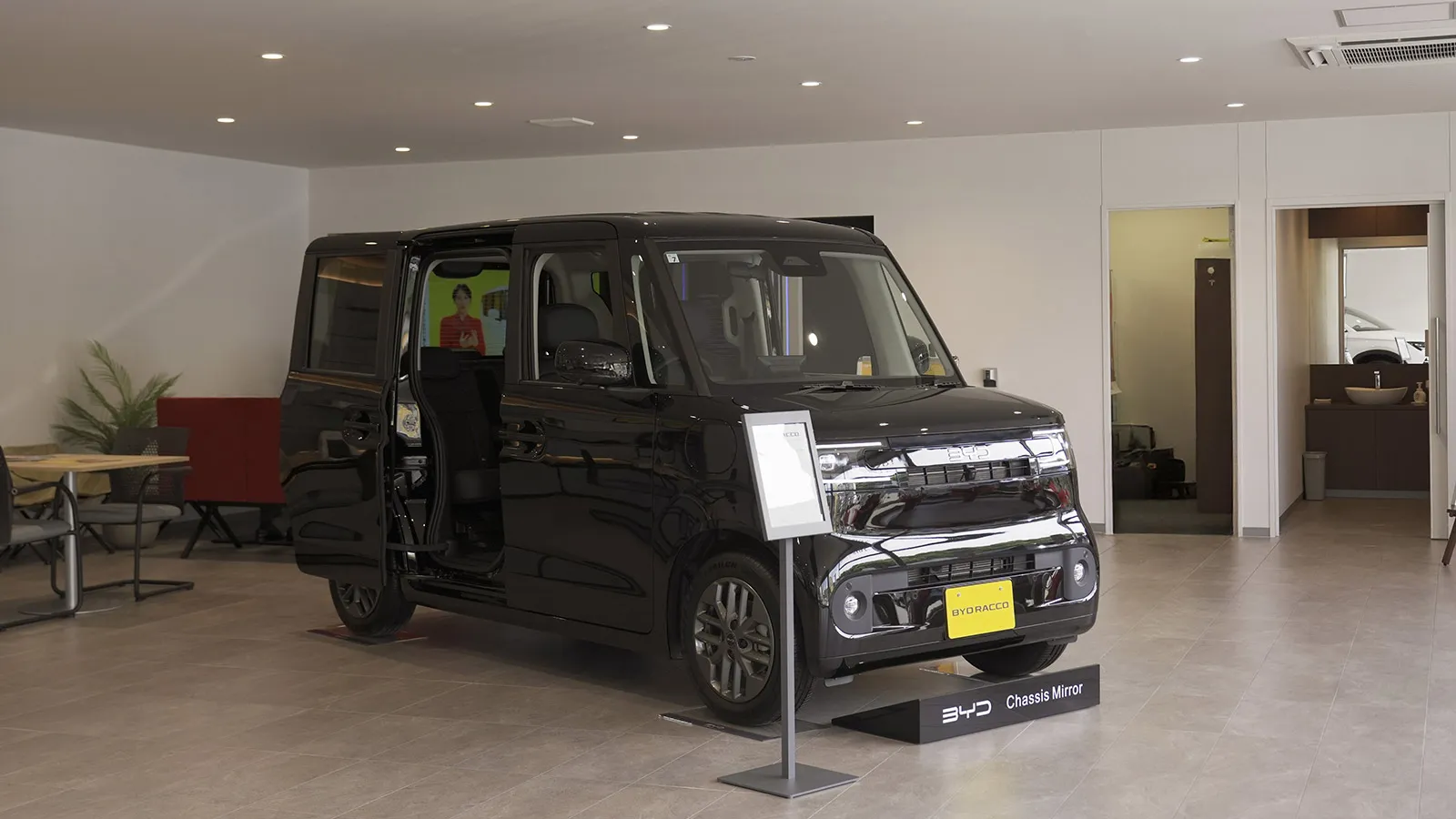
BYD is preparing a small electric car for global markets, based on the design from Japan’s Racco. It’s not so much about the kei car itself but rather the X-PACK architecture, which packs the inverter and some components into a battery pack under the floor. For Europe, this could be more interesting than yet another large SUV from China, as the focus is on urban vehicles and price.
Table of Contents
Show
Hide
The Japanese Racco made its debut on July 28, 2026, and immediately became a testing ground for BYD. The car was developed according to local kei car regulations, resulting in dimensions of only 3395 mm in length, 1475 mm in width, and 1800 mm in height. With such compact size, every centimeter counts.
It’s not about copying the kei car, but how it’s designed
BYD’s plan is not to bring to Europe a car with Japanese-sized dimensions at 1:1 scale. The company intends to use the solution employed in the Racco to develop other small EVs tailored to the requirements of Europe, Southeast Asia, or South America.
In traditional architecture, some of the power electronics are placed at the front of the car, in the “engine” compartment. This is a problem in small vehicles because it takes up limited space. X-PACK does this differently. The inverter and other key electrical components are integrated with the battery, and the entire system is located under the floor.
The effect is simple. More space is available for the cabin and the controlled crush zone at the front. This makes sense in a city car because it’s necessary to fit passengers, a battery, and still not compromise safety. Marketing likes to describe such things in grand terms, but here the specific problem and the solution are quite logical.
Racco has proven that customers will buy it
The Racco itself isn’t a monster in terms of specifications, but it looks reasonable for its class. The base version comes with a 22.4 kWh battery and a WLTC range of 210 km. Higher trims offer 35.84 kWh and a WLTC range of 320 km.
Of course, it’s worth noting a caveat. WLTC figures don’t reflect real-world range in European winters or on roads at speeds of 120-140 km/h. But for a city car in Japan, this range seems decent, especially since BYD claims to have surpassed the 300 km mark in its electric kei car.
The prices are also set aggressively. The Racco starts at 2.145 million yen, which is around $13,400–$14,400 according to various exchange rates at the time of publication. With a Japanese subsidy of 150,000 yen, the base version’s price drops below 2 million yen.
One more thing. The car received 1,002 orders in two weeks since sales began on August 9, with 80% of demand coming from the more expensive 300 Premium version. This isn’t a scale that changes the world, but for a niche model targeting a very specific market, the signal is clear. Customers aren’t turning away from small EVs if the product is well-designed.
Europe might be a better test ground for this technology than Japan
The most interesting part is the next step. BYD is reportedly planning to use X-PACK to develop small electric vehicles for Europe and other markets, with detailed development set to begin now, leading to a launch in a few years.
This fits perfectly with what Europe lacks the most today. Not another electric SUV priced at 200,000–250,000 zł, but a practical small car that doesn’t look like a compromise from 2018. The segment of affordable and small EVs is just beginning to develop. Volkswagen has the ID.2 and ID.Polo family ready, Renault is focusing on the new Twingo and Renault 5, while Hyundai and Kia are also targeting lower price points. BYD clearly doesn’t want to miss out on this opportunity.
There are also regulations in the background. According to reports, the EU has introduced a new car category inspired in part by Japan’s philosophy of small cars. This refers to models produced within the Union that are up to 4.2 meters long and can benefit from regulatory preferences or market-based support. Caution is needed here, as the details at the national level and how such rules will be applied in practice matter greatly. However, the general direction is clear. Europe is beginning to favor smaller cars, at least on paper.
BYD might therefore arrive at the right time. If it’s possible to build a car larger than a kei car but still very compact, with a practical cabin and battery without compromising safety, it could become a viable product for European cities.
Hungary and tariffs. Without these, this plan would be less meaningful.
The whole picture becomes serious only when we add production in Europe. BYD plans to open a factory in Hungary in 2026, and it could be there that a base for small X-PACK models is established.
This is important for two reasons. First, local production shortens the supply chain and provides greater flexibility in tailoring cars to European standards. Second, it helps reduce the issue of additional tariffs on EVs imported from China. And for a small car, every thousand euros makes a much bigger difference than in a car worth 50,000 euros.
In other words, BYD isn’t just trying to sell a Japanese concept in Europe. The company wants to turn it into a locally produced product with local assembly. And this already sounds like a strategic move, not just a curiosity.
BYD needs small cars if it really wants to compete with Toyota
The broader business context is also simple. Competition in China is fierce, margins are under pressure, and price wars have not disappeared. BYD continues to grow but increasingly relies on foreign markets.
In the first half of the year, the company generated revenue of 344.82 billion yuan, of which 181.27 billion yuan, or 52.57 percent, came from foreign markets. This was the first time that foreign markets accounted for more than half of BYD’s total revenue.
President Wang Chuanfu said in June that BYD aims to become the world’s largest car manufacturer in terms of sales within five years. An ambitious goal. However, it may be difficult to achieve this solely with sedans and SUVs, even if sold globally. Toyota built its scale on small, relatively inexpensive models for mass consumers. BYD apparently reached a similar conclusion.
That’s why the Racco is more important than its size would suggest. It doesn’t have to be a hit in its own right as an export product. Instead, it could serve as a blueprint for an European urban EV that is cheaper to produce, better equipped, and less susceptible to tariffs.
For drivers in Europe, one thing matters most: whether this vehicle can be significantly cheaper than larger compacts, while still having a spacious interior and a range that goes beyond just “to the bakery.” If so, BYD could enter a market where there are still too few viable options. What do you think? Should BYD’s European compact electric car target models like the Dacia Spring or Renault 5, or rather future Volkswagen vehicles from the ID.2 series?