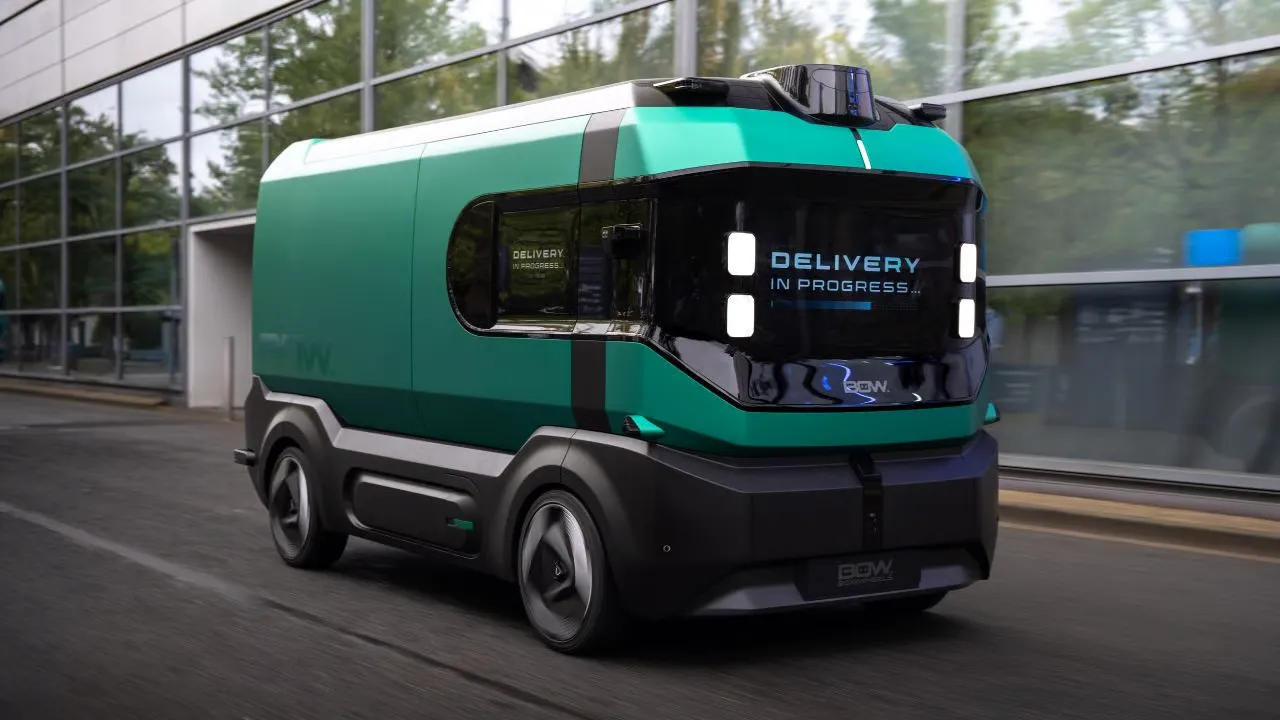
BOW: Stellantis envisions an amazing driverless electric utility vehicle for delivering goods in cities
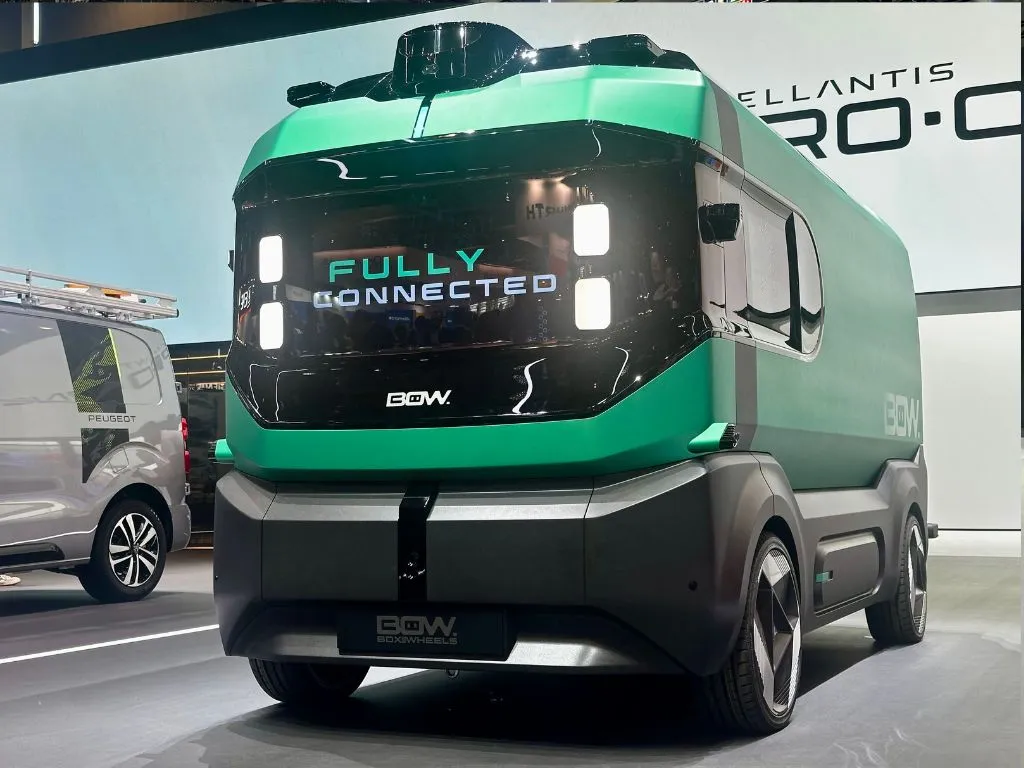
With BOW, short for “Box on Wheels,” Stellantis is exploring a new approach to last-mile delivery. This 100% electric and autonomous concept eliminates the need for a driver and could also find use in factories, hospitals, or airports.
What if the future of electric utility vehicles no longer needed a cabin at all? At the 2026 IAA Transportation show in Hanover, Stellantis unveiled a peculiar box on four wheels. Its name perfectly captures the concept: BOW, short for “Box on Wheels.” Behind its apparent simplicity lies a 100% electric and autonomous vehicle designed to transport goods without a driver. The BOW is one of the many innovations showcased by Stellantis Pro One in Hanover, but it is likely also the most original.
The company didn’t stop at displaying a static prototype in its booth: a demonstration vehicle was also operated in an outdoor area to illustrate its functionality in various situations.
A self-moving electric box
The principle of BOW is to eliminate everything that becomes unnecessary when no one is driving the vehicle. There’s no longer a need for a traditional cabin: the vehicle becomes primarily a space designed to transport goods. Stellantis developed this concept with UQI Robotics, a company specializing in artificial intelligence, robotics, and autonomous driving technologies. The goal is to explore how automation, electrification, and connectivity can make certain logistics operations more efficient.
Also read
Kia unveils the PV7, an 800 V electric SUV with a range of over 460 km
The company provides no technical specifications in its announcement. As a result, we know nothing about its battery capacity, range, power output, top speed, volume, or payload. Stellantis also does not specify the vehicle’s range or the technologies used to enable driverless operation. In short, it is merely a concept.
Not Just for Delivering Packages
The BOW was specifically designed for urban logistics. Stellantis envisions it being used in cities where traffic restrictions and low-emission zones are increasing. Such a vehicle could, for example, be used to transport goods over the final mile without requiring a driver on board.
But the group is also considering uses in more controlled environments where deploying autonomous vehicles could be potentially simpler. Stellantis cites factories, hospitals, and airports as examples. This last point is far from trivial. While fully autonomous vehicles still struggle to become widespread on public roads, vehicles that move at low speeds along defined routes in controlled spaces represent a much more feasible use case.
Coming to our cities soon?
For now, it’s better not to expect to see a BOW on one’s street corner. Stellantis explicitly presents the vehicle as a concept meant to explore new logistical solutions, rather than as a future model with an already scheduled release.
Also read
800-volt architecture and nearly 700 km of range: details on the new Renault Trafic electric vehicle
The BOW is primarily designed to implement Stellantis Pro One’s strategy, which aims to go beyond simply selling commercial vehicles by integrating vehicles, fleet management, connectivity, and services. The group already utilizes data from 800,000 connected commercial vehicles through its Pro One NEXT system.