
Bosch will cut around 900 of the 1,800 jobs in Nuremberg
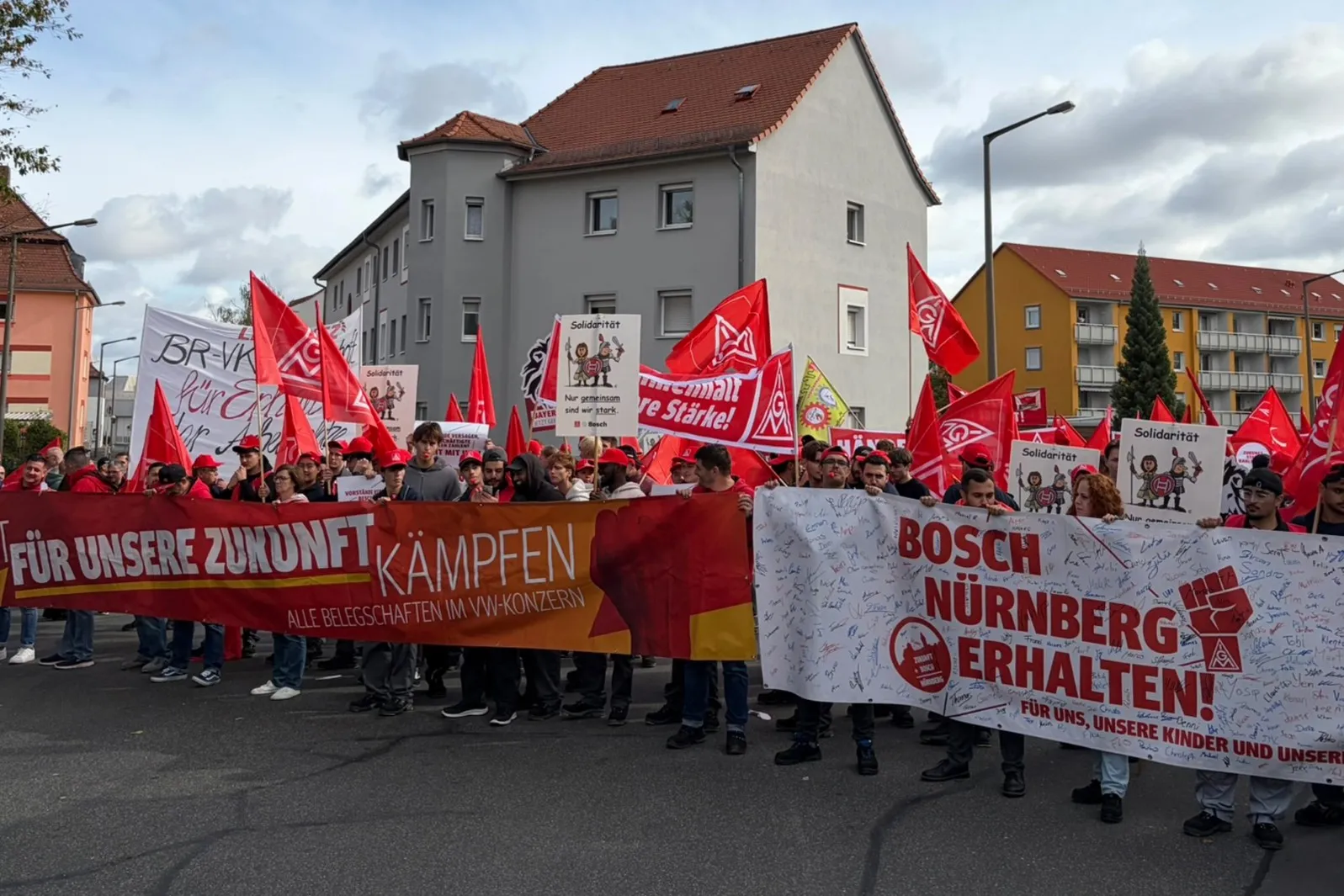
The automotive parts supplier Bosch shows no sign of slowing down and is now planning further cuts to its workforce: At its Nuremberg site, half of the 1,800 employees are set to leave by 2029. IG Metall and the works council strongly condemn this decision, describing it as a “massive purge.”
IG Metall’s Automotive Action Day at Bosch’s Nuremberg Plant
Image: IG Metall Nuremberg
This addition of 900 job cuts at the plant comes on top of the already announced reduction of 22,000 jobs. The majority of these job cuts affect the mobility sector, which refers to Bosch’s business as an automotive parts supplier.
The IG Metall union and the works council are vehemently criticizing the plans to cut jobs in Nuremberg. “If the employer’s plans for mass layoffs are implemented, the Robert Bosch plant in Nuremberg will die gradually. A closure of the plant by Robert Bosch GmbH after 2029 can no longer be ruled out,” states a press release from IG Metall.
Bosch plans a “mass layoff” according to the works council
Firm criticism also came from Andreas Weidemann, head representative of IG Metall Nuremberg: “The lack of vision and ignorance among Bosch’s managers remind me of the closure of AEG. Back then, profit-driven managers shut down a profitable facility and deprived hundreds of people of their livelihoods. As IG Metall, we will not sit idly by while watching Bosch’s management carry out this plan. Those who take away a factory’s future and expect the few remaining employees to bear the consequences with significant wage cuts will face our strong resistance.”
What Weidemann means: Despite financial cuts already made in the past — since 2007, there have been several agreements at the site to secure its operations, with employees contributing financially through reduced wages and working hours — Bosch still demands an additional 15 percent reduction in labor costs from the workforce, according to IG Metall.
Dependence of gasoline injection pump production location
Bosch itself has not yet commented on these plans. It is known, however, that the site’s license expires on December 31, 2026. The plant in Nuremberg has so far relied almost entirely on its internal combustion engine business. The main product produced there, the high-pressure pump for gasoline injection, “faces a devastating price war with other Robert Bosch plants in the EU and outside the EU,” according to IG Metall. Such plants typically have significantly lower social standards, and wage agreements are usually not in place there.
IG Metall and the works council had anticipated this challenge posed by the rise of electric mobility and called for new “future products” for the plant in Nuremberg. However, according to the union, Bosch management has so far refused to agree to this. Such job cuts in Nuremberg have been discussed for months, and it was not until September 21 that the workforce protested during IG Metall’s nationwide action day.
As shown in the half-year figures, by the end of the first half of 2026, Bosch Group employed 406,225 people, which is 6,549 fewer employees than on December 31, 2025. According to Bosch, this workforce reduction affected all business areas, but particularly Mobility. In Germany, 118,932 people were employed at Bosch by the end of the first half of 2026 (31.12.2025: 122,968), a decrease of 4,036 employees.