
Bosch is opting for electric drives in trucks while still sticking with hydrogen.
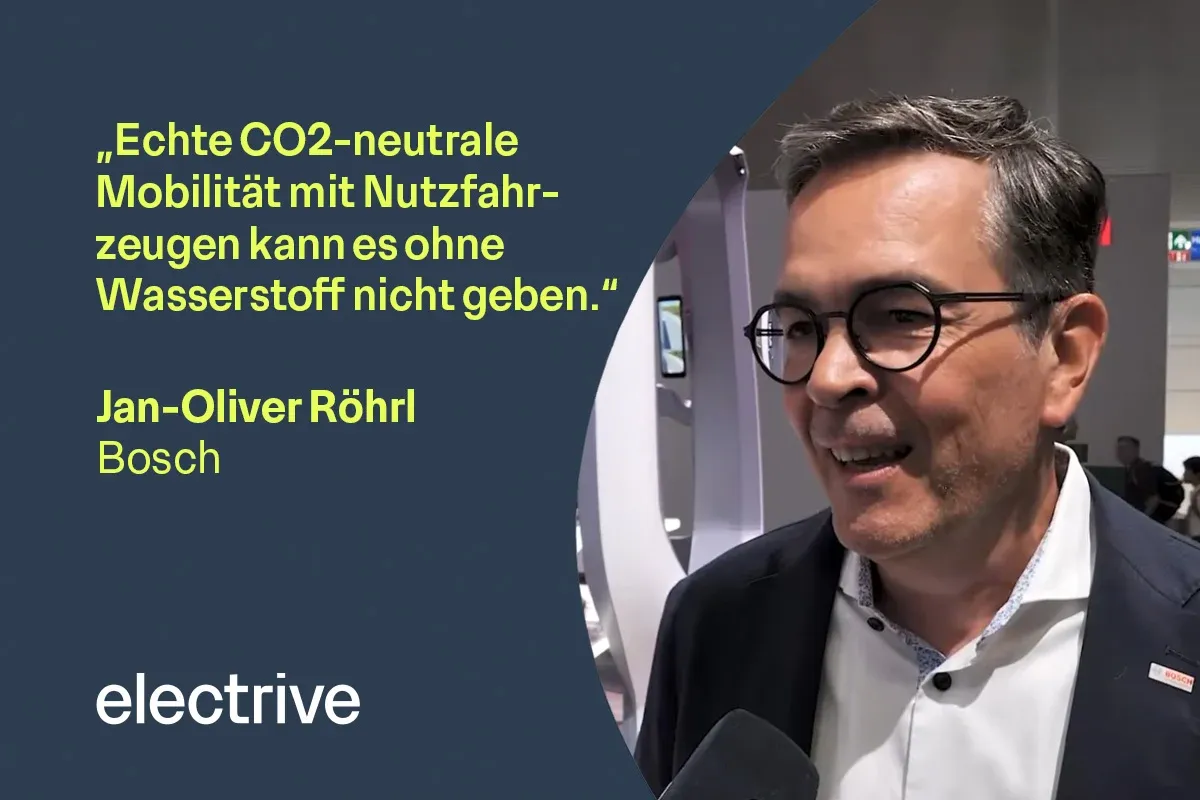
Bosch sees great growth potential in the commercial vehicle sector and aims to support the technological transformation of trucks comprehensively. At IAA Transportation, Jan-Oliver Röhrl, Executive Vice President Commercial Vehicles and Off-Road at Bosch, spoke with electrive about electric axles, the lack of charging infrastructure, hydrogen — and why Europe should not rule out new technologies too early.
Bosch expects the commercial vehicle business to become significantly more important in the coming years. The world’s largest supplier identifies two key drivers for this: a globally growing market for heavy commercial vehicles and a fundamental technological shift. Electrification, software, and assistance systems open up many new business areas for Bosch.
"We want to take the lead in driving this transformation from the supplier side," says Jan-Oliver Röhrl, Bosch’s head of commercial vehicles, in an interview with electrive. For this German supplier, the focus is not just on individual components but increasingly on complete system solutions.
An example is the new electric axle for heavy commercial vehicles: Compared to a conventional central drive, it is said to offer significant advantages in terms of efficiency, weight, and space requirements. Bosch combines an electric motor, power electronics, and various gear options for this purpose. In addition, there is an increasingly complex thermal management system that plays a crucial role in the 800-volt architectures of electric trucks.
No infrastructure, no operation
For experts in commercial vehicles, Röhrl believes the biggest challenge for the widespread adoption of electric trucks no longer lies solely in the vehicles themselves. Especially for heavy trucks used in international long-haul transport, charging infrastructure needs to develop much faster. While a large portion of regional traffic can be covered by depots, cross-border shipments require a dense network of fast charging stations across Europe.
"Innovation should actually precede infrastructure – and that’s not the case," Röhrl summarizes the problem from his perspective.
Hydrogen remains part of Bosch’s strategy
At the same time, despite its strong focus on battery-electric drives, Bosch remains committed to hydrogen. This applies both to fuel cells and hydrogen internal combustion engines. Röhrl still sees opportunities for their use, especially in heavy vehicles and long-distance travel. “We are convinced that true CO2-neutral mobility without hydrogen is not possible, particularly in the commercial vehicle sector.”
China plays a key role for Bosch in this regard: Röhrl views it as the leading market for both battery-electric heavy commercial vehicles and fuel cells. Technologies and experiences gained in China could later be transferred to Europe if suitable markets develop there as well.
Bosch views this broad approach as a sign of technological openness. Röhrl also warns against Europe becoming too technologically dependent on specific sectors: “We need pluralism in our solutions as well,” he says. Only in this way can Europe develop innovations, scale them up, and prevent other regions of the world from permanently overtaking it in new technologies. This aligns with Bosch’s participation in the Hydrogen Alliance, which was introduced at IAA Transportation alongside other companies such as Daimler Truck, the Volvo Group, and Toyota to advance the ecosystem in Europe.
You can watch the video interview from IAA Transportation either directly in the video player above or by going straight to Youtube.