
Bosch bets on electric drives for trucks – while still backing hydrogen
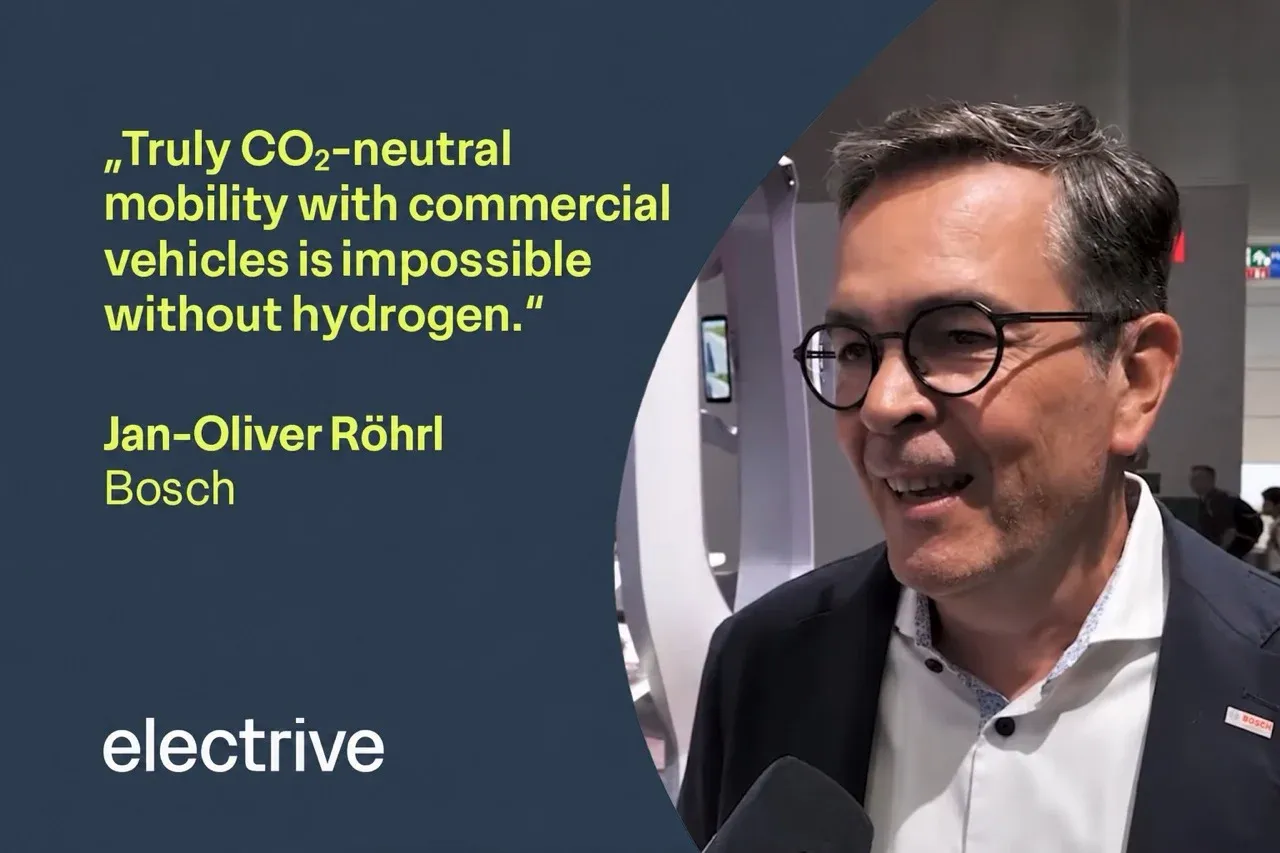
Bosch sees significant growth potential in the commercial vehicle sector and aims to broadly support the technological transformation of trucks. At the IAA Transportation, Jan-Oliver Röhrl, Executive Vice President Commercial Vehicles and Off-Road at Bosch, spoke with electrive about e-axles, the lack of charging infrastructure, hydrogen - and why Europe should not rule out options too early when it comes to new technologies.
++ The interview from IAA Transportation is available as a video in German. You can activate subtitles onYouTube. ++
The commercial vehicle sector is set to become significantly more important for Bosch in the coming years. The world’s largest supplier sees two key drivers for this: a globally growing market for heavy-duty commercial vehicles and a fundamental technological shift. Electrification, software and assistance systems are opening up many new business opportunities for Bosch.
As Jan-Oliver Röhrl, Head of Commercial Vehicles at Bosch, tells electrive: “We want to lead this transformation on the supplier side.” For the German supplier, the focus is no longer just on individual components but increasingly on complete system solutions.
One example is the new e-axle for heavy-duty commercial vehicles: compared to a conventional central drive, it is said to offer significant advantages in terms of efficiency, weight and installation space. Bosch combines an electric motor, power electronics and various transmission variants for this purpose. In addition, there is an increasingly complex thermal management system, which plays a central role in the 800-volt architectures of electric trucks.
No infrastructure, no ramp-up
However, for commercial vehicle expert Röhrl, the biggest challenge for the ramp-up of electric trucks is no longer solely the vehicle itself. Above all, for heavy-duty trucks in international long-haul transport, the charging infrastructure needs to grow much faster. While a large proportion of regional transport can be served via depots, cross-border transport requires a dense European fast-charging network.
“Innovation actually needs infrastructure to lead the way – and that is not happening,” Röhrl argues.
Hydrogen remains part of Bosch’s strategy
At the same time, Bosch remains committed to hydrogen despite its strong focus on battery-electric drives. This applies to both fuel cells and hydrogen internal combustion engines. Röhrl still sees potential applications, particularly for heavy vehicles and long distances. “We are convinced that truly CO 2-neutral mobility cannot exist without hydrogen, especially in the commercial vehicle sector.”
China plays a key role for Bosch in this context: Röhrl sees the country as the leading market for both battery-electric heavy-duty commercial vehicles and fuel cells. Technologies and experiences from China could later be transferred to Europe as corresponding markets develop there.
Bosch views this broad positioning as technological openness. Röhrl also warns against Europe becoming too narrowly focused on individual technology paths: “We need pluralism in solutions as well,” he says. Only then can Europe develop and scale innovations and prevent other world regions from permanently pulling ahead in new technologies. This aligns with Bosch’s participation in the Hydrogen Alliance, which was presented at IAA Transportation alongside other players such as Daimler Truck, the Volvo Group and Toyota, and aims to advance the ecosystem in Europe.
++ The interview from IAA Transportation is available as a video in German. You can activate subtitles on YouTube. ++