
The BMW i3 Neue Klasse shown in person. BMW chose proportions similar to those of a gasoline car.
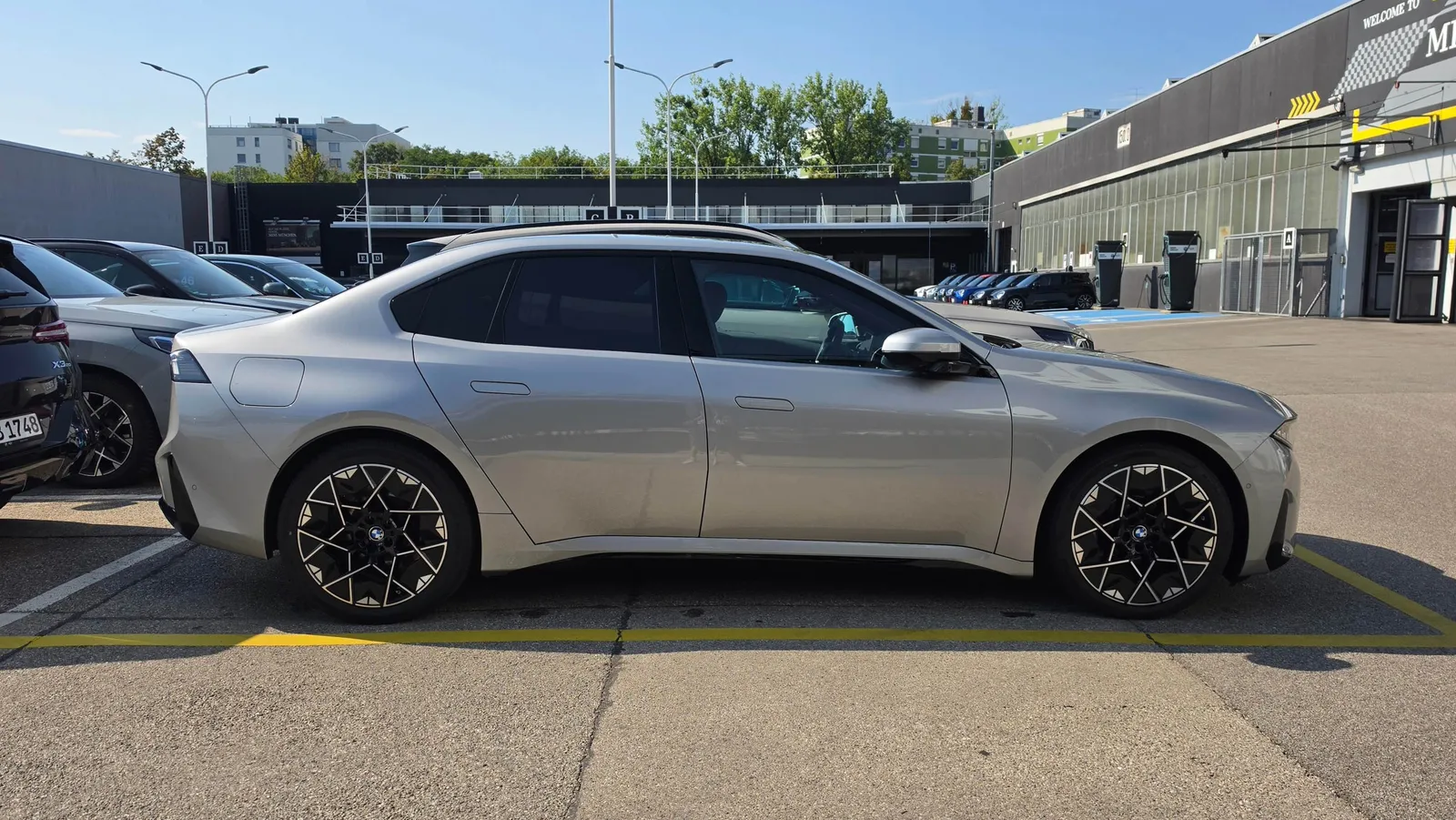
The first photos of the production BMW i3 Neue Klasse without filters from renders and press shots have surfaced online. The car has already rolled off the assembly line in Munich, and the discussion isn’t just about its 469 horsepower and 400 kW charging capability, but also whether BMW wasted some of the advantages of its electric platform.
Table of Contents
Show
Hide
Andy Palmer, former head of Aston Martin and one of the people responsible for introducing the Nissan Leaf, pointed out the latter aspect. And he’s right, because the new i3 looks like a BMW, only sometimes to an excessive degree.
More 2011 than an electric “blank slate”
The photos of the production car show proportions that strongly resemble classic BMWs with internal combustion engines. A long, high-mounted front end, a fairly traditional roof line, and a silhouette that reminds more of a 2011 BMW than an attempt to fully leverage EV architecture.
This isn’t a trivial matter for stylists. In an electric car, there’s no need to leave as much “packaging” in the front as in a gasoline model, since the powertrain takes up less space. The battery under the floor does raise the car, but it doesn’t explain everything.
Palmer calculated this his own way and compared it to the Tesla Model 3 Highland, which is one of the best examples of an efficient EV sedan today. In the Tesla, the hood extends on average to about 64 cm, while in the BMW i3 Neue Klasse it’s around 90.5 cm. That’s even higher than in the gasoline-powered BMW Series 3 G20. The difference is huge and doesn’t help much from an aerodynamic perspective.
Here, BMW’s philosophy is clearly visible. The brand apparently wanted the new “3 Series” to look like a BMW at first glance, rather than an anonymous electric car with a short nose. This might help sales. The question is only how much it costs in watt-hours per 100 km.
Interesting – analysis below.
The i3 is actually 40 mm taller than a Model 3 and 34 mm taller than the G20. Its wheelbase is only 22 mm longer than the Tesla’s despite being 40 mm longer overall.
I think BMW has deliberately sacrificed some of the theoretical EV packaging… pic.twitter.com/cisyeMCX1a
— Dr. Andy Palmer (@AndyatAuto) August 15, 2026
The specs are strong; the battery is also large.
Paper-wise, the BMW i3 50 xDrive looks very impressive. It has a battery with a usable capacity of 108.7 kWh, 469 horsepower, 645 Nm of torque, and a 0-100 km/h acceleration time of 4.7 seconds. The manufacturer also mentions charging at up to 400 kW and an actual combined range of around 700 km.
That sounds good. The issue is that this performance doesn’t stem solely from exceptional efficiency but also from a very large battery. For comparison, the old BMW ActiveE had around 32 kWh gross capacity and 28 kWh usable capacity. Thus, the new i3 is practically an entire generation ahead of that earlier model.
The vehicle segment has also changed. The ActiveE was a C-class car, while the BMW i3 50 xDrive is 4.76 meters long with a wheelbase of 2.897 meters, placing it in the D-class segment. It’s simply a large sedan equipped with a battery suitable for cars of a higher class.
In practice, this means one thing: if the i3 can indeed achieve around 700 km in normal mixed traffic, it will be a very strong competitor in its class. However, if such performance was mainly achieved by adding more battery capacity, part of its technological advantage becomes less impressive than advertised.
Prices in Poland and what’s next
The production of this model began a few days ago in Munich. According to BMW, demand for the i3 and iX3 is so strong that the factory must increase its production pace, with the plant set to produce only electric vehicles starting next year.
In Poland, the BMW i3 50 xDrive is expected to start at 331,900 złoty for the First Edition version and 290,000 złoty for the regular model. In the fall, a cheaper “40” version with a smaller battery and rear-wheel drive is set to join the lineup, which may be more appealing to many drivers than the top-tier configuration available at launch.
The new i3 appears to be a deliberate attempt to blend two worlds together. BMW didn’t create a “German version of Tesla”; rather, it developed an electric BMW Series 3 with thorough planning. The question is whether premium customers today prefer low fuel consumption or a familiar design. From your perspective, should they go for the Model 3 Highland, or is this what an electric BMW should look like?
LovEV Newsletter
Want more content like this?
Sign up — we’ll send you a weekly summary once the newsletter starts.