
Bilger plans to add more charging stations on the highway
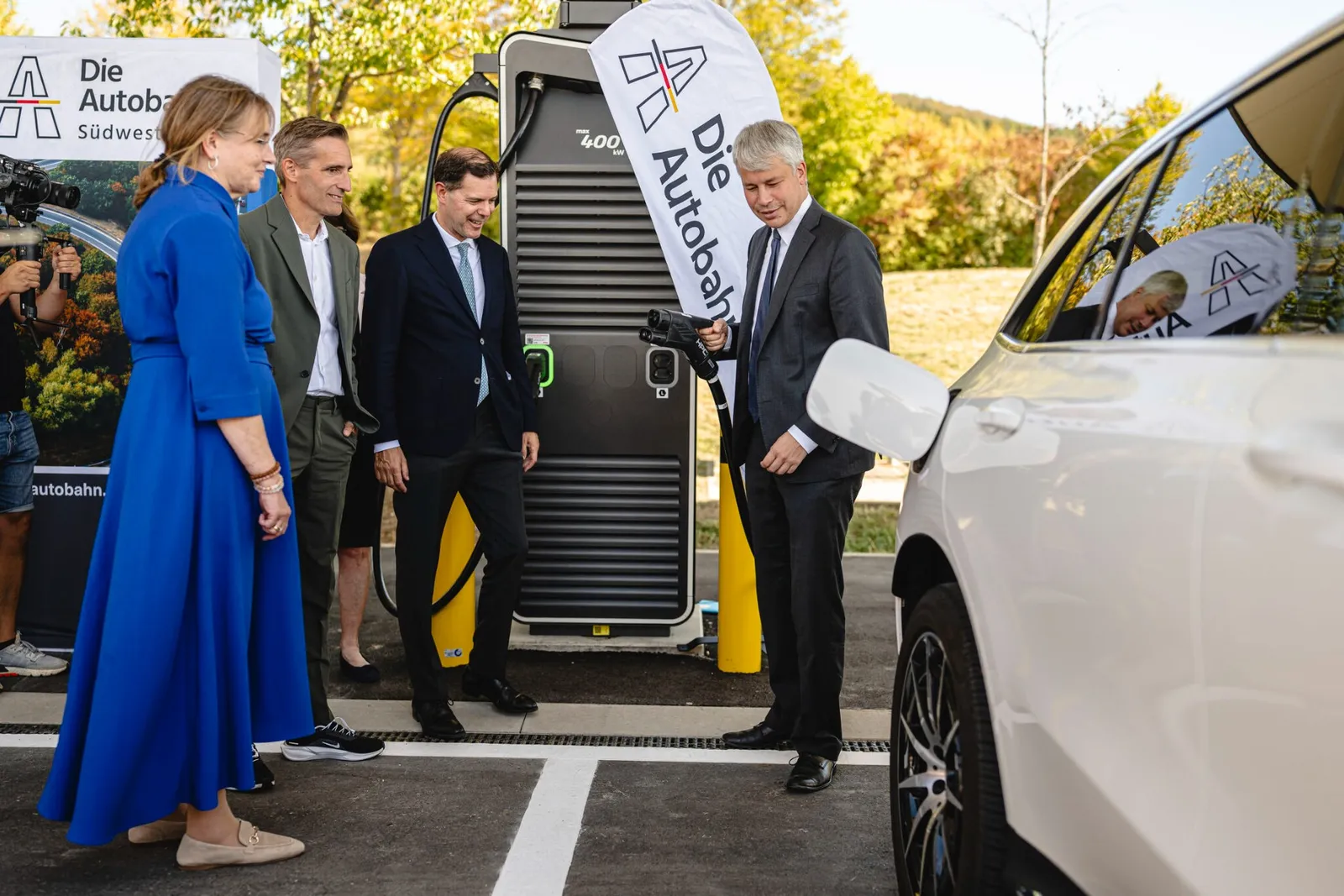
Transport Minister Steffen Bilger (CDU) plans to create more charging options for electric vehicles along Germany’s highways. Specifically, additional fast-charging stations are to be built at unmanaged rest areas, in addition to those part of the ongoing Deutschlandnetz network. A tender is scheduled for spring 2027.
Steffen Bilger at the opening of a Deutschlandnetz charging station
Image: E.ON
At the end of September, Transport Minister Bilger opened the 100th of a total of 200 planned Deutschlandnetz charging stations located at unattended rest areas. It is situated on Highway 81 near the PWC facility in Räthisgraben, in the direction of Stuttgart, and is operated by E.ON. The Deutschlandnetz network, which also includes thousands of charging points outside highways, was supposed to be fully developed by the end of 2026. However, already last year, due to issues such as difficulties in securing medium-voltage connections, it became clear that the network would not be complete until 2027 or even 2028.
However, given the accelerating growth of electric mobility — with more than one in three new car registrations recently being electric vehicles — the federal government now aims to further expand charging infrastructure along highways. At the initiative of Federal Transport Minister Steffen Bilger, the Federal Ministry of Transport (BMV) and the federal Autobahn GmbH plan to designate additional areas along highways for more car charging points. This is intended to drive the expansion of charging infrastructure more effectively. Private investors are expected to have the opportunity to set up fast-charging stations for electric vehicles at unmanaged rest areas, commonly known as PWC stations.
Allocation to investors planned
Steffen Bilger says, “By authorizing additional areas for electric vehicle charging stations at unmanaged rest stops, we create extra fast-charging options right along the highways. This saves electric vehicle drivers time and detours. We will make the approval process as simple as possible for investors while ensuring appropriate quality and transparent prices for users. Private capital is an important component of a efficient and modern transportation network. It helps to implement projects more quickly, thereby accelerating the development of charging infrastructure on our highways.”
It appears that, unlike the Germany network, these charging stations are not to be built and operated under federal commissioning or with billions in financial support from the government. Instead, as mentioned, Bilger and his ministry refer to “investors” with “private capital,” who are supposed to decide “on their own, through a competitive process, the scope and capabilities of the charging infrastructure” as part of the planned bidding process. Although the BMV does not currently specify the number of locations or target new charging stations, investments in the hundreds of millions are expected.
Autobahn GmbH plans market consultation soon
Autobahn GmbH will soon launch a market consultation regarding the key aspects of this project. It is likely to address questions such as which locations are suitable, or under what conditions companies are willing to build and operate fast charging stations along the highway at their own expense. The start of the bidding process is scheduled for spring 2027. The further timeline for the actual awarding, as well as the planning and construction phases, remains unknown.
What is still almost completely missing in Germany, however, are charging parks at the commercial service areas, those with gas stations and rest stops. The background to this is a multi-year legal dispute between charging provider Fastned and the Autobahn GmbH. This was resolved in March, with the outcome being that the construction and operation of charging stations at highway rest stops must be subject to bidding. Since then, Germany’s CPOs have been waiting for the relevant bidding process to begin, which concerns charging infrastructure at around 360 locations. In the meantime, charging parks at private parking lots near highway exits have flourished and established themselves as a good alternative. Additionally, a bidding process for 124 truck charging parks at highway rest stops was recently announced, set to begin in November.