
Stuttgart and Mettmann are leading in the development of charging stations
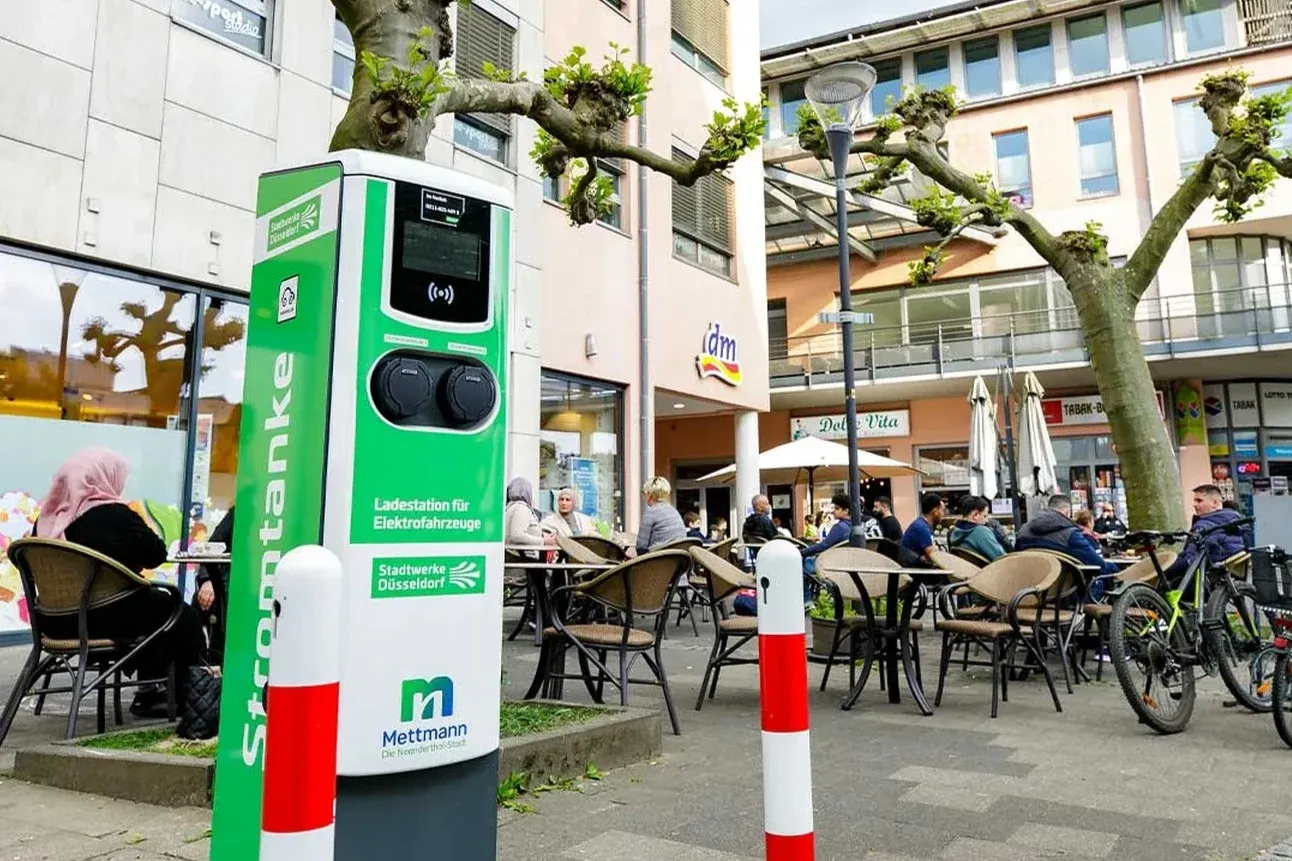
The 2026 Charging Stations Atlas shows significant regional differences in the development of public charging infrastructure. Stuttgart remains the leader among cities without districts, while the district of Mettmann now tops the list among districts.
Charging station of Stadtwerke Düsseldorf in Mettmann
Image: Stadtwerke Düsseldorf
For the 2026 Charging Stations Atlas, energy company 1Komma5° calculated for all 107 cities without district status and 294 districts in Germany how many public charging points there are per 100 square kilometers, as well as how much this figure has changed compared to the previous year. The data used are from the Federal Network Agency and area statistics from Destatis. According to this analysis, there are currently 209,136 public charging points nationwide, of which 150,316 are standard chargers and 58,820 are fast chargers. This represents a roughly 24 percent increase in the charging network density compared to the previous year.
Among the cities without districts, Stuttgart remains far ahead as the leader. There are 2,107 charging stations per 100 square kilometers, 12 percent more than the previous year. Regensburg comes in second with 1,452 charging stations, representing a 19 percent increase. Munich also makes it into the top three with 1,179 charging stations and a 19 percent growth rate.
The highest percentage growth among cities without districts was recorded in Schwabach, Bavaria. There, the charging station density increased by 112 percent within a year to 172 stations per 100 square kilometers. Mülheim an der Ruhr follows with an 89 percent increase.
Mettmann has the highest charging station density
There is a change at the top among the districts. The Mettmann district in the Düsseldorf area has around 344 charging stations per 100 square kilometers, representing a 40 percent increase. This pushes it ahead of the previous leader, Böblingen near Stuttgart, to second place. There, the density is just under 328 charging stations per 100 square kilometers, 19 percent higher than the previous year. The Main-Taunus district comes in third with around 281 charging stations.
Among the districts, Wesermarsch in Lower Saxony shows the highest percentage increase at 113 percent. However, this also reflects a low starting point: despite strong growth, there are only just under 30 charging stations per 100 square kilometers. The lowest-ranked remains Prignitz in Brandenburg, with only 3.5 charging stations per 100 square kilometers.
The disparity remains significant even at the level of federal states. Among the larger states, North Rhine-Westphalia leads with around 121 charging stations per 100 square kilometers, followed by Baden-Württemberg with about 99. The density is much lower in Thuringia, Saxony-Anhalt, Brandenburg, and Mecklenburg-Vorpommern. The city-states naturally have much higher densities due to their smaller size. Berlin has around 849 charging stations per 100 square kilometers, while Hamburg has 791.
The sheer number or density of charging points is merely one aspect of the supply issue. The latest charging infrastructure conference hosted by the Federal Ministry of Transport made it clear that the industry is shifting increasingly from a focus on mere expansion to discussions about quality. Alongside the quantity of charging points, factors such as availability, reliability, charging speed, location selection, and ease of use are gaining greater attention.
At the same time, grid connection for new charging projects is likely to become more important. Industry representatives warned at the conference that limited grid capacity and lengthy connection procedures could delay further expansion despite existing technology and willingness to invest.
An analysis based on charging stations per area is particularly useful for highlighting regional differences in infrastructure development. However, it only provides limited insight into whether the availability of charging stations is sufficient relative to the population size, vehicle fleet, or actual charging demand. Urban areas with high population density generally perform better structurally under an area-based assessment compared to large rural regions.
