
BDEW survey: Charging hubs gaining significant importance among electric vehicle owners
Electric vehicle drivers in Germany are generally satisfied with public charging. At the same time, their charging behavior is changing: Urban charging hubs are being used much more frequently than just a year ago, according to a new user survey by BDEW.
Public charging seems to pose fewer problems for many experienced electric vehicle drivers than they had expected before purchasing a vehicle. In the fifth user survey conducted by the Federal Association of Energy and Water Economy (BDEW), 91 percent of respondents who use public charging stations say the current offerings meet their expectations at least. For 55 percent, the expectations are even exceeded.
The high level of satisfaction does not mean, however, that there are no structural challenges in further expanding the charging infrastructure. For this reason, BDEW is also working on the operator side to simplify the regulatory framework. At the beginning of 2026, the association published a draft text for technical connection requirements in medium voltage. This is intended to standardize grid connections, particularly for larger fast-charging parks.
For the current user survey, UScale conducted online interviews with a total of 1,009 drivers of pure electric vehicles in Germany in July and August 2026 on behalf of BDEW. Plug-in hybrids were not included in the study. 775 participants, or 77 percent, use at least one public charging location. According to the study description, the sample is representative in terms of regional distribution across the federal states. 83 percent of respondents drive a new vehicle, while the proportion driving company vehicles is nine percent.
Charging hubs in cities are increasing according to BDEW survey
The usage of urban charging hubs has changed significantly compared to the 2025 survey. Now, 39 percent of respondents say they charge their electric cars there, up from just 21 percent the previous year. Customer parking spaces are also gaining slight importance, with their share rising from 43 to 47 percent. Here are the results presented graphically:
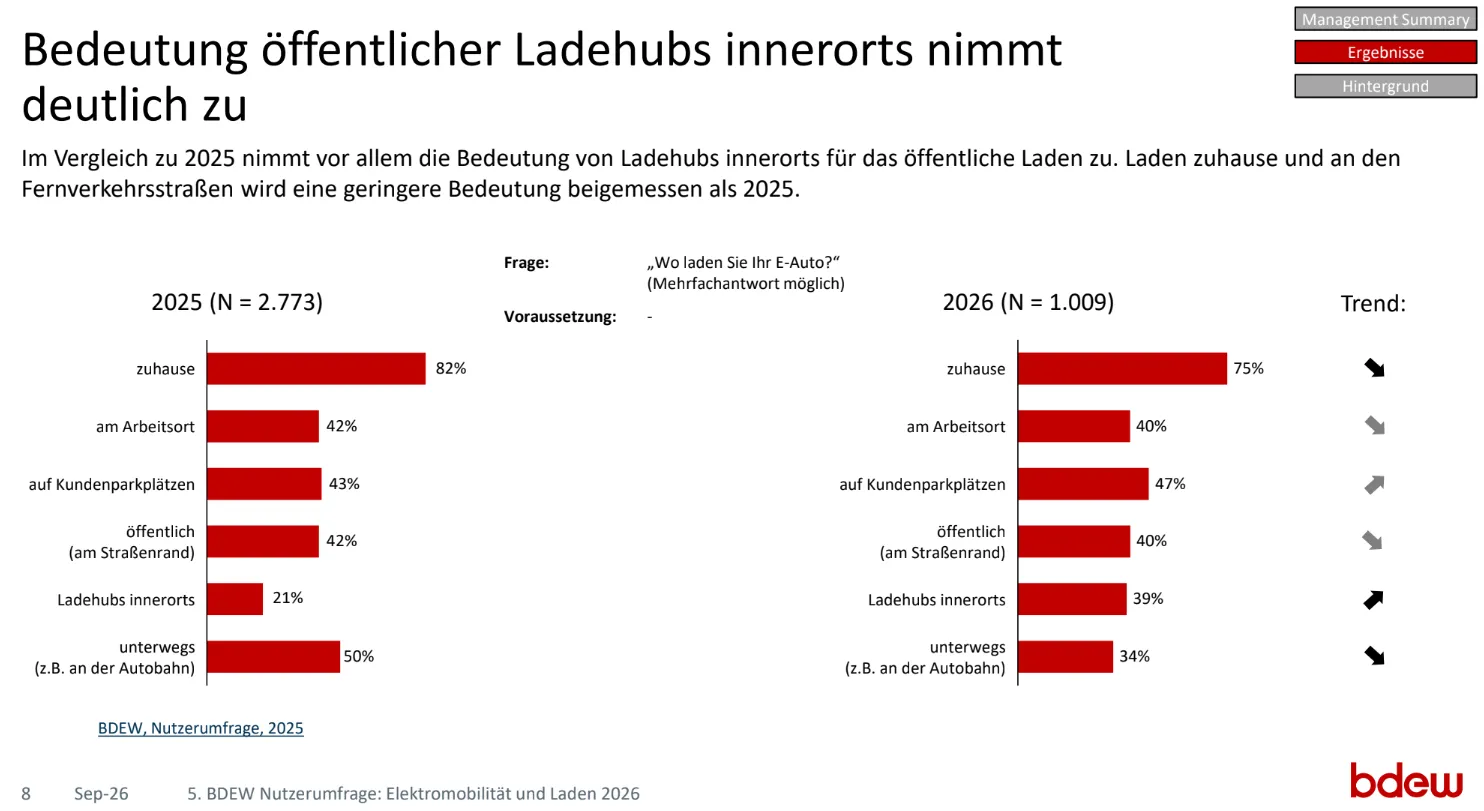
Home charging remains the most commonly cited location at 75 percent, but it dropped by seven percentage points compared to the previous year. The decline is even more significant for charging while on the road, such as on highways: here, the share fell from 50 to 34 percent. At work, it decreased slightly from 42 to 40 percent, and the same holds true for public charging at street sides, which dropped from 42 to 40 percent.
However, these figures should not be equated with the amount of electricity charged there. Respondents were able to mention multiple charging locations. Thus, the results show which locations are used, not how many kilowatt-hours are charged there.
When choosing a public charging station, price is not the top priority. For 46 percent, the location must primarily fit the route, while 43 percent consider charging speed to be a decisive factor. Charging price comes next at 34 percent. The provider of the charging station is important for 23 percent. At most two answers were allowed for this question.
For payment, contract-based charging still dominates. 82 percent of participants who charge publicly use a charging app or card with pre-loaded payment methods. 58 percent cite simpler processing as the main reason, while 43 percent expect lower prices and 38 percent seek transparent billing.
Price still plays a significant role: 59 percent of respondents who charge at public stations use price comparison apps. According to the survey, three-quarters are willing to pay at most 59 cents per kWh for AC charging and at most 69 cents per kWh for fast charging. The question asked was about the most commonly used tariff in each case.
Many concerns ease after buying an electric car
It is also interesting to compare the issues that concerned users before purchasing an electric car with their later experiences. Before buying, range was a concern for 66 percent. Home charging worried 57 percent, while operating and purchase costs concerned 48 percent each. 39 percent were concerned about the availability of public charging stations.
In daily life, many of these issues are considered problems much less frequently. Among those who had researched the range before purchasing, three percent now describe it as a major problem and nine percent as a minor one. For home charging, the corresponding figures are two percent and four percent. Regarding the availability of public charging stations, they are five percent and ten percent respectively.
The situation is different with regard to value loss. Only 18 percent had mentioned this as a relevant issue at all before buying. Of this group, 15 percent now consider value loss to be a major problem, while another 24 percent see it as a minor issue. Delivery times also perform relatively poorly in subsequent evaluations. Here is the relevant overview:
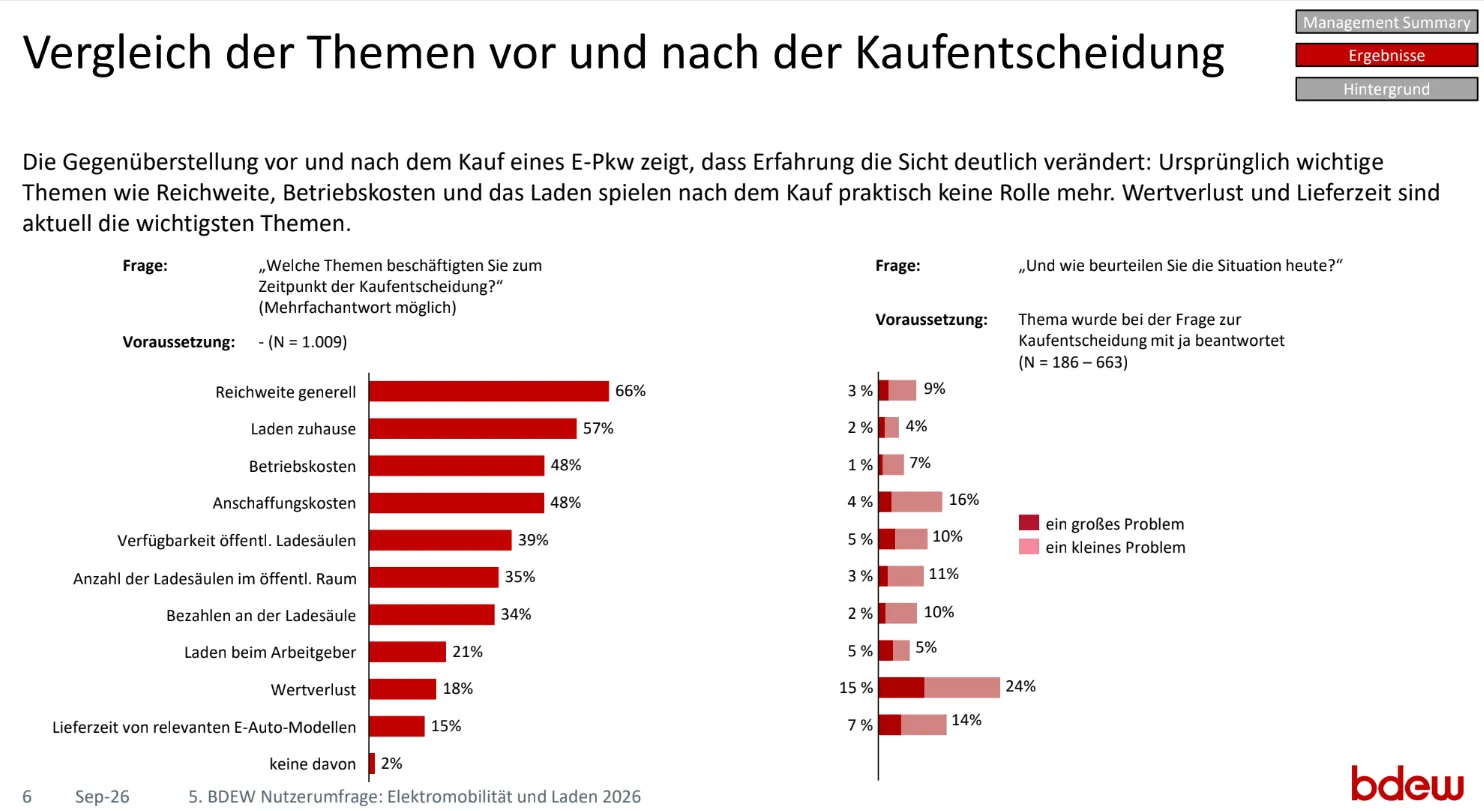
A methodological detail is important in this comparison: According to their current assessment, only those participants who were already concerned about the relevant topic before making the purchase were surveyed. Therefore, the percentage figures before and after purchase do not refer to the same overall group and cannot be directly compared.
In general, respondents have a high level of preference for electric drives. According to their previous experiences, 94 percent would “rather” or “definitely” choose an electric car again. Similarly, 94 percent would generally recommend purchasing an electric car. Among users with more than three years of experience driving electric cars, 71 percent would “definitely” recommend this type of drive, while those with less than two years of experience have 56 percent doing so.
The results should primarily be viewed as an indication of the attitudes of drivers who already use electric cars. It is only possible to draw limited conclusions about the overall German population, as only BEV drivers were surveyed. Additionally, 53 percent of the participants live in single-family homes. 70 percent of the respondents are male.
The study shows an interesting shift in the charging industry: Although home charging remains dominant, the proportion of users using urban charging hubs has nearly doubled within a year. For public charging, route and charging speed often determine station selection more than price. For operators, in addition to competitive rates, location, charging speed, and a user-friendly experience will likely remain crucial factors.