
BattSwap is entering Poland. Instead of charging, battery replacement in just 3 minutes!
In short:
BattSwap enters the Polish market with an idea that Chinese companies have been using in passenger cars for years
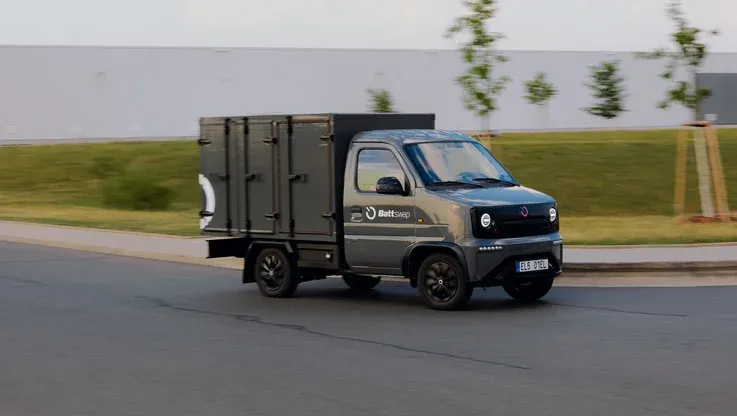
For this Czech company, it involves battery swapping mainly in delivery vehicles
Range and fast charging for BEVs are the main headaches for almost all fleet owners
The system allows battery swapping in about 3 minutes, which is much faster than even the most efficient charging methods today
Four BattSwap stations are already in operation in Prague and Brno, serving 78 electric delivery vehicles
Fleet operators will be able to see a working station during the September New Mobility Congress in Katowice
Will BattSwap help fleet owners?
An electric delivery vehicle can be inexpensive to operate and well-suited for urban routes, but it has one serious drawback when used in heavily utilized fleets: it doesn’t function while charging. BattSwap aims to overcome this issue by treating the battery somewhat like a huge battery in power tools. Instead of waiting for it to recharge, drivers can drive up to an automatic station that removes the depleted battery pack and replaces it with a charged one.
The entire process is supposed to take less than three minutes. The Czech company does not come to Poland just with a prototype. It already operates four stations in Prague and Brno that serve 78 electric delivery vehicles. According to the latest data, BattSwap has completed over 65,000 swaps, with the vehicles traveling more than 2.5 million kilometers without needing to use public chargers. One of the largest users is the online supermarket Rohlík.
One swap station instead of dozens of chargers
BattSwap addresses a quite specific problem. If a company wants to electrify a fleet of dozens of delivery vehicles at once, buying the vehicles themselves might be the easier part of the task. It still needs to provide them with an adequate number of chargers and, most importantly, sufficient power connections.
The automatic BattSwap station is the size of a shipping container. According to the company, it can draw up to 130 kW from the grid and handle around 30 vehicles per day. Batteries removed from vehicles are charged inside, and the system can spread out energy consumption over time, shifting it to hours with lower demand.
This is a key difference from setting up multiple fast chargers at a base. Vehicles don’t have to wait for their own batteries to charge, and operators don’t need to supply high power to dozens of vehicles simultaneously.
The station also doesn’t require the construction of a permanent structure and can be moved. This could be important for companies using rented warehouses and logistics bases, where a large investment in permanent charging infrastructure isn’t always cost-effective.
"Before we started talking more about BattSwap, we spent several years developing and testing our system in the daily operations of delivery fleets. That’s why we’re entering Poland with a solution that has already proven itself," says Radek Janků, founder and CEO of BattSwap. He adds that one of the challenges for Polish fleets is accessing sufficient power from the grid, and battery swapping should enable some operators to electrify their fleets without waiting for major upgrades to their power connections."
In Poland, starting with Lisek.app and Kuchnia Vikinga
BattSwap is preparing the first pilot implementations in Poland with companies such as Lisek.app and Kuchnia Vikinga, as well as other firms involved in so-called last-mile delivery. VeloHub is responsible for developing the business in our market.
It is urban logistics that represents the environment where such a model makes the most sense. Vehicles return regularly to the same base, follow predictable routes, and often operate for most of the day. Therefore, every hour spent charging means time during which the vehicle is not making deliveries.
Czech company Rohlík already gives an idea of the scale. In just the first five months of 2026, vehicles using BattSwap were expected to travel 790,000 km. Earlier tests started with just a dozen vehicles, after which the operator decided to expand its fleet by ordering more vehicles and stations.
A functional station will be at the New Mobility Congress
Radek Janků and BattSwap’s sales manager, Ondřej Koči, will also be in Katowice. The company aims to use the congress not only to showcase the device but also to discuss potential partnerships with more fleet operators in Poland.
"Increasingly, it’s not the vehicles themselves that pose a barrier, but access to power: an operator who wants to electrify dozens of vehicles overnight faces limitations due to the network’s connection capacity," notes Aleksander Rajch from PSNM’s management. He believes the market should develop fast charging, smart power management, and battery swapping simultaneously, rather than assuming that one method of energy replenishment will work in every scenario.
The idea is not new. Nio has completed over 120 million battery swaps.
The concept of removing the entire battery instead of charging it has a much longer history. The most well-known modern example is NIO. This Chinese manufacturer has been designing passenger cars over the years to enable them to use automatic Power Swap stations.
The scale in China is no longer experimental. By February 2026, NIO had exceeded 100 million battery swaps, and by August that figure had risen to over 120 million. The company also opened its 4,000th swap station in China and began deploying fifth-generation devices.
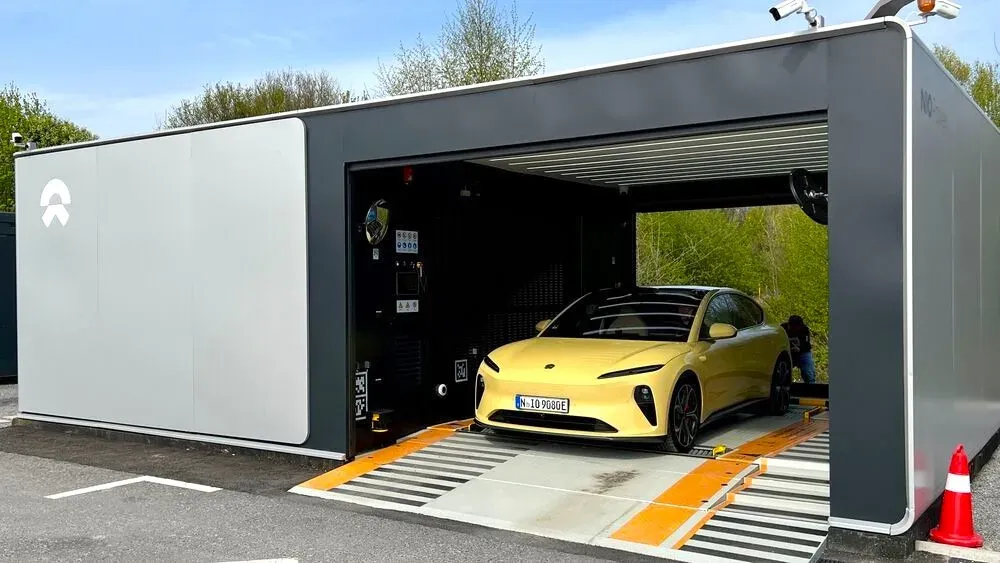
NIO’s experiment thus showed that battery swapping can indeed work on a large scale. However, there is one catch: mainly in China.
In Europe, the network developed much more slowly. As of April 2025, NIO had 60 battery swapping stations in several European countries, while globally there were already over 3,300 such stations at that time. Moreover, in 2026 the company slowed down its overseas expansion, and according to its plans, no new stations in Europe are expected until the end of 2027.
The technology works very well where a sufficiently dense network and a large number of compatible vehicles exist. Without such scale, justifying the cost of building infrastructure becomes much more difficult.
The most prominent companies in the battery swapping sector today are: NIO, CATL, First Technology, Aulton, Ample, Voltia, Eurofork, E-Energee, BattSwap, and BAIC BLUEPARK.
CATL Aims to Make Swappable Batteries a Standard
CATL, the world’s largest manufacturer of automotive batteries, has an even more ambitious plan. Its Choco-Swap system is not tied to any single car brand. CATL is trying to create standardized battery packs that can be used in vehicles from various manufacturers.
The expansion pace is enormous. In April 2026, CATL reported over 1,470 stations in 99 Chinese cities. By the end of June, this number had risen to 2,000, with the company aiming for several thousand locations by the end of 2026. Partners in this project include Changan, Chery, GAC, BAIC, and SAIC-GM-Wuling.
CATL is also developing a separate Qiji system for trucks. This is an important signal, as battery swapping is increasingly directed toward areas where vehicles operate intensively and every hour of downtime carries significant value.
Stellantis also tried it. So far on a small scale.
The technology is not solely a Chinese invention. The American company Ample, together with Stellantis and Free2move, launched a battery swap system in Madrid for used Fiat 500e vehicles in carsharing services.
The first batch included 40 cars, with the project planned to be expanded to 100 vehicles. The modular battery can be swapped in about five minutes. It is a functional implementation, but the scale remains incomparably smaller than Nio’s or CATL’s networks in China.
A more advanced version operates on two wheels. The Taiwanese company Gogoro has created a dense network for swapping small batteries for electric scooters. By the end of 2025, it served over 665,000 subscribers, covered more than 2,700 locations, and had completed over 800 million swaps.
Scooters are the clearest example of when such a system makes sense: a common battery standard is needed, along with a very large number of vehicles and a dense network of exchange points.
BattSwap takes a different approach
BattSwap isn’t trying to build a Polish equivalent of Nio’s public network for now. The model is more closed and potentially simpler to scale. A station is located at a specific fleet’s base, serving vehicles that regularly return there, without the need to cover the entire country.
This could be the biggest advantage of the Czech solution. The coming months will show whether the model, proven with dozens of cars in the Czech Republic, can be scaled up to Poland. The first opportunity to examine it closely will be at the New Mobility Congress in Katowice.
Piotr Sobczyk