
BattSwap is entering Poland. Battery replacement in delivery vehicles is supposed to take 3 minutes.
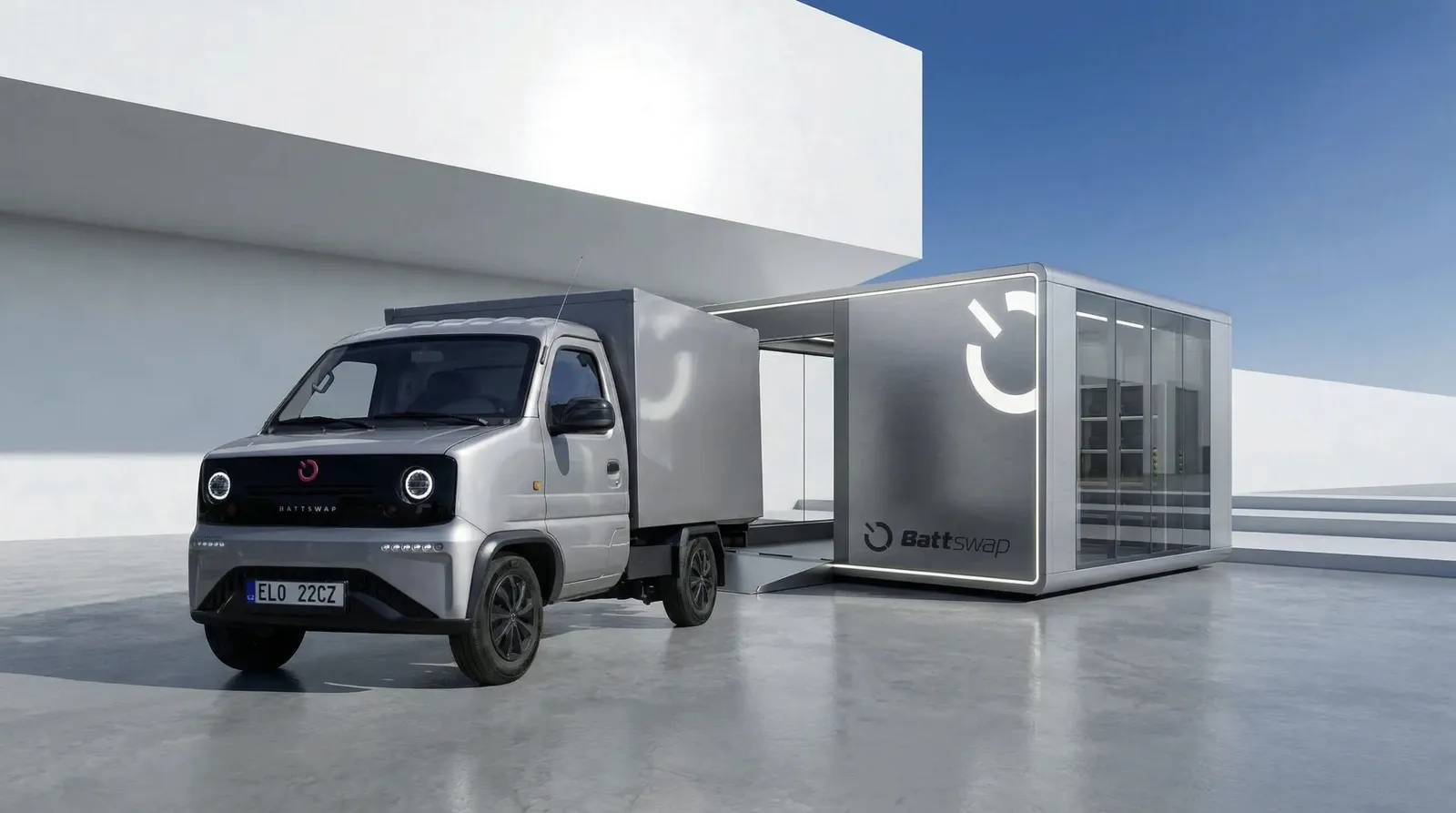
BattSwap has announced its entry into Poland with an automatic battery swap system for electric delivery vehicles. The Czech company already has 4 stations in Prague and Brno, serving 78 vehicles, and claims to have completed over 65,000 swaps as well as enabling 2.5 million kilometers without using public chargers. This offers a convenient solution for fleets, but only where vehicles return to a single base.
One station instead of a forest of chargers
The idea is simple. Instead of charging the vehicle, the driver drives up to a station, which removes the depleted battery pack and installs a charged one. The entire process is supposed to take less than 3 minutes.
The station is the size of a container, draws up to 130 kW from the grid, and according to the company can serve around 30 cars per day. The used batteries are charged inside, so power consumption can be spread out over time and shifted to hours with lower demand. On paper, this seems more sensible than installing several or a dozen fast chargers near a rented warehouse.
BattSwap is aimed at exactly this problem. Fleets can buy electric vans, but then run into connection limitations. Radek Janků, the founder and CEO of the company, says bluntly: “We are entering Poland with a solution that has already proven itself.” He adds that for some operators, battery swapping will enable electrification without having to wait for significant grid capacity expansion.
The first pilots in Poland are set to launch through platforms like Lisek.app and Kuchnia Vikinga, locations where last-mile deliveries follow fixed routes with regular returns to the base. This is important because such a model isn’t suitable for everyone. It won’t replace regular charging on intercity routes.
Czechia is already in action, China shows scale
The Czech project isn’t starting from scratch. Four charging stations are already in operation in Prague and Brno, with the online supermarket Rohlík being one of the major clients. In just the first five months of 2026, vehicles using BattSwap were expected to travel 790,000 km.
The Polish live demonstration is set to take place during the New Mobility Congress, which will be held from September 23-25, 2026, in Katowice. BattSwap will display a working station at booths 20 and 21. Organizers expect 7,500 attendees, 570 speakers, and around 250 partners and exhibitors. Radek Janků and Ondřej Koči will also be in attendance.
But there’s no need to pretend this is a new idea. NIO achieved 100 million swaps by February 2026, and the figure exceeded 120 million by August. The company has also launched its 4,000th station in China. The problem lies elsewhere: in Europe. As of April 2025, NIO had only 60 stations there, with more not set to open until the end of 2027.
CATL is pushing even harder. By April 2026, the company had over 1,470 stations in 99 cities across China, and by the end of June that number rose to 2,000. It aims to reach several thousand locations by the end of 2026. CATL is also developing a separate Qiji system for trucks. This shows where battery swapping makes the most sense: in situations where vehicles operate for long periods and downtime incurs real costs.
There have also been smaller implementations outside China. Ample, in partnership with Stellantis and Free2move, launched a system in Madrid for 40 Fiat 500e vehicles, with plans to expand to 100 cars, allowing battery swaps in about 5 minutes. Meanwhile, Gogoro has reached 665,000 subscribers, 2,700 locations, and over 800 million battery swaps by the end of 2025. Scale makes a difference; without it, economics quickly break down.
BattSwap is taking a much simpler approach than NIO. It doesn’t build a network across the entire country but instead sets up stations at specific fleet bases. If this works in Poland, some companies might stop waiting for larger charging connections and simply start using electric vehicles. Do you think this model makes sense only for delivery services or also for larger urban fleets?
LovEV Newsletter
Want more content like this?
Sign up — we’ll send you a weekly summary once the newsletter starts.