
Battery cell factory planning: How digital configuration integrates layout, costs, and capacity
Factory planning has become the bottleneck in the battery industry: high investment costs, long lead times, and little room for poor decisions. EDAG Group has developed an AI-powered configurator that delivers reliable layout concepts for battery cell factories in the early planning stage — within just a few minutes.
Whether it’s digitalization, decarbonization, or a shortage of skilled workers, manufacturing companies across industries face increasing pressure to transform, while supply chains remain fragile and energy prices volatile. Those planning a new factory today must make far-reaching decisions early on regarding location, capacity, and technology — even though reliable comparison data is often lacking and budgets are tightly constrained.
The battery cell manufacturing sector is under particular pressure: investments range from hundreds of millions to several billion euros, lead times are long, and demand trends remain difficult to predict. After several announced gigafactory projects in Europe were delayed or halted in recent years, there is growing pressure within the industry to make location and capacity decisions earlier and more reliably before capital is committed.
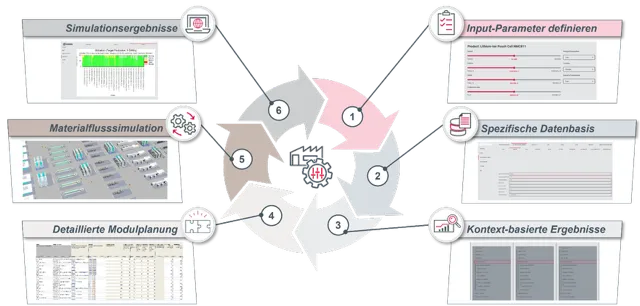
As a solutions provider, the EDAG Group aims to address this issue precisely. That’s why EDAG Production Solutions developed a Smart Factory Network Configurator in the summer of 2025, which uses just a few key parameters—such as target capacity, investment budget, and space requirements—to generate initial layout concepts within minutes, including preliminary material flow simulations, technology options, and cost estimates.
"The early planning phase determines the costs, timelines, and production goals for a battery cell factory. That’s exactly where the Smart Factory Network Configurator comes in: instead of spending weeks obtaining initial comparison data, our customers receive reliable layout concepts within minutes," explains Philipp Hummel, Specialist Consultant Planning Smart Factory. He presented the project at the Batteryforum Deutschland 2026 in January.
How a factory configurator works
Technically, the tool combines several AI methods: Through generative and agent-based AI applications as well as machine learning, hundreds of thousands of variants are created from just a few input parameters. The configurator evaluates the entered parameters, compares them with predefined knowledge, technology, and process databases, and automatically generates layout variants along with cost estimates.
According to EDAG, this reduces the time from the first idea to feasibility testing in reference projects from an average of two months to two to four weeks.
Two practical examples from battery cell manufacturing
The practical application of this is illustrated by two examples from battery cell manufacturing described by the EDAG Group in a whitepaper.
In the first case, a customer plans a new production line for NMC811 type lithium-ion pouch cells and defines at the start of the project
output targets,
investment and operating costs, and
guidelines for the layout area.
After considering an initial option with an annual capacity of eight gigawatt-hours, the customer requests a design that allows for a 1.5-fold increase in capacity. The EDAG team simulates various scenarios using the configurator and prepares a cost estimate for the twelve gigawatt-hours version.
According to the EDAG Group, the result includes several validated layout concepts with scalable production structures and transparent investment scenarios for future capacity expansions.
In the second case, a company with European locations is considering moving a factory to the USA and provides data from its German site:
Investment and operating costs
Technologies
Suppliers
Current processes
To facilitate comparison, the system keeps the target capacity, investment amount, and space requirements constant for both locations to ensure a fair comparison. The differences mainly lie in the details—such as alternative supplier structures and varying energy costs at the US site. Optionally, the EDAG team further optimizes the layout to meet the logistical requirements of the new location.
At the customer’s request, the results can be transferred into detailed planning and the creation of digital twins on the Industrial Metaverse platform metys — for example, to virtually visualize and evaluate layout adjustments.
Conclusion: Data quality remains crucial
The Smart-Factory network configurator does not replace the expertise of factory planners nor the subsequent detailed planning. However, it shifts the comparison of possible options to a stage where changes can still be made with relatively little effort.