
24 hours in saltwater: everything is fine with the Chery Tiggo 9
The battery was submerged in saltwater for 24 hours: this is the test the Chery Tiggo 9 CSH Super Hybrid (plug-in hybrid) underwent, coming out without any signs of corrosion.
Battery in saltwater, in a 1.2-meter tank
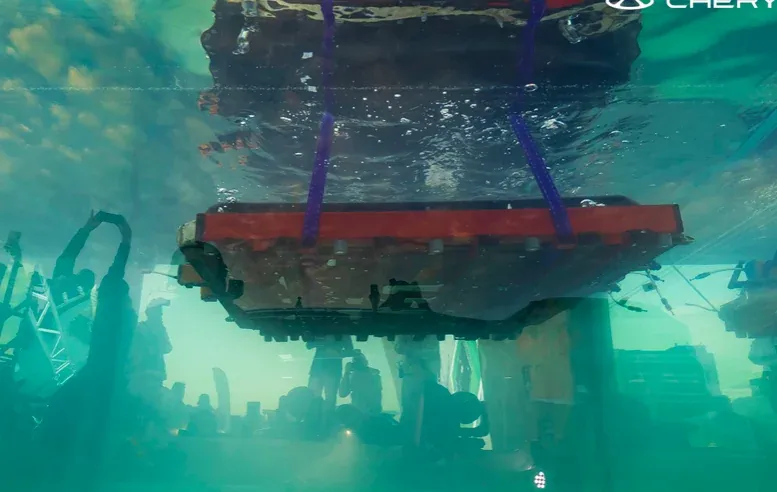
Water and fire represent the two most severe challenges for the battery of an electric car. But regarding the first of these challenges (such as driving through a flooded underpass), reassuring answers continue to emerge. Moreover, once installed in the vehicle, Chery’s battery pack passed a test involving impact against a step from below the chassis. The test was conducted in Constanța, on the Black Sea, by engineers from FEV, a German automotive engineering company. Over 150 journalists from 16 European countries were present. The battery pack, weighing 228 kg and with a capacity of 34.46 kWh, was dropped into a tank 1.2 meters deep filled with water at a salinity of 35 grams per liter, the average level in oceans. “Salt,” explains Chery, “makes the test more severe than with freshwater because it increases conductivity and the harshness of the environment on seals and connections.”
“Electrical.” No corrosion, swelling, or leaks were detected upon exiting the tank. Nor were there any signs of water in the high-voltage and low-voltage connectors or in the vent valve.Another test: impact against a step

"To test the integrity, the enclosure is pressurized and the rate at which pressure drops is measured," explains Chery. "The leakage is 8.067 Pa per minute, compared to an acceptable limit of 31. For electrical safety, the resistance between the high-voltage terminals and the enclosure is measured. It remained above 500 MΩ, indicating that the high-voltage system stayed insulated." The battery was then reinstalled in the Tiggo 9 CSH, which started normally. It was then driven up a 25 cm step at 14-15 km/h, causing the underbody to scrape against a rigid obstacle. "The PVC coating on the protective plate was slightly damaged. Meanwhile, the battery enclosure shows no structural damage or cracks. The high- and low-voltage connectors between the battery and the vehicle, as well as the cooling fluid inlet and outlet circuits, are also intact. None were affected.
No electrolyte leakage, no abnormal thermal phenomena, and no warning light on the dashboard. The battery pack is protected by a multilayer structure with a lower steel plate rated at 780 MPa.“READ ALSO: Those excluded from the charging station subsidy speak out. And watch the VIDEO
Previous Article
ECOdolomitesGT: Operation will start solely in electric mode on October 16
Next Article
Diesel Euro 5 saved; Salvini wins