
Avere Barometer: Over 200,000 charging stations in France
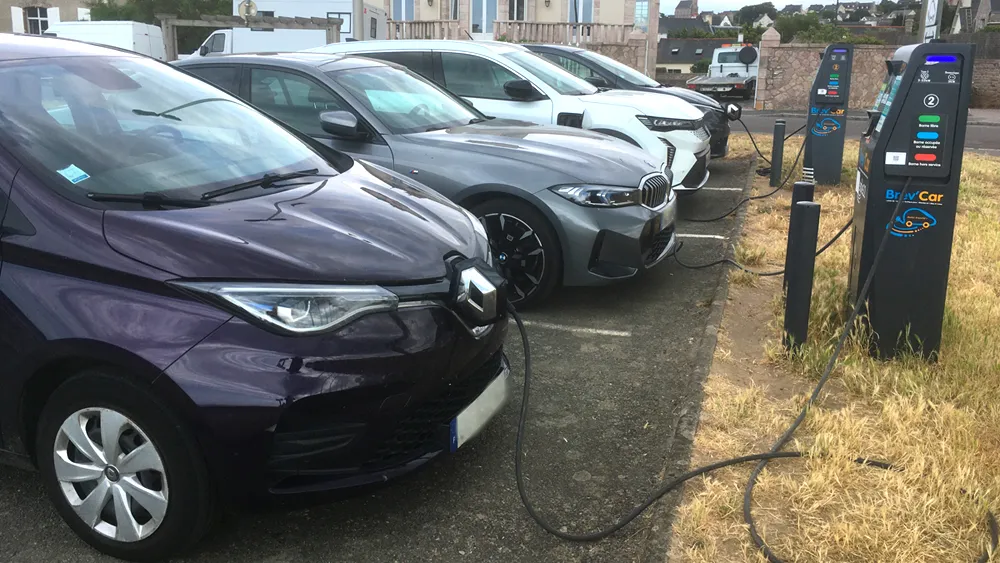
As of the end of September 2026, Avere-France reports 202,804 charging points for electric vehicles available in public spaces. This represents a 12.75% increase from the same month last year, when 179,876 such points were recorded.
A brief look at highway charging
In partnership with the Ministry of Ecological Transition, Avere-France has been publishing a barometer on electric vehicle charging infrastructure (IRVE) for five years now. The October 2026 report specifically highlights those available on highways. This is indeed valuable information. Why?
Simply because the massive investment in developing charging stations along these high-speed routes has clearly given many more drivers confidence to switch to electric vehicles. From there, the versatility became undeniable—electric cars can be used just as well for short daily trips as for longer journeys, especially for vacations. This also applies to professionals who sometimes travel several hundred kilometers a day.
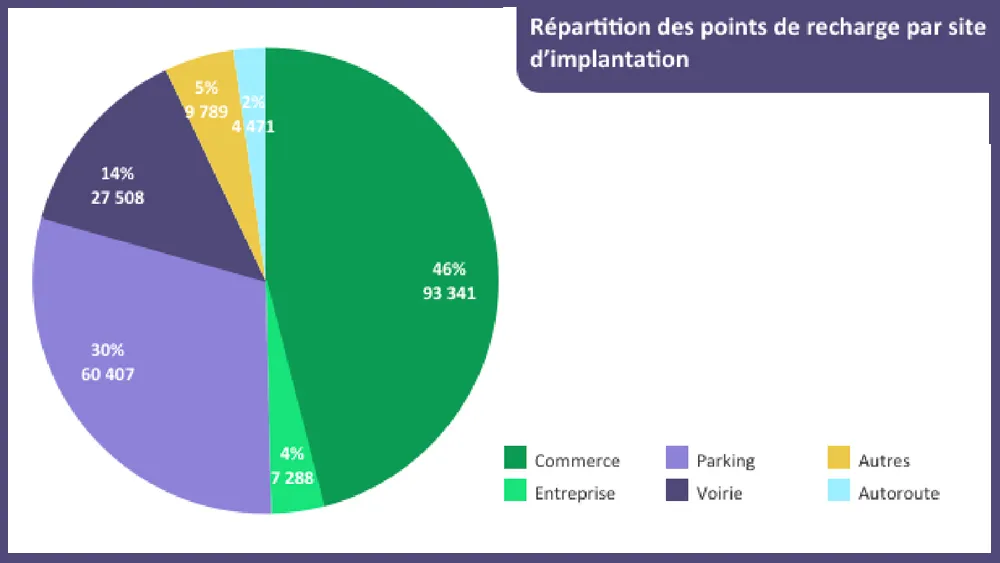
Yet, of the 202,804 charging points installed in public spaces, those on highways account for only 2.2%, totaling 4,471 units. This may seem small, but we must not forget all the chargers located near exits that are not included in these figures. We’re thinking particularly of Tesla superchargers, but there are also an increasing number of areas where multiple operators operate within a radius of sometimes less than one or two kilometers.
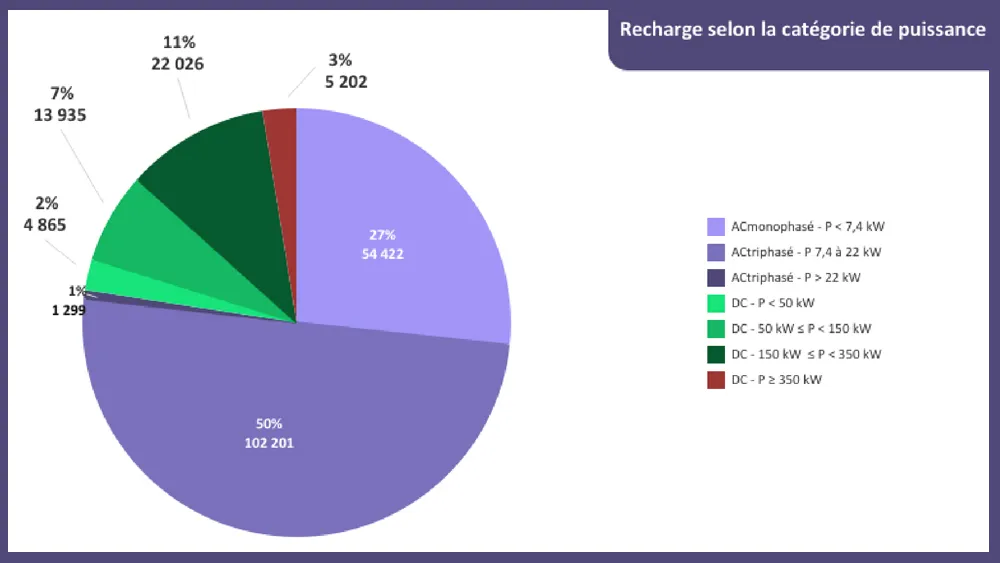
Over 50% of PDRs are three-phase AC chargers
Charging stations are mostly located around businesses. As of the end of September 2026, they accounted for 46% with 93,341 units, compared to 80,238 units (45%) during the same period in 2025. Next are charging stations installed in parking lots (60,407 units, 30% in 2026 / 50,784 units, 28% in 2025); on roads (27,508 units, 14% in 2026 / 29,612 units, 16% in 2025); and within businesses (7,288 units, 4% in 2026 / 6,957 units, 4% in 2025).
It should be noted that several of these other categories are inevitably affected by the concentration of charging stations available on highways. With advancements in electric vehicle charging capabilities and battery energy storage, charging stations are evolving accordingly. For example, those with single-phase 7.4 kW AC charging have decreased from 58,463 units accounting for 32% at the end of September 2025 to 54,422 units accounting for 27% this year.
Growth almost everywhere
Although the growth of PDRs in France is slower this year, at 12.75% compared to 20% between 2024 and 2025, an interesting threshold has just been surpassed. There are currently an average of 301 charging points per 100,000 inhabitants, up from 267 at the end of September 2025. An increase in charging points is expected across France.
There are, however, a few exceptions. Corsica, for example, saw its PDR count drop from 1,130 at the end of September 2025 to 1,056 this year. The same trend is observed in Réunion (from 508 to 497 PDRs) and French Guiana (from 31 to 27). Yet Corsica differs from these two overseas regions in that it still experiences growth in installed charging capacity, rising from 31,494 to 36,035 kW.
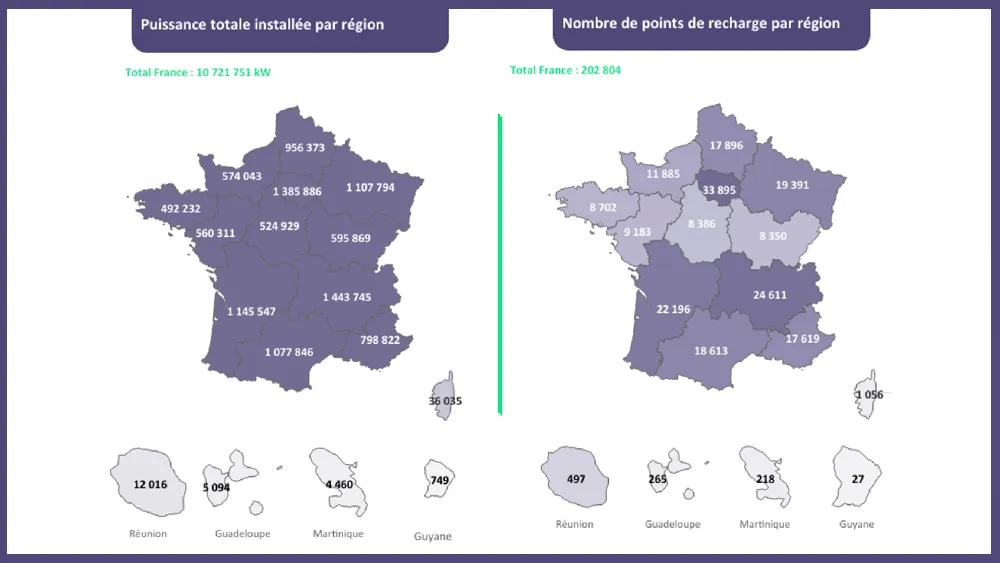
The three regions with the highest number of charging points are still Île-de-France (33,895 PDR), Auvergne-Rhône-Alpes (24,611 PDR), and Nouvelle-Aquitaine (22,196 PDR). In mainland France, the three regions with the fewest charging points are Centre-Val de Loire (8,386 PDR) and Bourgogne-Franche-Comté (8,350 PDR), which have swapped places compared to last year. Brittany follows with 8,702 PDR.
More in demand charging points
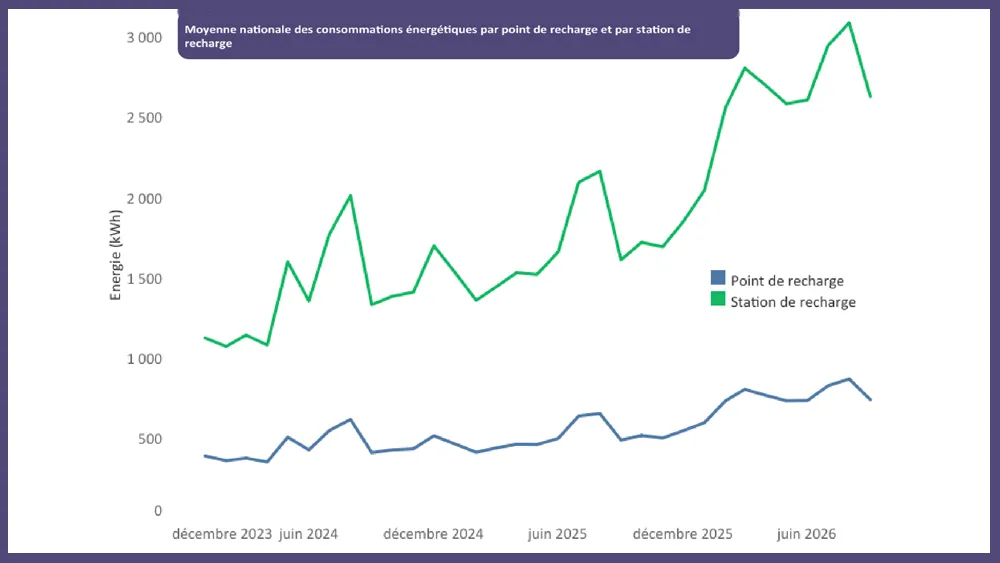
The growth of electric vehicles is also evident in the sharp increase in total energy consumption at charging stations in France. For example, it was 85 GWh in September 2025. With 147 GWh last month, Avere-France’s data shows a rise of nearly 73%. It can be inferred that charging stations where new installations have not kept up in number have been under greater strain.
Last September, an average charging station recorded 25.2 sessions per month, consuming 474 kWh, which means an average of 18.81 kWh per session. In September 2026, the average number of sessions per station rose to 32.7, with consumption soaring to 725 kWh, resulting in 22.17 kWh per session.
This has led to declining availability rates: 89.9% for AC fast chargers this year compared to 92% in 2025, 85.2% for DC fast chargers with power below 150 kW (92.2% in 2025), and 88.3% for DC fast chargers with higher maximum power (95.7% in 2025).
Similarly, the probability that an electric vehicle driver can immediately access a charging station dropped from 95% to 93% in September, which seems not particularly concerning on paper. However, these figures indicate that during peak hours, delays may become more frequent.