
Automated by the city: Mercedes launches new assistance system
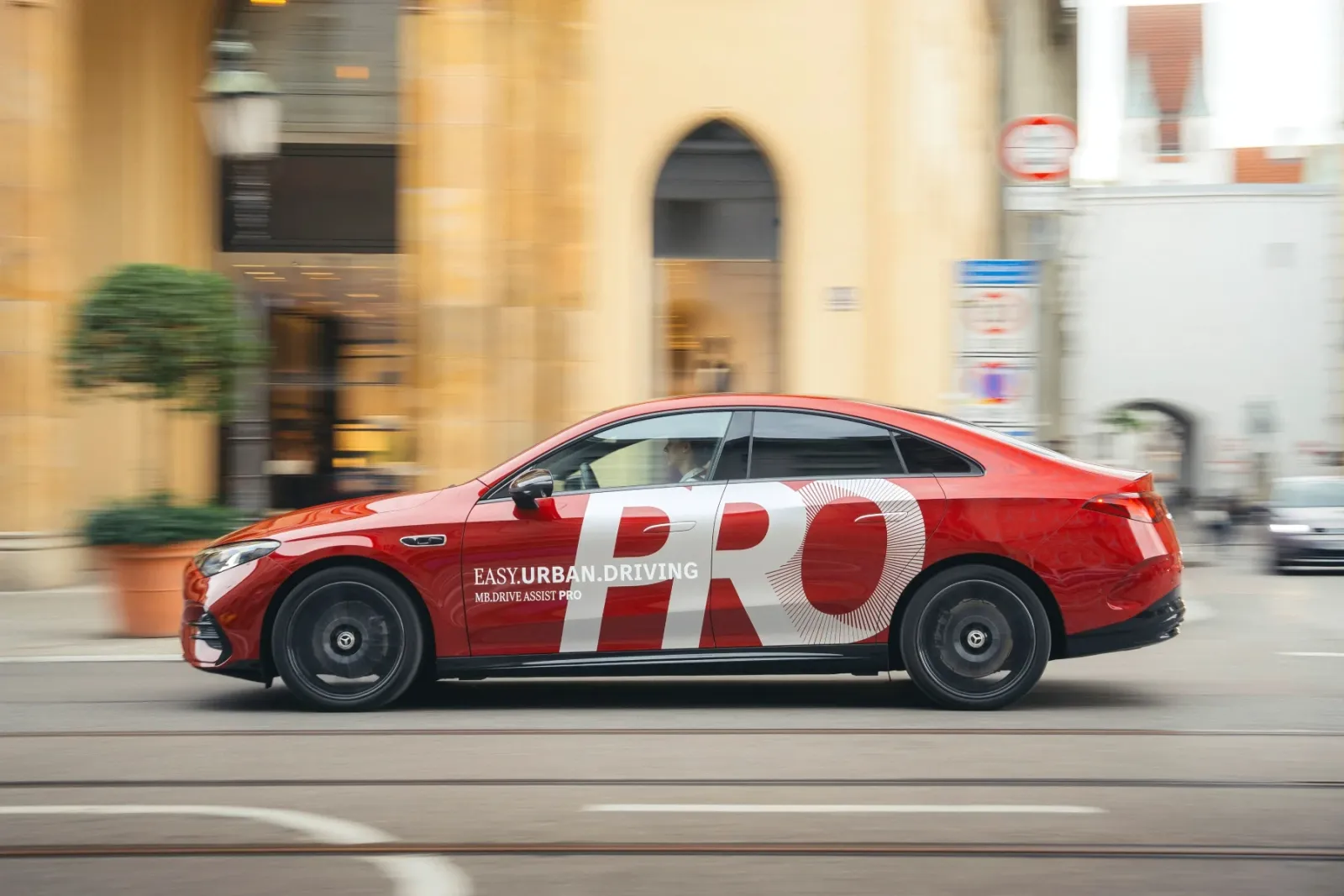
Mercedes-Benz is now introducing its MB.Drive Assist Pro system in Germany as well. With this, Mercedes becomes the first automaker to offer enhanced urban partial automation at SAE Level 2 not only in China and the U.S. but also in Germany. Customers with compatible models can test the feature for free for one month.
Image: Mercedes-Benz
In early 2026, Mercedes-Benz introduced the MB.Drive Assist Pro system at CES in Las Vegas, with its launch in the U.S. set to occur soon. Now, the manufacturer has announced the so-called extended urban partial automation driving at SAE Level 2 for Germany as well, significantly expanding the assist functions already in use on highways.
Specifically, MB.Drive Assist Pro is designed to assist with door-to-door driving in urban areas, including merging into traffic, changing lanes, turning, braking, and accelerating at traffic lights. The driver remains fully responsible for monitoring the road and operating the vehicle. This represents an advancement in Level 2 automated driving, which has been available in Germany for several years already.
Existing customers can obtain these new features via over-the-air update in the future, provided their vehicle meets the necessary technical requirements. The price at which Mercedes will offer MB.Drive Assist Pro remains unknown. In the U.S., the manufacturer has announced a subscription model priced at $3,950 (approximately 3,520 euros) for three years. In Germany, customers are expected to receive a free trial month to test the system.
First deployment of MB.Drive Assist Pro starting at the end of 2026
Starting from the end of 2026, selected customers with compatible models are expected to benefit from these new features, as Mercedes plans to launch the system ahead of schedule in Stuttgart and Munich. According to Mercedes, these selected individuals will be notified separately and receive the update for their respective vehicles. By leveraging these initial customer experiences, the automaker aims to incorporate new insights into the continuous improvement of the system.
The approval of this system in Germany is enabled by the regulations set forth by the UNECE Working Party on Automated/Autonomous and Connected Vehicles. The new regulation UN R171 establishes the relevant provisions and safety requirements that vehicles equipped with driver assistance systems must comply with. Mercedes-Benz can utilize this framework for the future EU-wide rollout of MB.Drive Assist Pro without additional individual approvals. In this regard, Mercedes-Benz is in a head-to-head competition with Tesla, as the company is also striving to bring a door-to-door automated driving system to the German market.
The hardware of the urban Level-2 system includes 27 sensors (ten cameras, five radar sensors, twelve ultrasonic sensors) and a computer with up to 254 TOPs (Trillion Operations Per Second). The software architecture combines the MB.OS operating system with NVIDIA Hyperion, the Halos security system, and the Alpamayo software.