
Used electric cars: okay, now the price is (more) reasonable

Used electric cars lose value more slowly than estimated by current market benchmarks. According to a new analysis by Transport & Environment (T&E), the residual value gap between a BEV and a conventional car can shrink to 2.6 percentage points, down from 12.9 percentage points observed in sales data for 2025 across the four major European markets. This difference also directly affects leasing and financing costs, and in Italy, it is exacerbated by tax policies that are still not closely tied to emissions levels.
Faster depreciation for used electric cars
The residual value, that is, what remains of a car’s price after several years of use, is a key factor in determining the costs of leasing agreements and financing options. An overly cautious assessment of this value can artificially increase the cost of accessing an electric vehicle, affecting both the adoption of BEVs and the subsequent availability of used cars.
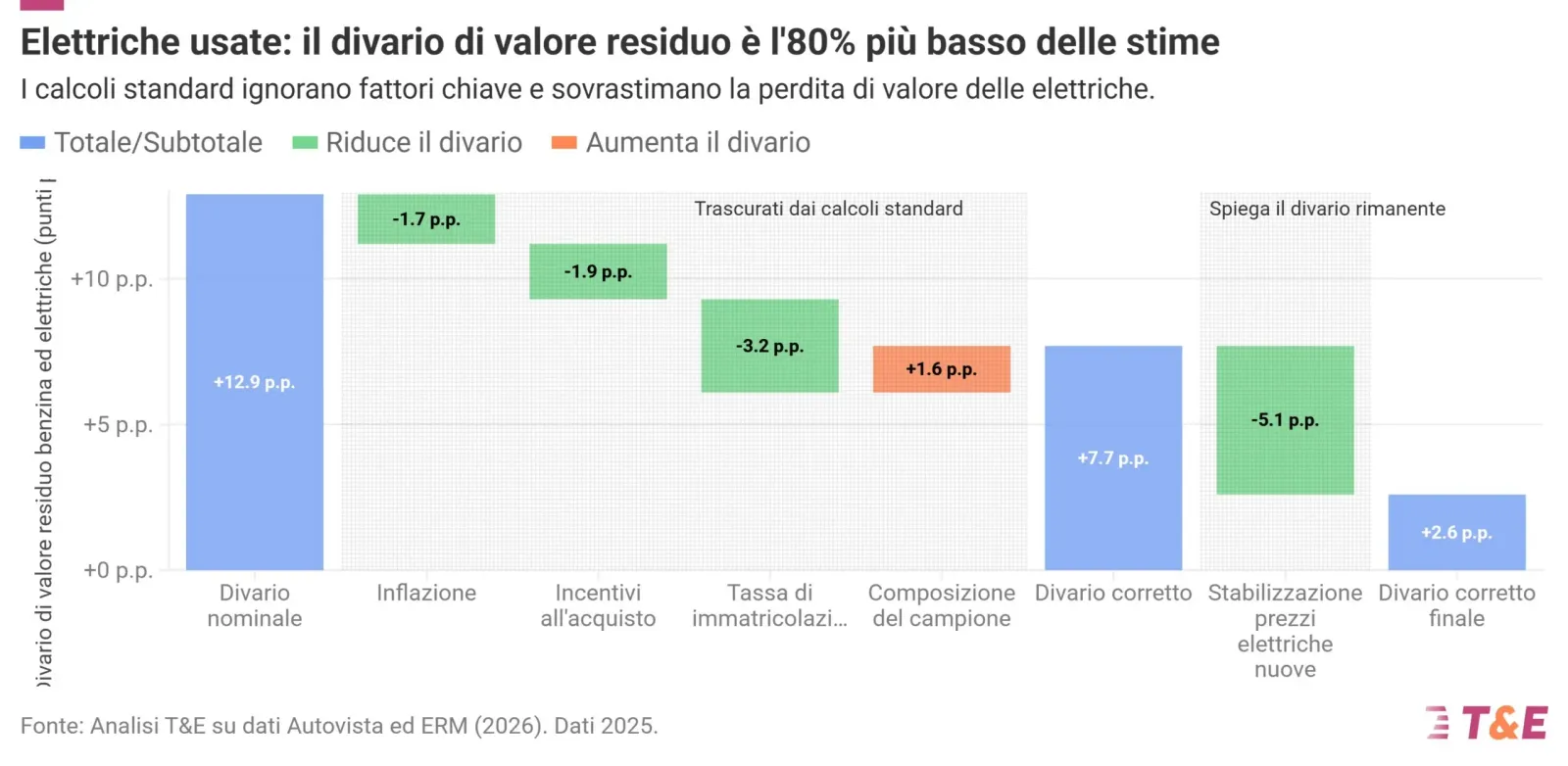
Five factors that affect residual value calculations
T&E’s analysis challenges the standard method used to assess the depreciation gap between electric vehicles and internal combustion engine cars. According to the organization, standard estimates fail to adequately account for five variables: inflation, purchase incentives, registration taxes, the composition of the sample used for comparisons, and the price trends of new electric vehicles.
The first three factors tend to narrow the gap between the two technologies, while the sample composition—which takes into account factors such as vehicle age, mileage, and segment—slightly widens it.
The decline caused by falling prices of new electric vehicles, as seen in the trend over the past 5 years, has an additional impact on used vehicle prices (-5.1 points), reducing the final gap (the difference in depreciation between the two technologies) from 12.9 to 2.6 percentage points: a reduction of about 80%.
Italy is the country where the gap narrows the least
The situation changes significantly when looking at individual countries. Among Germany, France, Italy, and Spain, Italy is the one where taxation contributes the least to narrowing the residual value difference between electric vehicles and internal combustion engine cars.
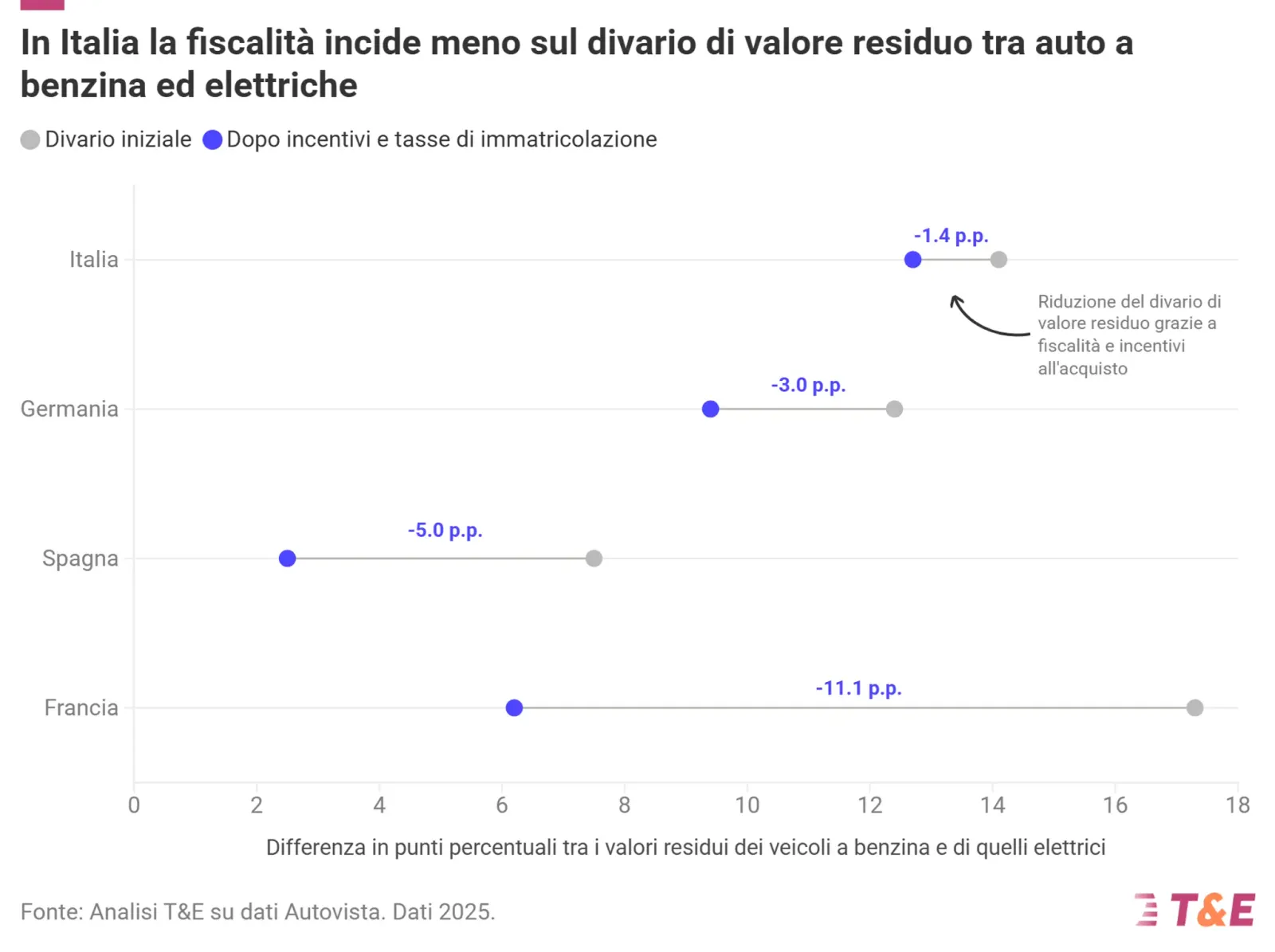
According to T&E, incentives and registration taxes reduce the gap by just 1.4 percentage points in our country. In Germany, the effect is 3 points, in Spain it’s 5 points, and in France it’s 11.1 points.
The difference mainly depends on how vehicle taxation is structured. In France, for example, the registration tax imposes a greater penalty on higher-emission vehicles, and on its own, it accounts for 9 percentage points according to the analysis.
Why residual value matters even for electric vehicle buyers
For T&E, the issue is not just statistical. An overly low estimate of residual value can lead to higher leasing costs, making an electric vehicle less attractive compared to what it would be based on its actual performance in the used car market.
Another key factor mentioned is the battery. Standardized metrics for assessing battery health could boost confidence among buyers of used BEVs and increase transparency in the market.
Corporate fleets can fuel the used electric vehicle market
This issue is closely related to Italy’s corporate car market. According to data cited by T&E, fleets account for around 47% of vehicle registrations in Italy but nearly 70% of new car CO₂ emissions. Additionally, corporate vehicles are typically replaced after three to four years, ending up in the used car market.
This leads to the proposal of tying corporate vehicle taxes more closely to emissions by adjusting VAT, deductions, fringe benefits, and registration fees.
Esther Marchetti, Clean Transport Advocacy Manager at T&E Italia, argues that emission-based taxation could bring the residual value of electric vehicles even closer to that of gasoline cars. T&E also calls for stable regulations, starting with the European proposal on decarbonizing corporate fleets.
More electric vehicles for families and public sectors
An increased supply of BEVs from fleets could help create a larger and more predictable used electric vehicle market. According to T&E, part of the funds generated from tax reforms could be allocated to supporting the purchase or leasing of used electric vehicles by lower-income families.
The public administration could also become a buyer of these vehicles through green procurement, providing a market outlet for cars that have been used in corporate operations for the first time.
The issue of residual value thus becomes crucial not only for leasing companies and fleets but also for the entire adoption process of electric vehicles: more BEVs in fleets today can mean more used electric cars available tomorrow, offering a potentially more affordable option even for those who cannot afford a new car.
READ ALSO: “Why aren’t electric cars taking off in Italy? According to Daze…” and watch the VIDEO
