
Electric cars: The EU accelerates (but not too much). Italy? 6 years behind.
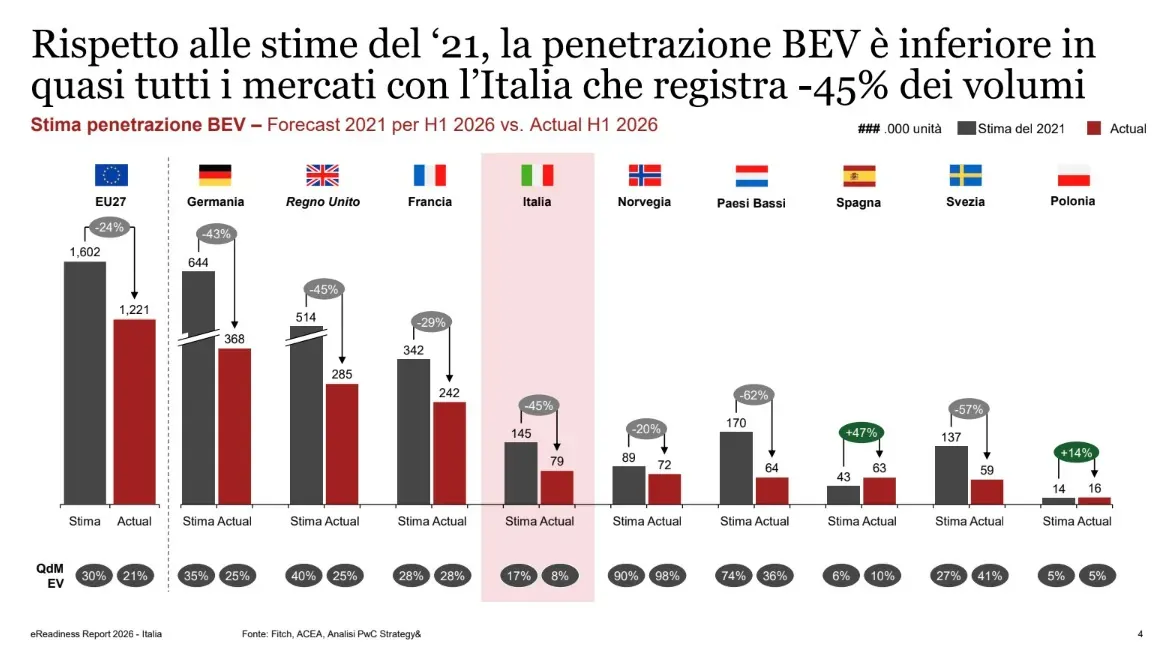
The electric car market in Europe is accelerating, but it is falling behind the targets set for 2021. Italy is progressing even more slowly. Yet two of the main historical barriers to purchase are beginning to diminish: in the utility vehicle segment, prices for electric and conventional models are now aligned, and the average range of new BEV models has increased by 11%. Two obstacles remain: the difficulties and costs associated with public charging.
41% Electric in France, a Puzzle for Manufacturers
The gap with Europe is widening
This picture emerges from the seventh edition of PwC Strategy’s eReadiness 2026 study, conducted through approximately 19,000 interviews in 31 countries. According to the analysis, Italian electric car registrations are currently 45% lower than the projections made in 2021.
If the current trajectory remains unchanged, Italy will reach its 2030 emission reduction target about six years late. The situation is even more concerning regarding zero emissions: the goal set by the European framework for 2035 would only be achieved in our country at that time if the current rate of electrification continues.
However, there is a potential demand. 59% of Italian respondents say they are willing to buy an BEV within five years, while 39% would do so within two years. The main reasons cited are lower driving costs, mentioned by 65%, and the ability to charge at home, chosen by 46%.
Prices and range change the landscape
Between 2023 and 2026, the average price of the top ten electric models in this segment dropped by 28%, while the prices of corresponding internal combustion engine models rose by around 8%.
Range is also moving in the direction expected by the market: the average WLTP range of new electric vehicles increased by 11% compared to models launched in the 2024-2025 period.

"The significant improvement in price and range of electric vehicles is an important signal, as it addresses exactly the two factors that have hindered mass demand in the utility vehicle segment for years — a segment that remains at the heart of the Italian market," says Francesco Papi, Partner at PwC Strategy & Automotive Leader.
The problem is no longer just the purchase price or battery capacity. For a growing number of drivers, the issue has become the daily usability of electric vehicles, especially when there is no home charging facility.
Little sales of electric cars in Italy? The Renault version
Charging stations remain the weak point in Italy
It is precisely in public charging that Italy exhibits one of the most significant shortcomings. Among the five major European markets analyzed – Italy, Germany, France, the United Kingdom, and Spain – our country ranks last both in terms of high-power infrastructure availability and in the ratio of charging stations to vehicles on the road.
Charging stations with over 150 kW account for 8% of the total, compared to an EU-5 average of 12%. The overall ratio is 2 charging stations per 1,000 vehicles, whereas the average for these five countries is 3.5.
65% of electric vehicle owners still charge primarily at home or in the office. Satisfaction with public charging has declined: the NPS dropped from 60 to 51 points in one year. Reported issues include the location of charging stations, their availability, and especially their actual functionality.
The regional disparity remains significant: there are 1.3 charging points per 1,000 vehicles in the South, compared to 2.6 in the North.
Robotaxi: Italians Are More Ready Than the Market
The study also covers autonomous mobility. 75% of Italians surveyed say they are willing to use an autonomous driving service. This interest turns into concrete enthusiasm for robotaxi: 44% would use such a service for short urban trips, and over 40% would be willing to pay more than a traditional taxi.
The results reveal a curious asymmetry: while the adoption of electric cars is progressing slowly, interest in certain technologies that could support their development is already high.
For Italy, however, the main challenge remains transforming theoretical willingness to purchase into actual demand. Prices and range are reducing two historical obstacles, but infrastructure, charging reliability, and purchasing affordability continue to influence drivers’ decisions.
READ ALSO: Autotorino: “Electric cars are irreversible—now it’s infrastructure and trust” and watch the VIDEO
Previous Article
Free Wallbox? No subsidies for charging stations
