
Audi relies on “two brands, two partners” in China.
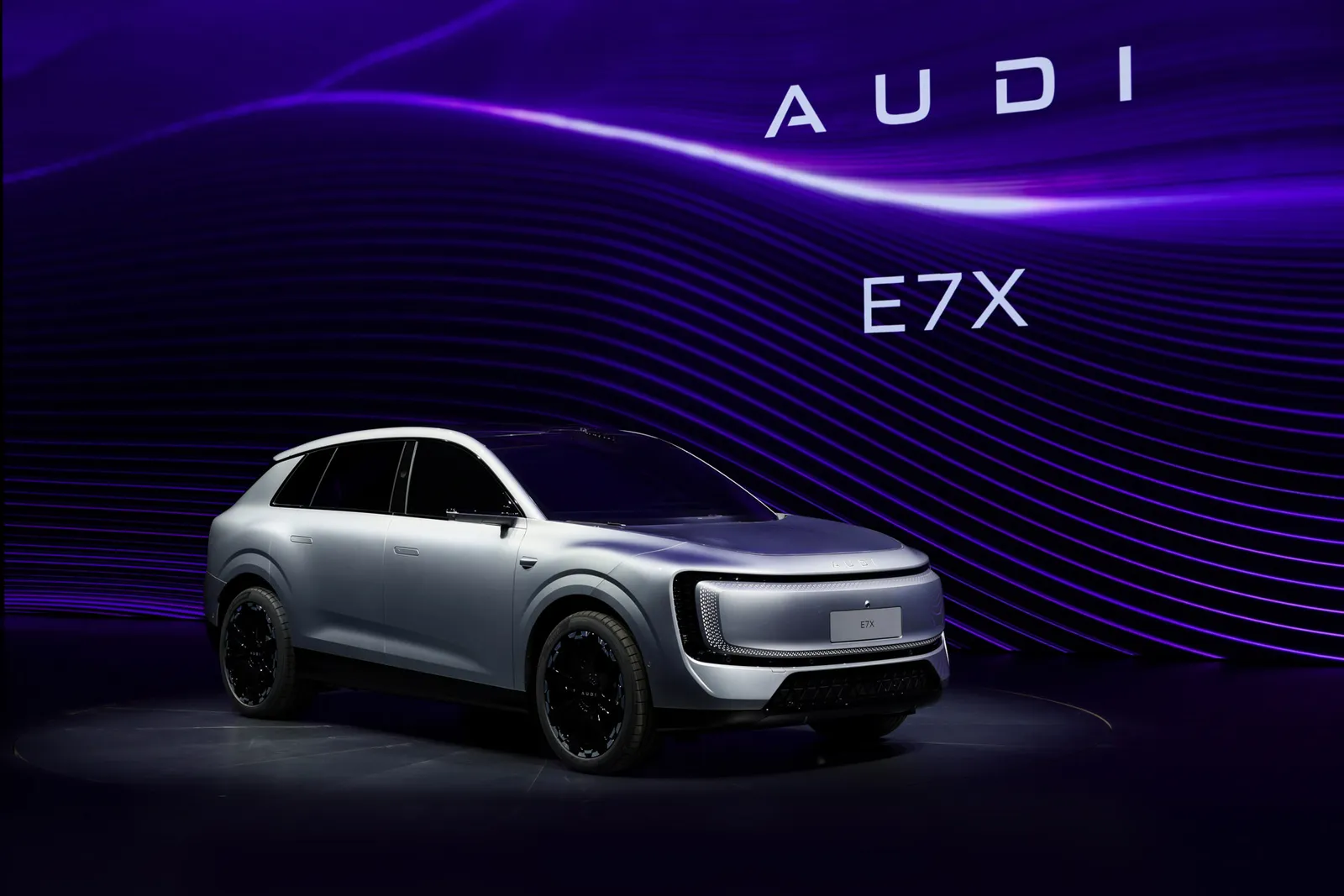
Audi is reorganizing its joint ventures in China, adopting a “two brands, two partners” strategy going forward. The joint venture with SAIC will focus exclusively on the new AUDI subbrand (without rings), while sales of vehicles with four rings will be handled through the joint venture with FAW.
Audi’s Chinese electric vehicle AUDI E7X
Image: Volkswagen
We reported earlier in September that such a move might occur. Now Audi’s new China strategy is official: The company announced on the Chinese social media platform WeChat that it has signed new agreements with its long-standing Chinese partners FAW and SAIC Motor. These aim to differentiate the positioning of the two Audi brands (with four rings) and AUDI (without rings), adjust strategies, and restructure sales accordingly.
The new approach is guided by the motto “two brands, two partners”: while the joint venture with FAW, established in 1988, focuses on the classic brand with the four Audi rings, the company formed with SAIC in 2021 is entirely dedicated to the new AUDI brand (in uppercase, but without rings) to be launched in 2025. This setup aims to enable both brands to target the Chinese market more swiftly and accurately in the future.
AUDI (without rings) focuses on electric vehicles
AUDI, which has often been referred to as a sub-brand, along with SAIC — which has already introduced two models, the electric station wagon E5 Sportback and the E-SUV E7X — plans to continue offering only electric vehicles or New Energy Vehicles (NEVs). With the official opening of the AUDI Innovation Tech Center (AITC) in Shanghai, dedicated exclusively to the AUDI brand, both parties aim to further deepen strategic synergy and cooperation across the entire value chain of future vehicles.
According to media reports, SAIC-Audi had already drastically reduced or even completely halted production of four-ring models with internal combustion engines such as the A5L Sportback, A7L, and Q6. SAIC-Audi will no longer be responsible for these models going forward. However, it will remain active in selling four-ring models until the end of 2027 and will continue to provide after-sales support beyond that period.
On the other hand, FAW-Audi is expected to continue producing both premium vehicles with internal combustion engines and new energy vehicles. Under the joint venture, Chinese versions of long-wheelbase electric models from the PPE series will also be developed, specifically the Audi A6L e-tron and Q6L e-tron.
Johannes Roscheck, outgoing president of Audi China, says, “Implementing the two-brand strategy helps local partners deliver top-quality products and experiences to Audi customers. With a clearer strategic focus and differentiated brand positioning, we are laying a solid foundation for Audi’s long-term and sustainable development in China.” In November, Roscheck will be replaced as president of Audi China by current Chery manager Jeff Zhang.
Achieving Shared Progress
FAW CEO Liu Yigong states, “In the future, FAW Audi will adhere to the ‘customer-centric’ development concept, continuously implement the strategy of ‘shared progress among internal combustion engines, hybrids, and fully electric vehicles,’ and meet the diverse needs of users across all areas.”
SAIC President Jia Jianxu added, “The Chinese automotive industry is at the forefront of global intelligent electric innovation. What SAIC needs to do is truly integrate the advanced industrial ecosystem, technology system, and Audi’s luxurious heritage. The AUDI brand carries the mission of establishing a new model of joint venture cooperation, building on the solid foundation of ‘leadership through technology’ to further strengthen Audi’s competitive edge in the Chinese market.”