
Audi A2 e-tron: How inverters, electric motors, and gearboxes make it more efficient
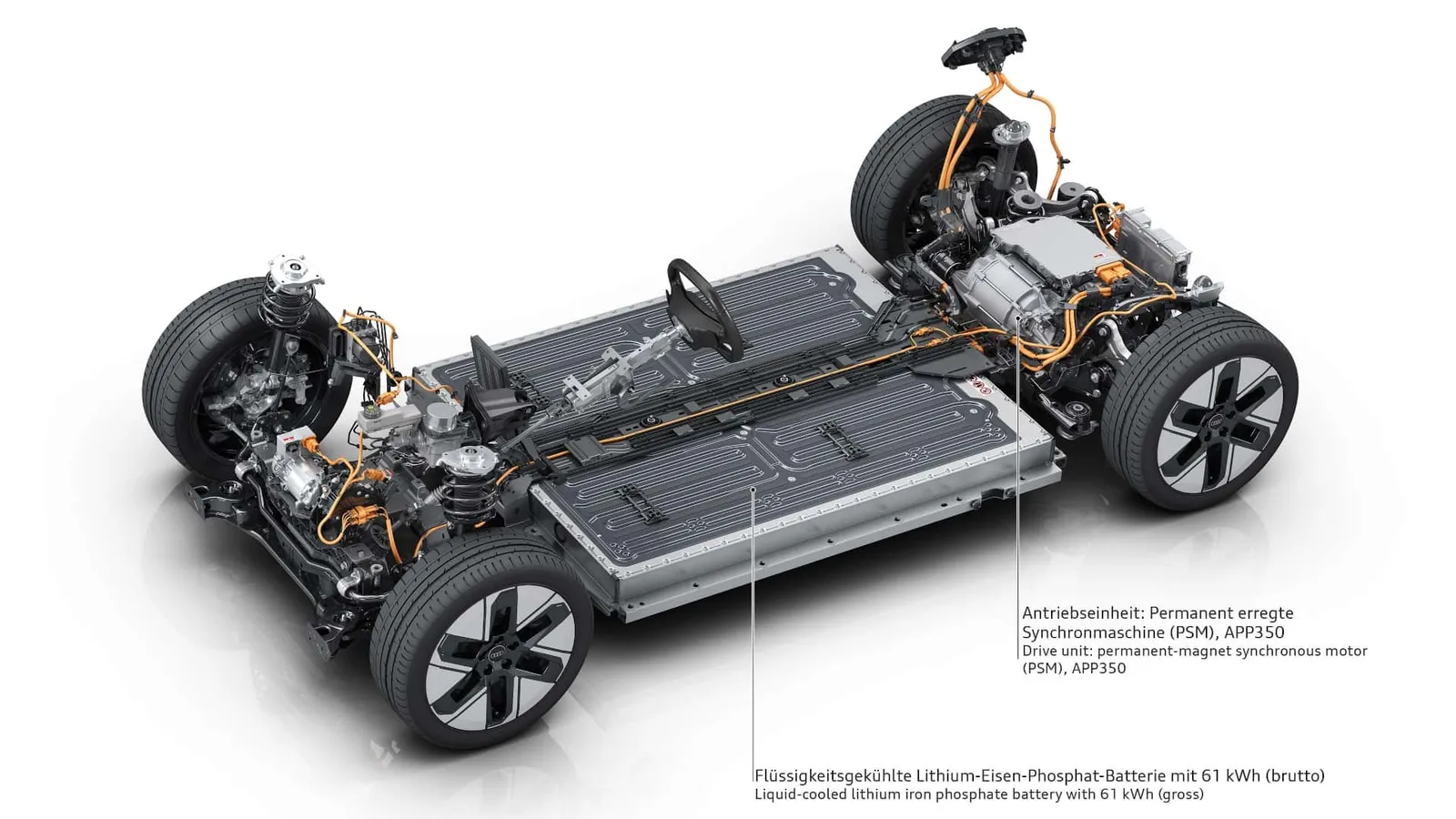
The new Audi A2 e-tron uses only 12.8 kWh/100 km in the most fuel-efficient version according to the WLTP cycle. This makes it one of the most economical electric cars available. It was already known that silicon carbide inverters play a role in this efficiency. Now, the manufacturer explains additional details.
The record-low consumption is achieved in the Audi A2 e-tron with a 140-kW rear drive system and the optional efficiency package costing 2,410 euros. This package includes a lowered suspension via a sport chassis and tires optimized for rolling resistance. The new drive system also contributes to this efficiency. The improvements involve the inverter, the APP350 electric motor (axial parallel configuration with around 350 Nm of torque), and the single-speed gearbox.
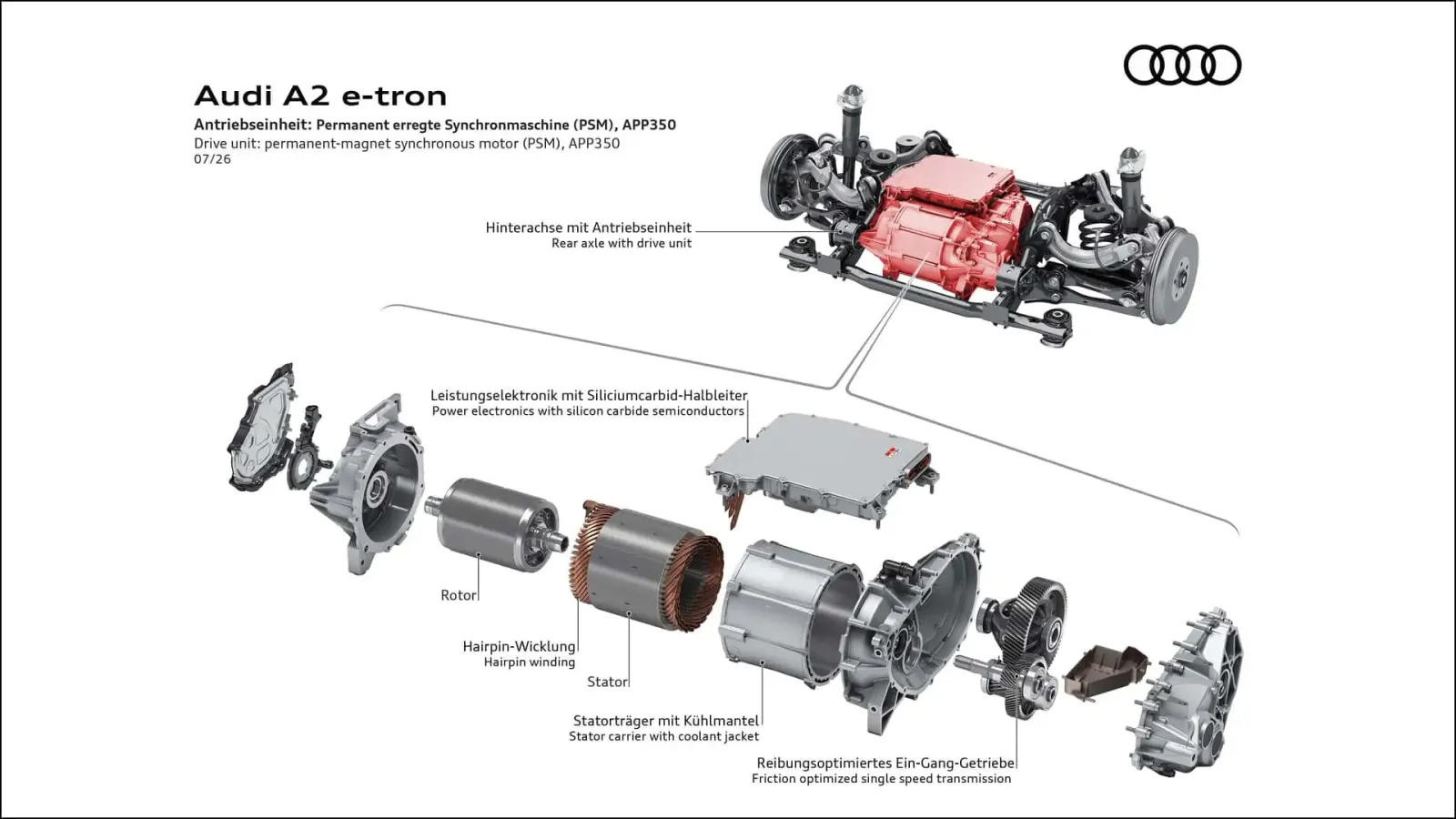
The rear axle of the Audi A2 e-tron, including the inverter, APP350, and input gearbox
Image source: Audi
Inverter
The inverter converts the direct current from the battery into alternating current for the motor. This involves transforming a direct voltage of around 400 volts into a sinusoidal voltage. Pulse width modulation is used for this purpose: the polarity is continuously reversed, for example from +400 volts to -400 volts and back. By varying the width of these voltage pulses, a sine wave is generated (after smoothing through the inductance of the copper windings).
Transistors are used for switching, and this process inevitably generates so-called switching losses. However, these can be reduced using metal-oxide-semiconductor field-effect transistors (MOSFETs) based on silicon carbide instead of silicon. According to Audi, lower switching losses enable efficiency levels of over 97 percent to be achieved.
What’s new is that Audi also employs specialized software to adjust the switching frequency to the specific operating conditions. The switching frequency is set as low as possible, as fewer switching operations mean less loss. Audi states that this should bring efficiency benefits, especially in urban driving and long-distance travel at moderate speeds and loads. By making better use of energy, the power electronics can also deliver full performance even when the battery level is low.
Audi states that another function of the inverter is to improve noise comfort inside the cabin. This is achieved by deliberately adding “high-frequency harmonic components” to the motor current, thereby compensating for distracting noises depending on operating conditions.
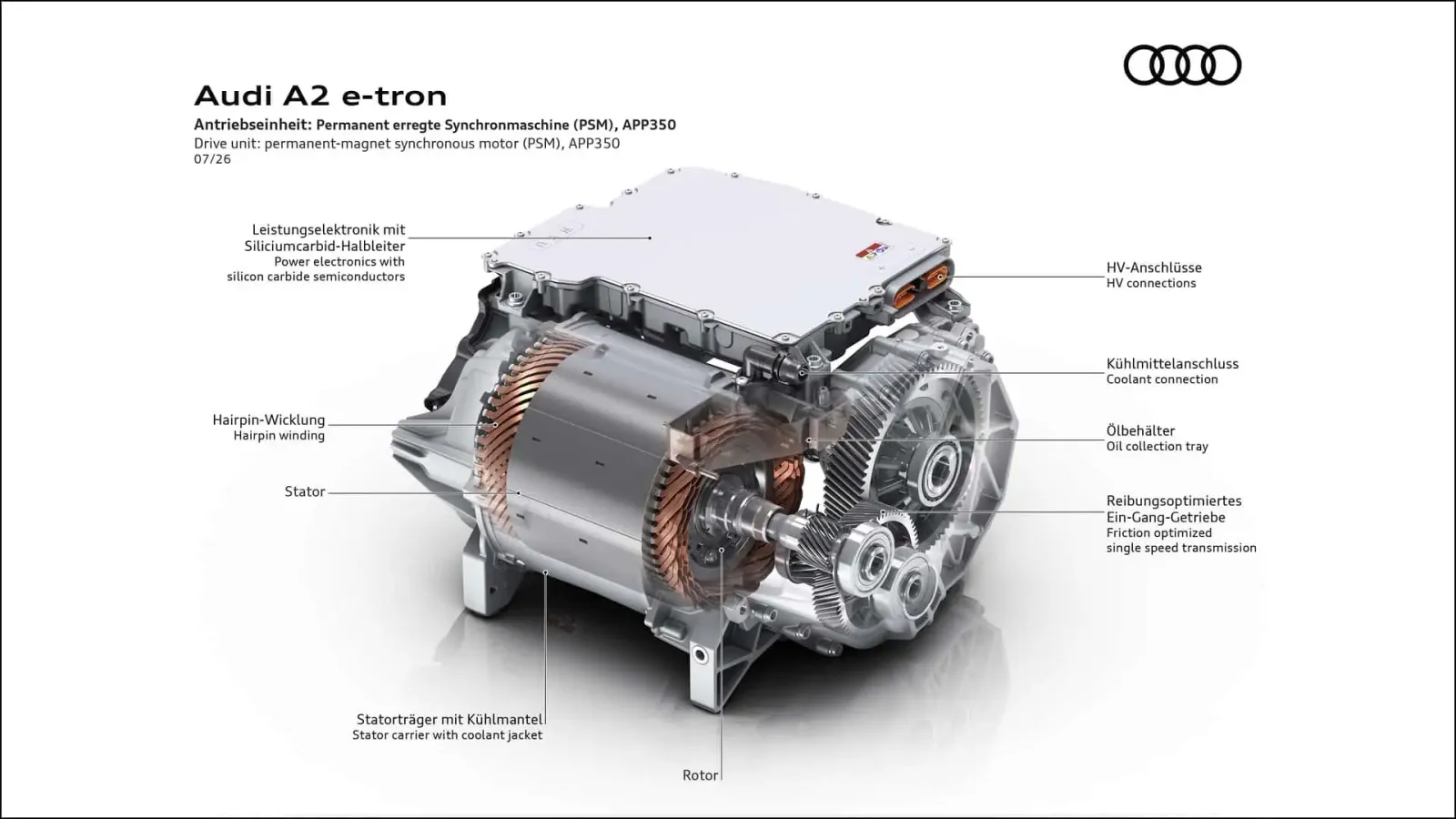
The new APP350 electric motor with inverter (top) and gearbox (right)
Image by: Audi
Electric motor APP350
The efficiency of the new permanent magnet synchronous motor APP350 has been improved through reduced iron losses. These losses occur due to the remagnetization of the material in time-varying magnetic fields: Since the magnetic field in an electric motor constantly changes, the small magnetic regions (the Weiss regions) in the rotor laminations must continuously realign. This process requires energy, which is ultimately converted into heat. To reduce these losses, the thickness of the rotor laminations was decreased from 0.3 millimeters to 0.2 millimeters compared to the previous model, the APP310.
"The design changes to the rotor and stator involve the thickness of the laminations, the arrangement of the rotor segments, and the wiring of the stator windings." (Audi)
To improve the noise level, the permanent magnets in the rotor were also rearranged. When the magnets are arranged in a straight, continuous line from front to back, they suddenly encounter the slots of the stator as it rotates. This creates a magnetic impact (a locking moment) with each pass. In the APP350, the magnets are instead installed at slight offsets (rotor skewing or staggering). This way, they no longer all encounter the stator’s magnetic field at the same time, but at staggered times, which improves the acoustic performance.
In addition, the stator configuration is changed from star to delta. Furthermore, the number of parallel branches per phase has been reduced. This increases copper losses at high speeds but reduces the so-called circulating currents under partial load. This is intended to improve efficiency during everyday driving in urban areas or on rural roads.
Transmission
The improvements to the transmission are easier to understand than those in the engine. Here, two gear ratios are used depending on the power level: 10.21 at 125 kW and 140 kW, and 11.53 at 170 kW. This means that weaker versions use a longer gear ratio, which reduces the required engine RPMs—the engine rotates 10.21 times per wheel rotation instead of 11.53 times in the more powerful version. According to Audi, these different gear ratios help keep the engine RPMs in optimal ranges.
Audi does not provide information on the gear ratio for the top-tier A2 e-tron model with 240 kW, but this version uses the APP550 instead of the APP350.
In addition, a transmission oil with very low viscosity is used, which reduces so-called splashing losses. A special process for fine finishing of the gear teeth is also employed, allowing for particularly smooth surfaces. This reduces friction and increases efficiency.
More on the efficiency of electric drives:
In summary
Phew, Audi’s new press release about the A2 e-tron’s drive system is quite impressive. We’re sure we didn’t understand everything completely; one would need an engineering degree for that. We hope experts will explain it to us a bit better at the upcoming test drive event.