
Audi A2 e-tron starting at 38,200 euros. Its record-breaking 12.8 kWh/100 km has its downsides.
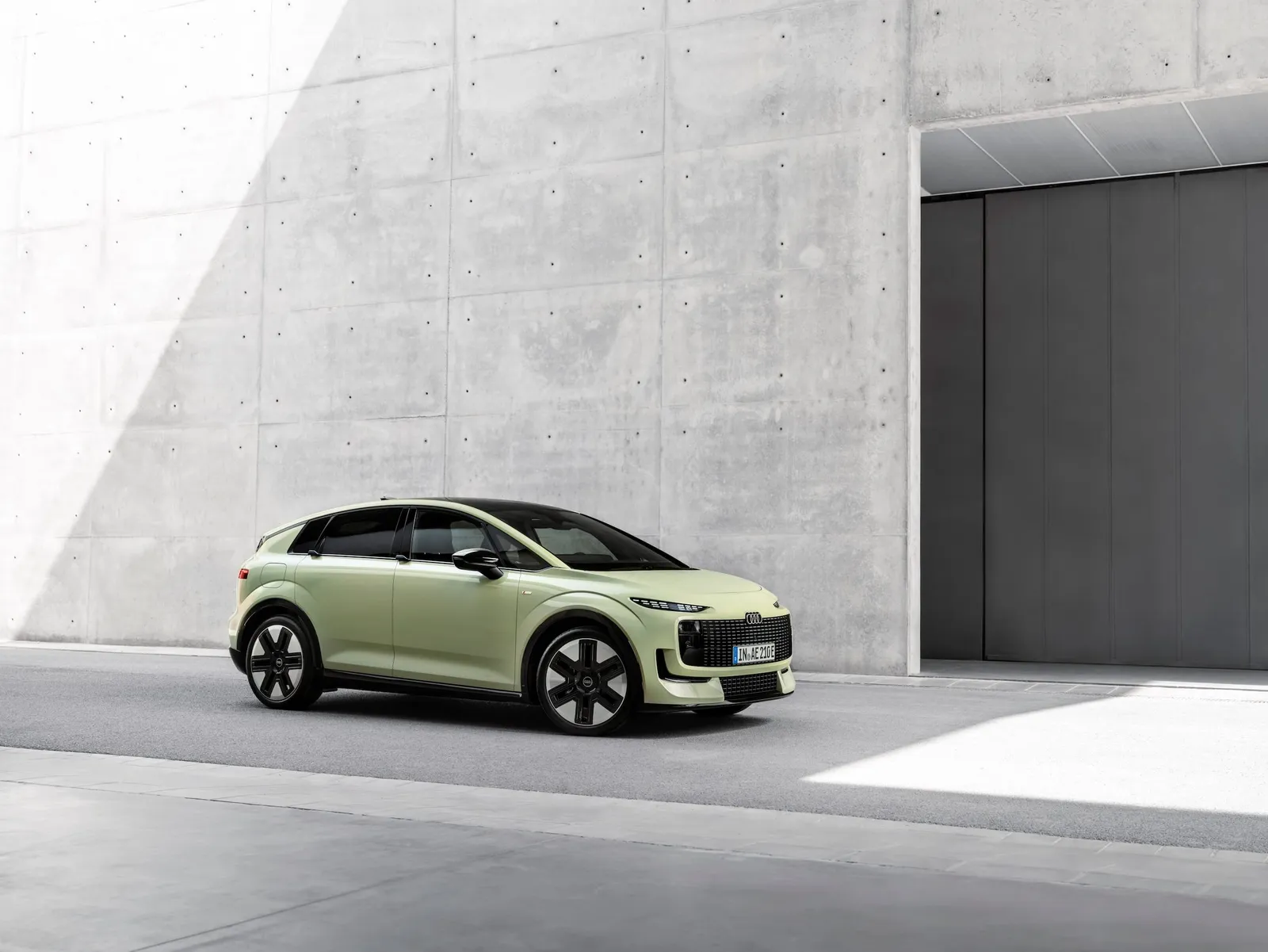
Audi unveiled the A2 e-tron, an electric compact car based on the MEB+ platform with rear-wheel drive, priced at 38,200 euros and offering a WLTP range of up to 646 km. Orders in Germany will open on September 10, with first deliveries scheduled for December 2026. The lowest energy consumption in Audi’s lineup sounds impressive, but it applies to a specific version and requires the Efficiency package as well.
Table of Contents
Show
Hide
Three batteries, four power levels, and one version for the brochure
The Audi A2 e-tron will come with three batteries having a gross capacity of 52, 61, and 84 kWh, which translates to approximately 50, 58, and 79 kWh net. In addition, there are four power variants, all with RWD drive: ranging from 125 kW and 350 Nm in the base version to 240 kW and 545 Nm at the top of the range.
The cheapest version has a battery of 52 kWh gross and an engine of 125 kW/170 HP. In Germany, it starts at 38,200 euros, which translates to around 170,200 zł when simply converted. We don’t know the prices in Poland yet.
In the middle of the range is the 140 kW/190 HP version with a battery of 61 kWh gross. And this is where the marketing trick comes in: the manufacturer claims 12.8 kWh/100 km WLTP for this configuration only with the optional Efficiency package. Without it, the figure can still be very good, but it’s no longer the number mentioned in the headline.
The maximum range of 646 km WLTP is assigned to the variant with the largest battery of 84 kWh gross and an engine of 170 kW/231 HP. This makes sense. A more powerful engine usually worsens the range, so Audi didn’t try to defy physics here.
Aerodynamics help, but WLTP remains WLTP
Audi reports an air resistance coefficient of Cx 0.24. For a compact car in this class, this is an exceptionally high figure and one of the key aspects of the entire design. It’s clear that the A2 e-tron was developed using the proven formula from the original A2: it’s meant to be lightweight for the powertrain, economical for the driver, and practical for daily driving.
That said, it’s important to separate marketing claims from reality. The 12.8 kWh/100 km WLTP figure doesn’t mean 12.8 kWh/100 km on Polish highways in winter. Similarly, 646 km WLTP doesn’t equate to 646 km at 140 km/h. However, under normal mixed driving conditions, the A2 e-tron indeed has the potential to be one of the most fuel-efficient cars in the MEB+ lineup, possibly even Audi’s most energy-efficient electric vehicle.
The DC charging capacity is set at 183 kW, with a charging time from 10% to 80% ranging from 24 to 29 minutes depending on the version. This is a good level, but nothing extraordinary. It’s more about efficient commuting than demonstrating technological superiority.
The equipment is extensive, and V2H gets a geographic boost
As standard, Audi offers features such as ACC, AEB, a rear camera, an 11.9-inch instrument cluster, and a 12.8-inch central display. There’s also a rearview mirror with a camera and a Park Assist Plus system. Some parking functions, including the more advanced Park Assist Plus and memory parking, are available as options.
The door topic is interesting. The exterior handles are operated electrically, so each door has its own power source to allow them to be opened even in the event of a main power failure. It’s good that someone thought of this, as such solutions often look impressive until the first problem arises.
The A2 e-tron will support V2L, V2H, and V2G, but there’s again limited documentation. The V2H function will be available initially in Germany, Austria, and Switzerland and will require a compatible DC wallbox. No promises have been made for the Polish market yet.
Audi also claims to have shortened the development process by 21 months compared to previous models. That’s nice, but let’s remember that the car is based on Volkswagen’s existing architecture. It’s not a build from scratch, but rather an efficient refinement of a known setup.
The Audi A2 e-tron looks set to be one of the most sensible electric Audis in years, but what’s truly interesting will be how much of its advertised efficiency remains in the standard version without the Efficiency package. What do you think? At a starting price of around 170,000 zł, would it make more sense in Poland than the VW ID.3?
LovEV Newsletter
Want more content like this?
Sign up — we’ll send you a weekly summary once the newsletter starts.