
This is how Tesla Roadster’s revolutionary propulsion system works: Elon Musk adds SpaceX’s rocket engines to the electric motors.
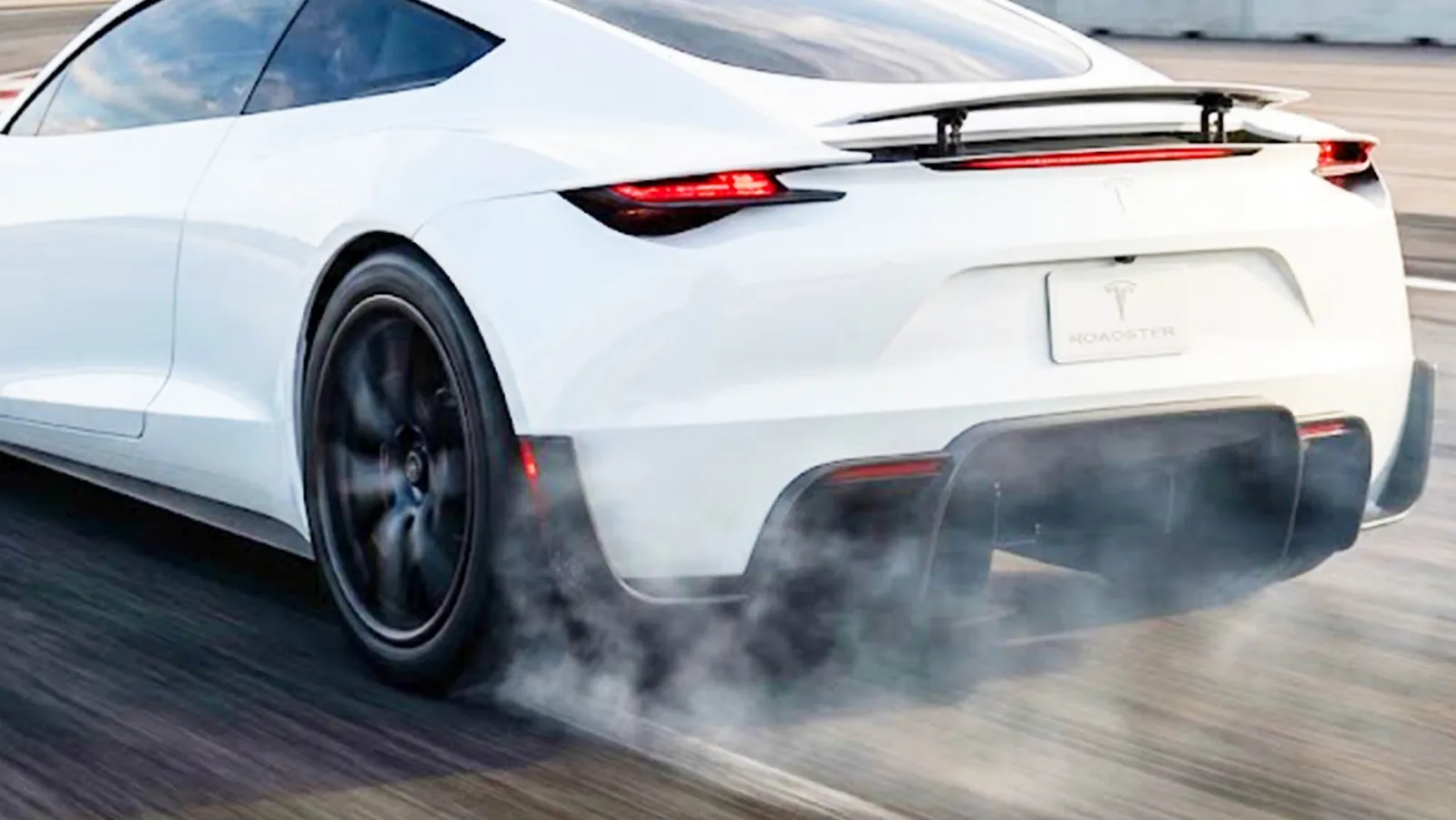
The new Tesla Roadster aims to take electric car performance to a realm previously reserved for aerospace technology. Its secret lies not only in the power of its engines but also in combining conventional electric traction with fans that enhance grip, along with compressed gas thrusters that generate thrust without relying on tire contact with the asphalt.
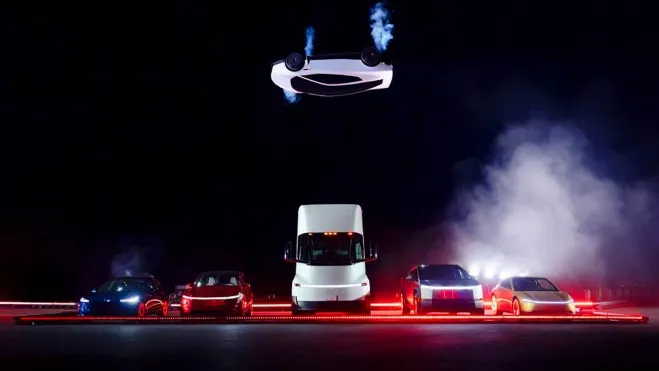
The presentation held in Texas on October 15, 2026, provided a better understanding of this design. However, although the demonstration showed spectacular maneuvers, there are still uncertainties regarding its performance in a production vehicle and its future use on roads.
Two propulsion systems to overcome tire limitations
The technical approach of the Roadster stems from a fundamental limitation of conventional cars: the force that tires can transmit to the road has a limit. Even with electric motors capable of delivering very high torque from a standstill, acceleration ultimately depends on the available grip.
Tesla aims to overcome this barrier through two complementary technologies. The first is a fan system that generates aerodynamic drag at low speeds, even when the car is stationary. The second relies on cold gas thrusters, a solution originating from the aerospace industry.
The brand has introduced three configurations: Performance, Thrust, and Rocket. The latter two feature rear thrusters or a set of ten units distributed throughout the vehicle, depending on the version. The goal is to improve acceleration, and in the most extreme variant, to control the car’s movements during short aerial maneuvers.
Suction fans: improved grip even at zero speed
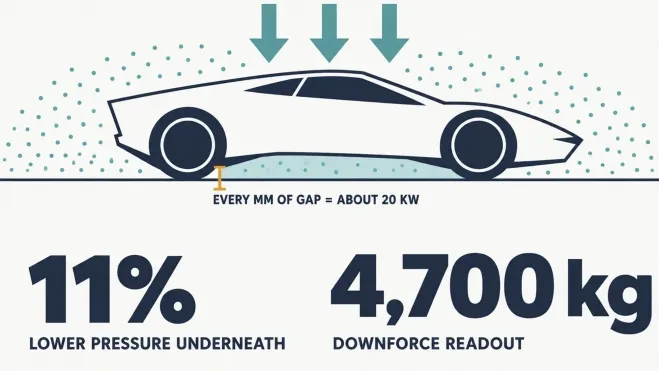
The first of the notable technologies is a system of fans located beneath the chassis. Its function is to draw air from the space between the bottom of the vehicle and the ground to reduce pressure in that area.
The pressure difference causes the external atmospheric pressure to push the car downward. In this way, the tires can handle additional load without needing to travel at high speeds, something that conventional spoilers cannot achieve when the vehicle is stationary.
During the presentation, Tesla mentioned a downward force equivalent to up to twice the car’s weight. A reading shown in the demonstration reached 4,700 kg of equivalent load, although not all the data needed to independently verify the system’s performance has been made public.
This solution allows increasing the force that the tires can transmit to the asphalt and is particularly important when the car needs to accelerate at extreme speeds. It also explains how the car was able to remain inverted for part of the demonstration.
The challenge will be maintaining the seal between the undercarriage and the surface under real conditions. Irregularities in the asphalt, potholes, and small gaps can reduce the effectiveness of suction and require more power from the fans.
Cold gas thrusters: the leap from automotive to space technology
The second major innovation is the propulsion system developed using SpaceX’s technology. Instead of burning fuel like a conventional rocket, these thrusters expel high-pressure gas through nozzles.
The reaction generated by that flow produces thrust in the opposite direction. Unlike electric motors that drive wheels, this force does not depend on tire traction.
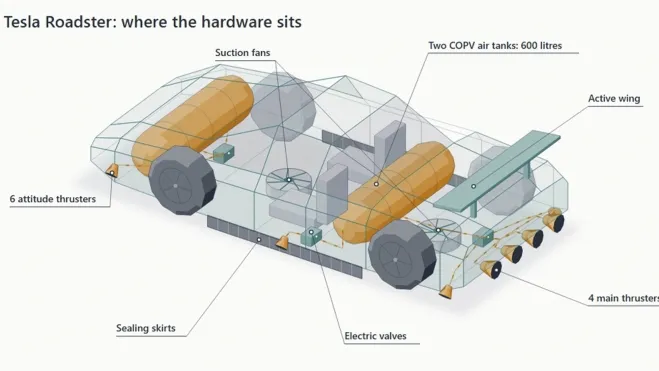
The system announced features ten thrusters and a storage capacity of 600 liters of compressed air. The specified operating pressure is around 380 bars, equivalent to about 5,500 psi. Technical estimates place the amount of air stored at approximately 230 to 250 kg.
The system can generate over 80 kN of thrust, according to the announced figures. To give an idea of its magnitude, this force is roughly equivalent to the weight of 8.2 tons under Earth’s gravity.
The rear nozzles provide longitudinal thrust to propel the car, while the other thrusters allow control of its orientation during maneuvers. Rapid regulation of the valves is essential for dosing thrust and adjusting the vehicle’s position.
There is, however, a significant limitation: the stored gas is consumed. Independent physical calculations indicate that maintaining an 80 kN thrust would deplete a charge of this magnitude in approximately 1.5–1.7 seconds, depending on operating conditions. The force also decreases as the pressure in the tank drops.
Tesla has not yet provided sufficient details regarding the charging process, the time required to complete it, or the actual duration of each maneuver.
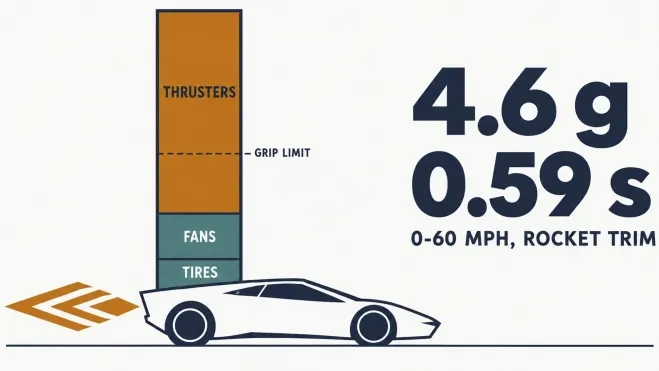
The acceleration figures announced are the most striking aspect of this project. Tesla claims that the Performance version can go from 0 to 60 mph, or about 97 km/h, in less than 1.6 seconds. The Thrust variant is said to reduce this time to under 0.9 seconds, while the Rocket version aims to go even faster at less than 0.59 seconds.
During the presentation, an acceleration time of around 0.81 seconds to that speed was shown. This result should not be confused with any already certified production performance or independently verified data.
Achieving 97 km/h in 0.59 seconds would require an average acceleration of about 4.6 times Earth’s gravity from a standing start. This figure far exceeds the grip limit of standard road tires, which is why combining suction with external thrust is crucial.
Weight, range, and unresolved doubts
The integration of high-pressure tanks, fans, ducts, and valves adds complexity and affects the weight. Tesla has not yet released a complete technical specification that would reveal the overall mass, battery capacity, or energy consumption of the auxiliary systems.
It has also not been proven that all these technologies can function with the same efficiency outside a controlled testing environment. The security requirements related to pressurized tanks, occupant protection, and engine certification will be decisive for their arrival on the market.
Tesla has set 2028 as the planned start date for production, following numerous delays since the announcement of this second generation in 2017.
The Roadster is therefore more than just an electric sports car with extreme acceleration. Its technical interest lies in combining conventional traction with systems that alter grip and generate thrust using compressed gas. The big question is no longer whether these technologies can produce extraordinary forces, but whether Tesla will manage to integrate them into a safe, practical, and road-legal vehicle.