
ANIE on renewables: Either Italy changes course or goodbye to the 2030 target
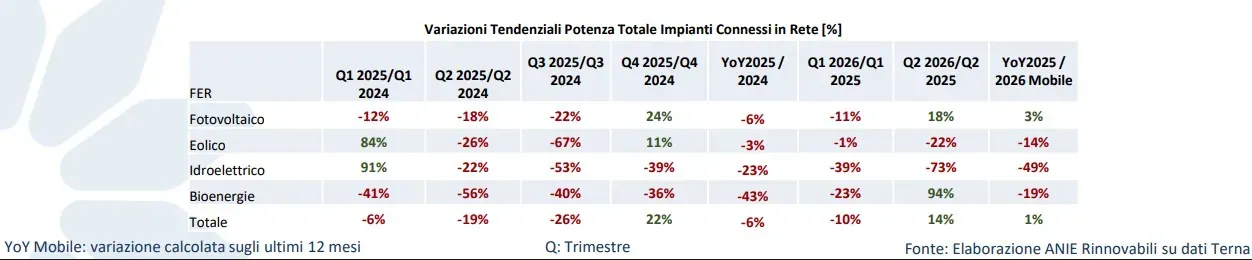
ANIE renews its warning about renewable energy sources: Italy’s market shows signs of recovery in the second quarter of 2026, but this improvement is not enough to indicate true acceleration. After six months of decline, renewable energy capacity grew by 14% on an annual basis, driven mainly by photovoltaic systems (+18%). In the first half of the year, 2,918 MW of new capacity was installed, plus approximately 550 MW from repowering projects. However, an additional 3.3 GW will be needed by December to meet the target set for 2026.
Record-breaking renewables: 814 GW installed in solar and wind by 2025
Photovoltaic systems drive growth in renewable energy capacity
The data from ANIE’s FER Observatory, compiled based on information from Terna, show a market still far from a path of structural growth. In fact, the overall increase in renewable energy over the past twelve months has been only 1%, following a contraction recorded in 2025.
Solar photovoltaics remain the main driver of new installations. Between January and June, 83,732 solar photovoltaic systems were connected, with a total capacity of 2,610.9 MW—accounting for about 90% of the new FER capacity installed during that half-year.
The contribution from other technologies is much smaller: wind energy added 295.2 MW with 21 systems, hydroelectric power added 5.4 MW with 16 systems, and bioenergy added 7.4 MW with 22 systems.
The “treasure” accumulated since 2021 risks disappearing
The most interesting figure emerges, however, from a comparison with the burden sharing trajectory. By the end of 2025, Italy had a positive surplus of about 1.6 GW relative to its targets, accumulated thanks to installations carried out in previous years.
With 2,918 MW of new installations and about 550 MW of repowering in the first half of 2026, the overall progress relative to this trajectory amounts to roughly 5 GW. However, the annual target for 2026 is set at 8.3 GW.
To meet this target, it will therefore be necessary to add another 3.3 GW in the second half of the year, at a rate essentially similar to that of the first six months. The goal is not out of reach, but the buffer built up in previous years would effectively be exhausted.
Even stricter targets after 2026
This is the aspect that deserves the most attention. Reaching the 2026 target would not mean solving the problem of installation speed.
The planned trajectory calls for 10 GW in 2027, 11 GW in 2028, 13 GW in 2029, and 15 GW in 2030. The safety buffer accumulated so far risks being used to compensate for growth that has not yet reached the necessary pace.
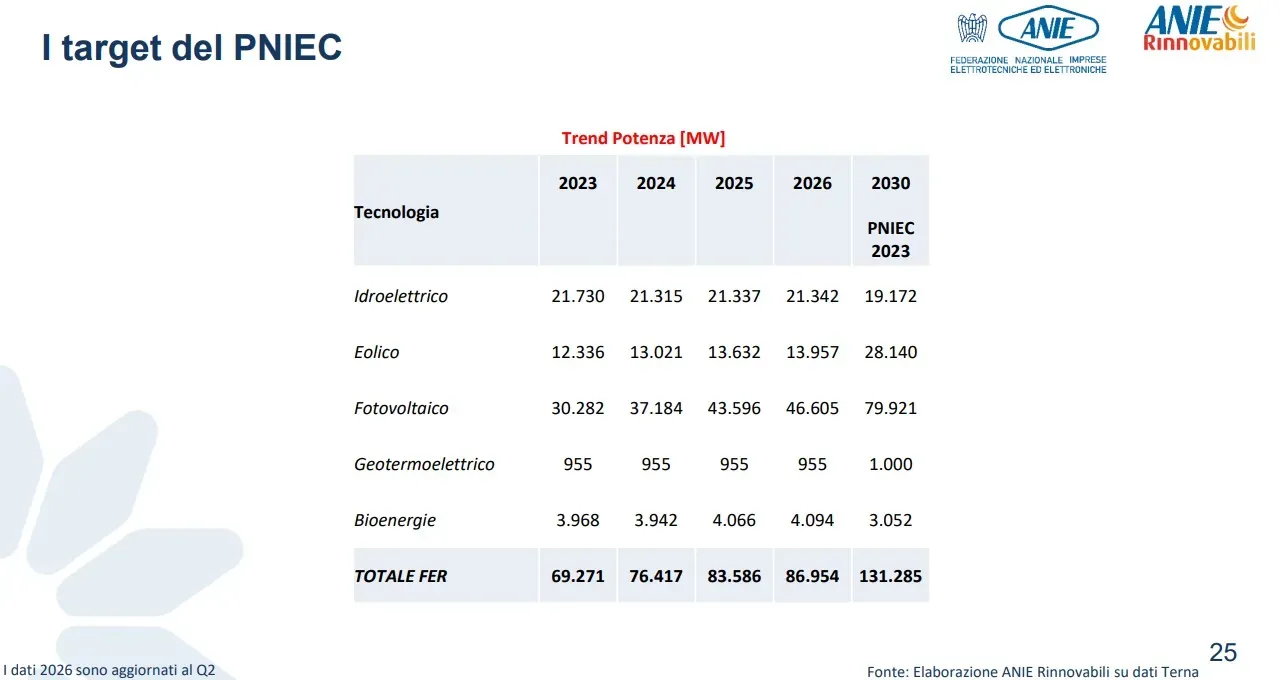
The situation appears even more challenging when looking at the ultimate goal: from the current approximately 86 GW of installed renewable capacity, we need to reach 131 GW by 2030. This means adding about 44 GW in just over four years.
The bottleneck? Permits and connections
The issue isn’t solely related to the availability of capital or industrial capacity. ANIE Rinnovabili identifies the permitting process as one of the main obstacles to investment, along with regulatory uncertainty.
President Andrea Cristini specifically calls for unlocking the environmental impact assessment opinions related to 13 GW of projects currently under evaluation by the President of the Council.
On the agenda is also the announced reform of the mechanism for allocating connection capacity and finalizing the definition of suitable areas, a process that has been ongoing for years.

Larger plants and distributed generation growing further apart
The composition of growth also reflects a system with varying speeds. In the photovoltaic sector, the residential segment continues to slow down, with a 20% decline over the past twelve months. In contrast, Commercial & Industrial grew by 8% during the same period.
The situation for large-scale installations is more complex: Utility Scale declined by 12% compared to the first quarter, while Large Utility Scale showed a +197% increase on a quarterly basis and +12% over twelve months, partly due to the significant discontinuity in large-scale projects.
The regional distribution confirms this polarization. Puglia, Sicily, and Lazio benefit most from large-scale photovoltaic and wind installations, while Lombardy and Veneto maintain a strong presence of small and medium-sized photovoltaic systems.
For Italy, the goal is not merely to reach the target set for 2026. The real challenge lies in building an authorization, industrial, and grid capacity that allows for a steady increase in installation rates, without having to rely each year on the surplus accumulated earlier.
READ ALSO: Armaroli: “More announcements than projects on nuclear energy: renewables and storage are the priorities” and watch the VIDEO
Previous Article
The charging station bonus starts (September 22): 80% full subsidy
Next Article
Electric grids: The EU can save 10.6 billion through smart charging