
AMG GT 4-Door Coupé entry-level model priced from €115,430
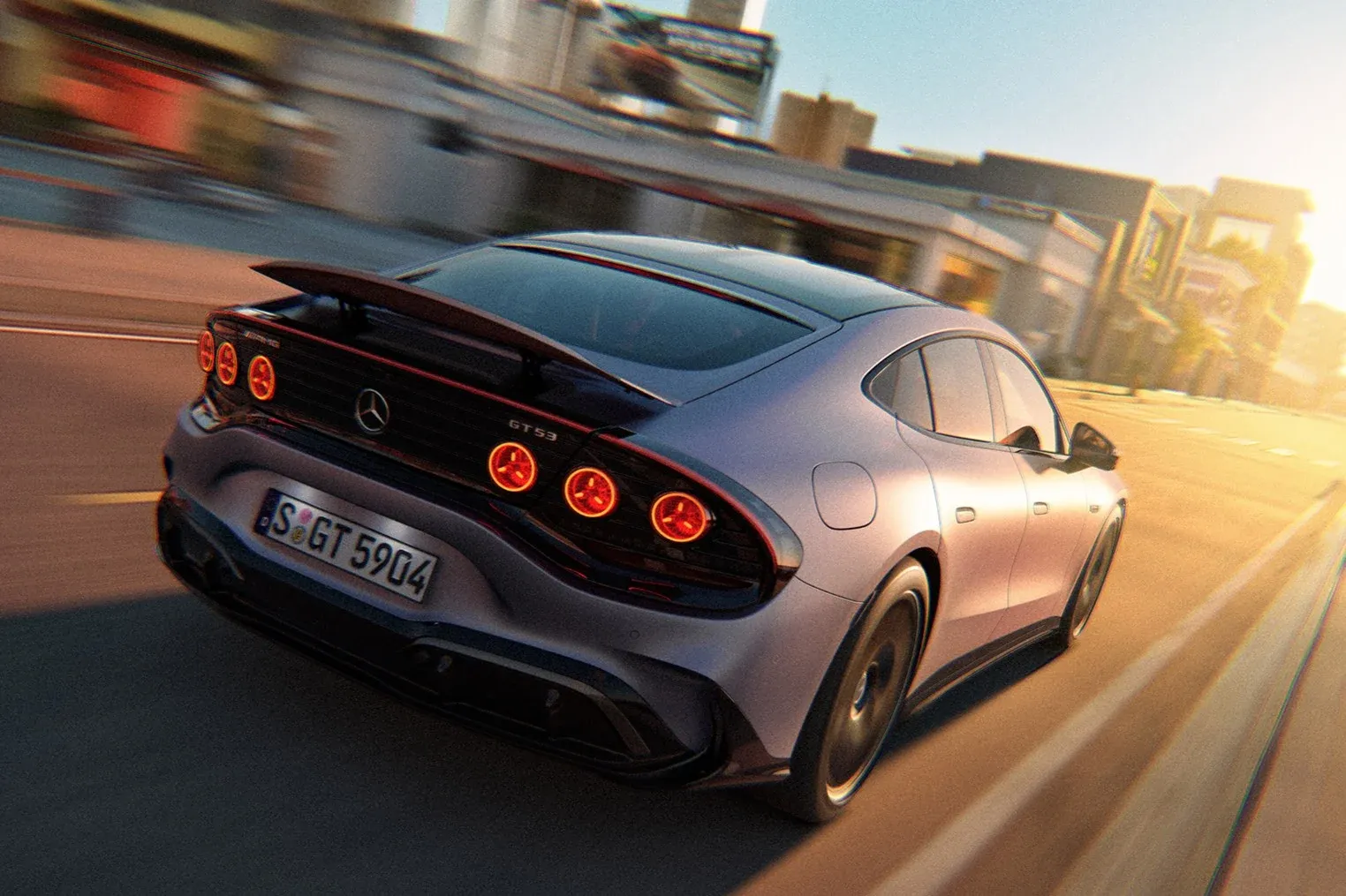
Mercedes-AMG is expanding its GT family with the new GT 53 4-Door Coupé, which joins the recently unveiled all-electric four-door GT Coupé as a more affordable option. The most notable difference, aside from the lower price: Instead of three axial flux motors, the sports car is powered by two synchronous motors.
Mercedes-AMG has been building anticipation for the GT 4-Door Coupé for some time. The company presented a heavily camouflaged prototype on the sidelines of the Formula 1 race in Las Vegas last November, when it also announced actor Brad Pitt as the face of the model. In March, Mercedes-AMG revealed the interior of the GT 4-Door Coupé, notably without mentioning that the model is fully electric.
Any concerns that AMG could alienate customers accustomed to V8 combustion engines with an electric model are likely to have eased since the world premiere in May. AMG unveiled the GT 4-Door Coupé with a system output of up to 860 kW and three axial-flux motors supplied by Yasa, the British electric motor specialist acquired by Mercedes-Benz in 2021. The GT 4-Door Coupé is the first Mercedes production model to use these high-performance motors. Until now, axial-flux motors have primarily served as additional ‘booster’ motors in hybrid models from Ferrari and Lamborghini.
Yet Mercedes-AMG is abandoning this unique selling point for a new variant of its four-door GT. The Mercedes-AMG GT 53 4-Door Coupé instead uses two permanently excited synchronous motors (PSM) with a combined system output of 400 kW. The main electric drive unit is located at the rear axle, while a second PSM at the front acts as a boost motor. Depending on the driving situation and selected programme, a Disconnect Unit (DCU) engages the front motor when additional power or traction is required. At low loads, it decouples the motor to improve efficiency.
Compared with the flagship GT 63, the GT 53 sacrifices some performance due to its different motor configuration and lower system output, but still delivers figures well above those of most volume models. Torque drops from 2,000 to 800 Nm. The 0-100 kph sprint with a one-foot rollout takes 3.5 seconds, compared with 2.1 seconds for the GT 63. From a standstill, the GT 53 reaches 100 kph in 3.9 seconds, versus 2.4 seconds for the GT 63 4-Door Coupé.
There are no differences in the battery or charging performance. The GT 53 4-Door Coupé uses the same 106 kWh battery as the GT 63 and retains a peak DC charging capacity of 600 kW, allowing the battery to charge from 10 to 80 per cent in just 11 minutes. However, this requires a 600 kW charging station, which remains rare. Thanks to its lower system output, the GT 53 is expected to offer a WLTP range of more than 800 kilometres, significantly exceeding that of the GT 63.
Sales of the GT 53 4-Door Coupé in Germany will begin on 13 August 2026, with prices starting at €115,430. For comparison: the top-of-the-range GT 63 starts at €196,350, while the mid-range GT 55 is available from €154,700. It remains unclear whether Mercedes-AMG will introduce an even more affordable GT 43 model, as was previously offered in the combustion-engine version of the AMG GT 4-Door Coupé.