
Ambibox and Decarbon1ze present a billing solution for Bidi stores
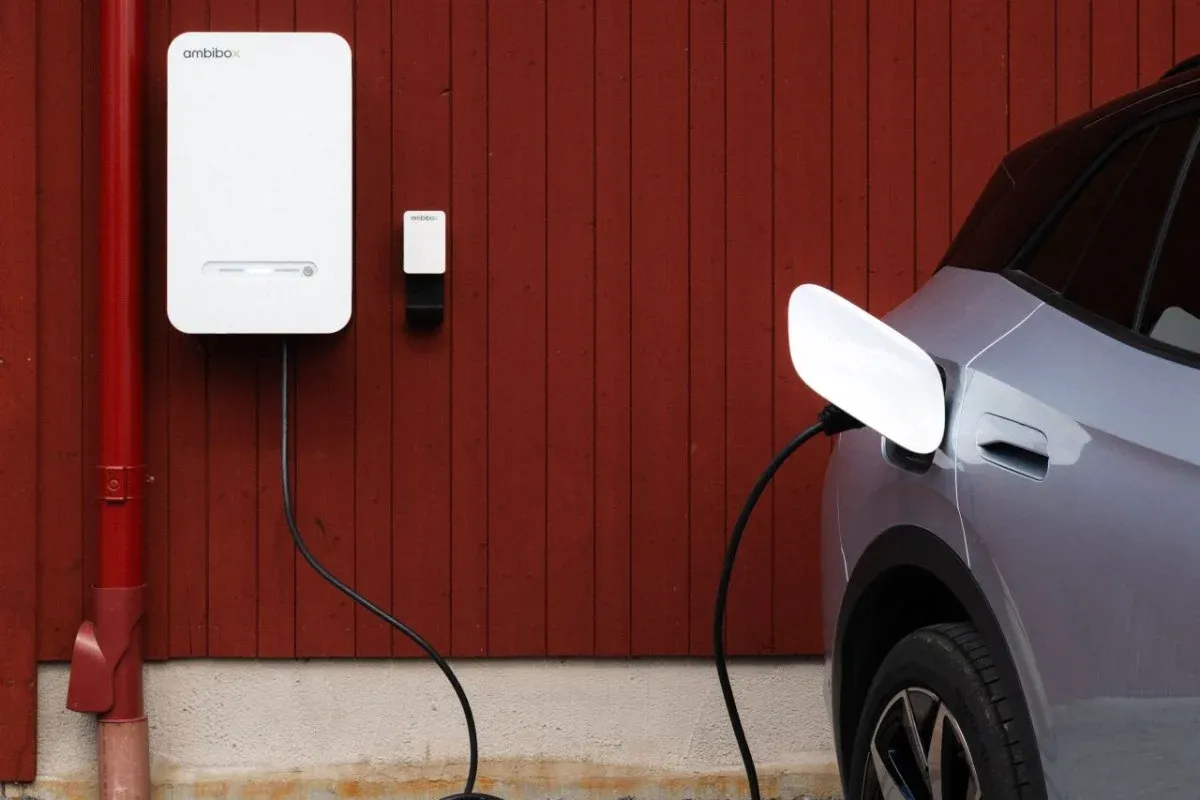
Ambibox and Decarbon1ze have considered how to achieve metering compliant with calibration laws and energy accounting for bidirectional charging. The approach developed by this duo aims to avoid costly modifications to metering installations.
Image: Ambibox
Ambibox, a specialist in Wallbox solutions, and Cleantech startup Decarbon1ze claim to have already demonstrated their solution at a test site in Berlin. At the core of their approach is combining an FNN basic meter with Decarbon1ze’s virtual data collection tool, which generates minute-level time series during charging and discharging. This represents a way “to significantly simplify the previously complex energy accounting processes,” according to the duo. Ambibox is known as the manufacturer of a bidirectional DC Wallbox called ambiCHARGE, making it interested in such billing systems.
To put this in context: For what is technically already possible with bidirectional charging to become a scalable product, charging and energy return processes must not only be controlled but also accurately measured, balanced, and
can be billed for. Ambibox and Decarbon1ze emphasize that vehicles with two-way charging are already often used as business vehicles today. However, “special challenges arise if they are also to be charged and discharged at home in the future. The two-way charging stations available today still lack certified measurement technology that meets all requirements for billing and accounting.”
Conventional measurement concepts may therefore require additional meters, larger meter cabinets, and corresponding rewiring.”
According to the duo, merely expanding a charging station can “result in additional costs of 2,000 to 4,000 euros depending on the installation.” Moreover, the charging point may later often only be usable for a specific supplier or application scenario, thereby losing some of its flexibility. What’s important to the officials is that Bidi charging points will enable various applications in the future—such as personal charging, charging a company vehicle, Vehicle-to-Home, or providing
flexibility for the energy market.
Ambibox and Decarbon1ze refer to their corresponding solution as a “transaction-oriented approach,” since the charging point isn’t permanently assigned to a single energy-related application scenario; instead, individual charging and discharging processes can be tracked separately.
they can be assigned to different accounting cycles or suppliers. “The decarbon1zer captures the measured values from an FNN base meter and enables linking to legal time,” the companies describe their idea. “Based on this, quarter-hourly time series can be generated and transferred into decarbon1ze’s virtual accounting area for use in energy market communications.”
For Ambibox, energy sector integration is a crucial element for the spread of Bidi charging. “Bidirectional charging becomes a scalable product only when it not only works technically but is also easy to bill for and can be integrated into existing energy sector
processes,” says Ambibox CEO Manfred Przybilla. “It is precisely this
We are addressing this gap here together with decarbon1ze. If we don’t have to build additional complex metering infrastructure for every customer, we remove a significant obstacle to the widespread rollout of V2G.
The ability to clearly distinguish between individual transactions is also gaining importance in connection with the regulatory initiative by the Federal Network Agency for the market integration of energy storage and charging points (MiSpeL). As reported this week, there is resistance within the industry to the current draft, as they fear overly high barriers to bidirectional charging—either due to high costs for an additional meter or because the setup is economically unattractive. Ambibox and Decarbon1ze aim for their demo to be seen as an alternative.
We want to activate more small-scale flexibility options faster so that electricity
"It can become cheaper," emphasizes Knut Hechtfischer, CEO and co-founder of Decarbon1ze GmbH. He adds, "We are proud to be able to combine a measurement technology innovation with powerful digital processes in the virtual accounting domain here. As a service provider, we assist utility companies in accurately accounting for consumption behind the meter." This creates a technical and energy economics foundation on which various V2H and V2G business models could be implemented in the future using the same infrastructure.