
Alpitronic added a compact Depot Dispenser to the HYC1000 system. It provides up to 400 kW for electric bus and truck charging stations.
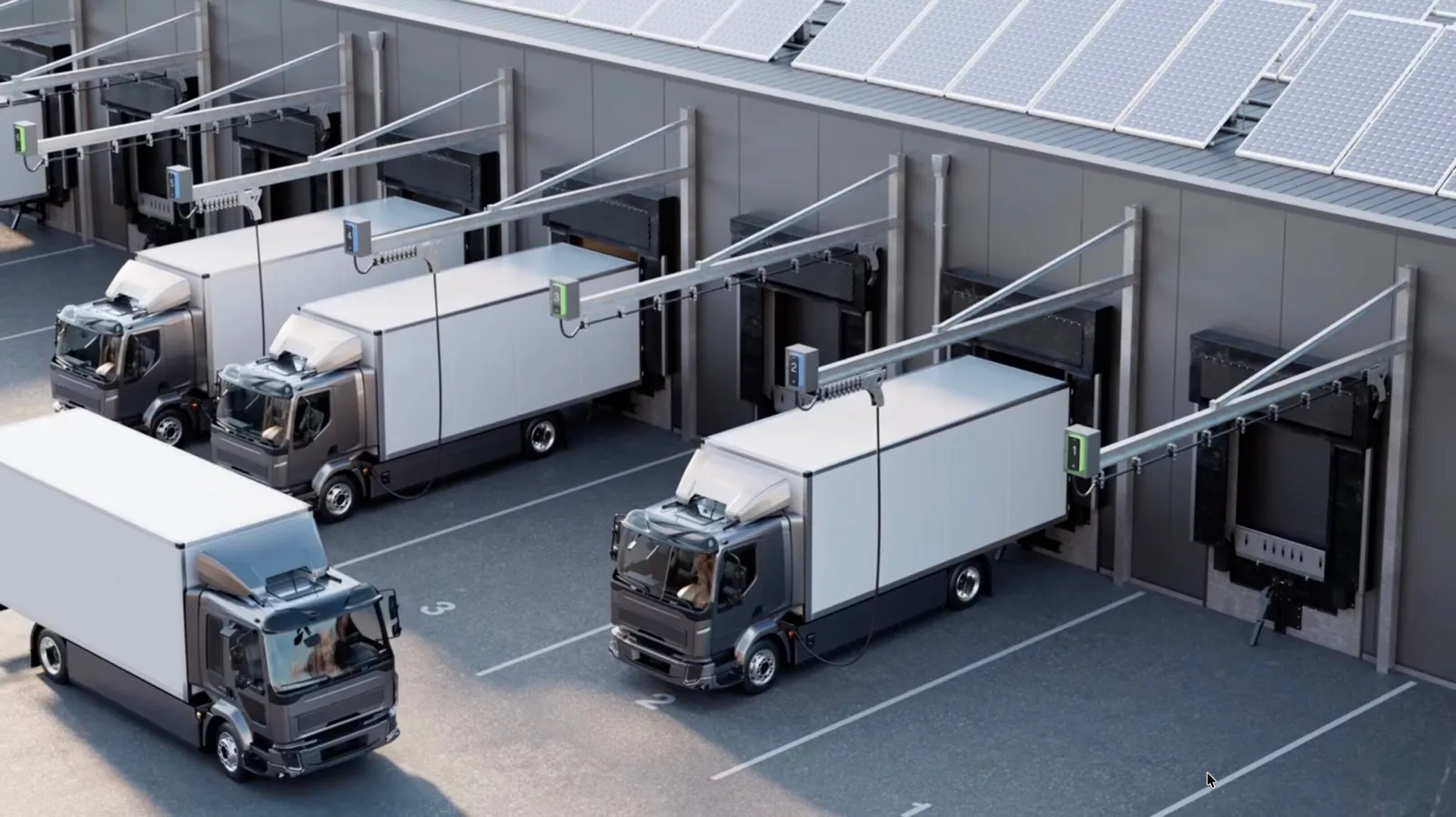
Alpitronic has expanded the HYC1000 megawatt charging system with a new Depot Dispenser, which is a small terminal for charging fleets at bases. The device delivers up to 400 kW, operates across a voltage range of 150-1,000 V, and will make its public debut at IAA Transportation.
The focus here is not on power records. It’s about ensuring that e-buses or e-trucks are fully charged by morning and preventing operators from overspending on overly complex infrastructure.
Smaller footprint, same shared power cabinet
Alpitronic unveiled the HYC1000 itself in February 2025. It is a system where power modules are not housed in poles but rather in a separate Power Cabinet. Inside, there are eight Power Stacks, each with 125 kW, bringing the total capacity to 1 MW. The power can be distributed across up to eight outputs in increments of 62.5 kW each.
The manufacturer now also claims a higher efficiency for the Power Cabinet. Instead of 97.5 percent at launch, it’s said to be up to 98.2 percent. On paper, this is a small difference, but it becomes significant with large fleets and high mileage.
To date, there have been three types of dispensers for the HYC1000. The MCS Dispenser with an MCS connector could handle up to 1,500 A and 1,000 kW, optionally with CCS up to 600 A and 600 kW. The HP Dispenser with CCS was designed to handle over 1,000 A and up to 1,000 kW. The EV Dispenser offered two CCS connectors, each capable of 600 A and 600 kW.
The new Depot Dispenser looks different because it’s simply smaller. Instead of a unit 2.32 meters tall and weighing up to 350 kg, we have a housing measuring 600 x 400 x 250 mm with a weight of up to 35 kg, without the cable. The difference is enormous.
400 kW, but without marketing hype
The Depot Dispenser has a CCS connector and a peak current of 400 A. This is where the claimed 400 kW comes from, but only when the vehicle is operating at nearly 1,000 V. At lower voltages, the power will be less, so it’s not some small unit that suddenly delivers 400 kW for everything.
In this regard, the new terminal is comparable to the uncooled cable of the EV Dispenser, which also handles 400 A. So Alpitronic isn’t aiming for record-breaking performance here; rather, it focuses on a real-world depot charging scenario.
The device can be mounted on a wall, pedestal, crossbeam, or under the ceiling of the facility. The cables are available in 2.0, 5.5, or 7.5 m lengths, so the ceiling-mounted option makes sense for buses and trucks with charging ports in various locations.
There is no large touchscreen here. It has an LED indicating charging status, RFID, and optionally a credit card reader as well as a QR code reader. This allows it to handle both own fleets and guest vehicles, which suits shared charging station models.
It also has regulatory considerations. If such a station is publicly accessible and has more than 50 kW, the EU’s AFIR requires payment via card on the spot. Alpitronic apparently leaves some flexibility for operators in this regard.
In addition, there is an optional, legal DC meter. The enclosure meets IP55 standards, so it is better protected than the larger HYC1000 dispensers with IP54 protection. The operating range is from -30 to +55 degrees Celsius, and the standby power consumption is supposed to be less than 25 W. For comparison, other dispensers require up to 82 W.
The company’s owner, Philipp Senoner, says bluntly: “For fleet operators, it’s not about maximum power at every charging point. What matters is reliable and cost-effective charging that fits operations and downtime.” And on this point, it’s hard to argue.
Initially, the Depot Dispenser will reach Europe, followed by other markets. Prices have not been announced yet. For the Polish market, this is mainly a signal for bus operators, logistics companies, and those building infrastructure for electric trucks, not for car drivers at Lidls.
The most interesting aspect of this launch isn’t the 400 kW capacity, but rather the attempt to fit meaningful flexibility into a much smaller housing. Do you see room in Poland for shared charging stations for e-trucks and e-buses?
LovEV Newsletter
Want more content like this?
Sign up — we’ll send you a weekly summary once the newsletter starts.