
Allye brings a 400-kW fast charger with Second-Life batteries
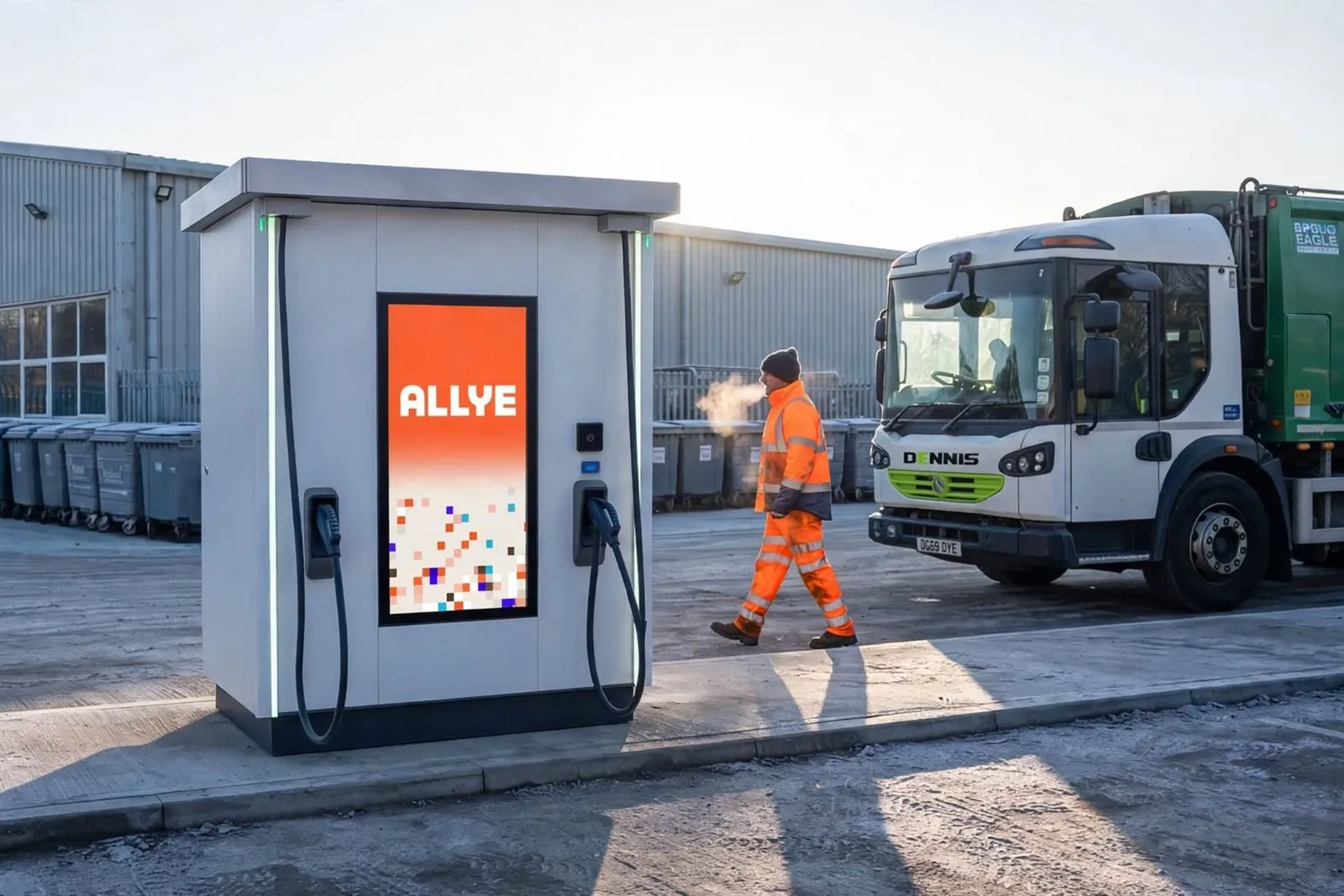
The British company Allye Energy has introduced the MEV, a battery-powered fast charger for depots. The system uses fully used second-life batteries from electric vehicles and is designed to deliver up to 400 kW of charging power without requiring a more powerful grid connection.
First deliveries of the MEV are scheduled for the second quarter of 2027.
Image: Alllye
The MEV is designed to draw its energy from an existing power connection at a depot and initially store it in reusable vehicle batteries. During charging, the energy can then be delivered at a significantly higher power level. According to media reports, Allye aims this solution primarily at fleet locations where the existing connection capacity is insufficient for conventional fast charging.
Two variants will be available at launch. The MEV200 has a storage capacity of 155 kWh, while the MEV300 has 232 kWh. Both systems are intended to charge two vehicles simultaneously. Allye states that the maximum DC charging power reaches up to 400 kW.
The technical foundation is the 800-volt architecture of the mobile battery storage system Max300. According to the manufacturer, it supports vehicles with both 400-volt and 800-volt systems. The so-called PackFlex technology is intended to enable different battery packs of varying sizes, ages, and cell chemistries to operate together within a single system.
Allye uses complete battery packs from retired electric vehicles, rather than newly produced cells, as it claims. This approach is said to save approximately 15 to 24 tons of CO2 equivalent per unit compared to a system using new batteries, per the manufacturer’s calculations.
Battery storage systems compensate for weak grid connections
The approach involves decoupling grid power from charging capacity. The battery system can be charged from the grid at a relatively low power level over an extended period and then deliver this energy to vehicles at high power levels in the short term.
A project carried out by the company at J&M Murdoch in Glasgow demonstrates that this approach is already in practical use. According to Allye, a network expansion costing around 300,000 pounds had been proposed for a waste management company’s facility. Instead, Allye and charging provider Chargepoly installed a Max300 unit at an existing 32-A connection with a capacity of 22 kW. The battery system now powers a separate DC fast charger for two electric vehicles and supplies approximately 200 kWh of energy per day, according to the company. 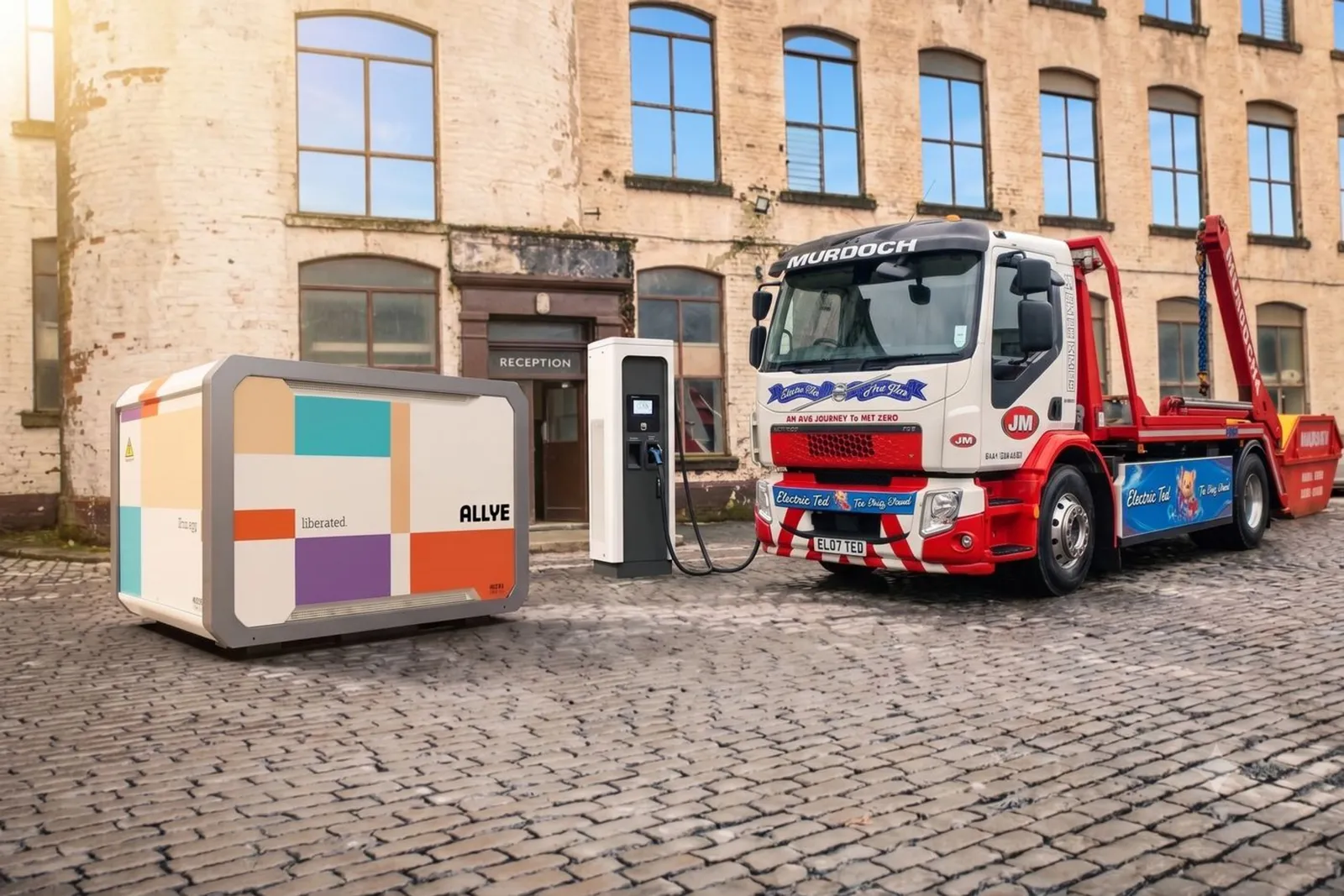
This example also highlights the limitations of the concept. A battery storage system can enable high charging speeds despite a weak power connection, but it does not replace the required amount of energy. The number of vehicles that can be charged daily still depends on how much electricity can be replenished through the existing connection over several hours.
Allye argues that this approach is needed especially to avoid long waiting times for new network connections. The company cites 18 to 36 months for new depot connections in the UK. In contrast, the MEV is designed to be installed via industrial sockets or a fixed connection and brought online within a few hours. The system is also meant to be dismantled and reused at another depot if the location changes.
For operation, Allye relies on additional safety features. According to the manufacturer, the charging cables have cut monitoring, forensic markings, and quick-release fasteners to enable faster replacement of damaged cables. Cameras monitor the charging stations and cables. Inside the storage area, there are also pyrotechnic safeguards, gas detection systems, and fire barriers between battery packs.
The MEV remains a stationary system at the depot. Its technically related counterpart, the Max300, is designed to be mobile and can be used, for example, as a replacement for diesel generators or to power additional charging stations. Prices for the MEV start at 70,000 British pounds. Alternatively, Allye offers the system as “EV Charging as a Service” at 1,900 pounds per month for the MEV200. First deliveries are scheduled for the second quarter of 2027.
Allye, a battery storage solution, addresses a well-known issue in the electrification of fleets. Energy is not always entirely unavailable at a given location; rather, it is often the short-term available connection capacity that is limited. Whether a battery-backed fast charger is economically viable compared to grid expansion depends heavily on the location, charging patterns, existing connections, and the costs of potential grid upgrades.