
Currently: Tesla’s FSD assistant is supposed to take control automatically when a collision is likely.
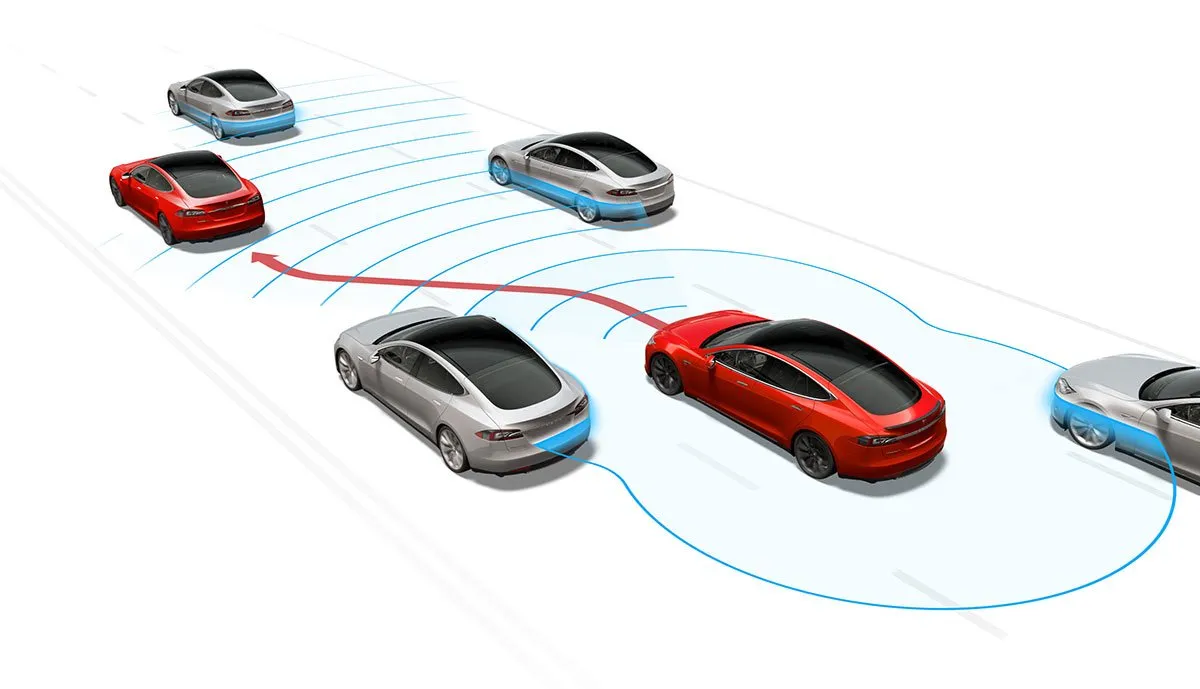
Image: Tesla (symbolic photo)
Since September 2024, Tesla has officially labeled its FSD software (short for Full Self-Driving) as “supervised,” explicitly indicating that the assistance system must be monitored by the driver. The more capable it becomes, the higher the likelihood that FSD will make better decisions than a human. It now seems this happens more often, as Tesla claims the next version will intervene in emergencies even when the system is not activated.
Tesla’s system monitors in the background
The Cybercab added to Austin’s robotaxi fleet last week operates entirely with FSD control — it typically doesn’t even have a steering wheel or pedals for humans. However, according to Tesla, both the computer hardware and software of this two-seater vehicle are more advanced than those in cars available to regular customers. Whether these electric vehicles equipped with HW4 and FSD 14.x will eventually drive autonomously remains uncertain. Tesla CEO Elon Musk claims this will begin (in the U.S.) still this year.
FSD Supervised v14.3.9 starting to roll out shortly
This release includes a new active safety feature set: FSD Supervised can now activate on your behalf when an imminent collision is detected and Automatic Emergency Braking (AEB) may not be enough.
It may also engage if we…
— Tesla AI (@Tesla_AI) September 4, 2026
First up, there’s another update for the over-the-air software. Distribution of FSD 14.3.9 will begin soon, Tesla announced on X on Friday, just a few hours after the highly publicized launch of Cybercab in Austin. This version is supposed to reverse the role distribution between human and computer: even when FSD isn’t activated, it monitors in the background and can intervene to prevent a potential collision.
FSD takes control of steering in emergencies
This would mean the computer system oversees the driver instead of the other way around as it is now. According to Tesla’s brief explanation, this update represents an active safety feature. However, FSD is intended to intervene only when it detects an imminent collision and determines that the existing “automatic emergency braking” function is insufficient as a solution. In such cases, the system will apparently take over steering as well in the future.
The specific design of this function remained unclear at first. It was not mentioned in Tesla’s online manuals for electric vehicles on Tuesday, and FSD 14.3.9, including emergency takeover from a disabled state, seemed to have not reached any customers yet. An interesting point in this regard is whether the new function can still be disabled, just like previous active assist features. Additionally, it remains to be seen whether Tesla will take responsibility if an automatic FSD intervention does not function as intended.
Tesla hopes for FSD approval in the EU
In Germany, one can wait for now since the supervised (and soon likely also self-driving) FSD system does not yet have approval. According to Tesla, this could change after an EU agreement at the beginning of October. Ahead of that, the company released a series of data last week regarding tests of FSD Supervised in Europe and especially the United States. In the Netherlands, the system has been allowed since April under an exception permit. Since then, five similarly small EU members have joined, most recently Slovenia on Monday.