
Current: CEO Musk announces launch of Tesla and SpaceX’s first AI satellites for Q4 2027
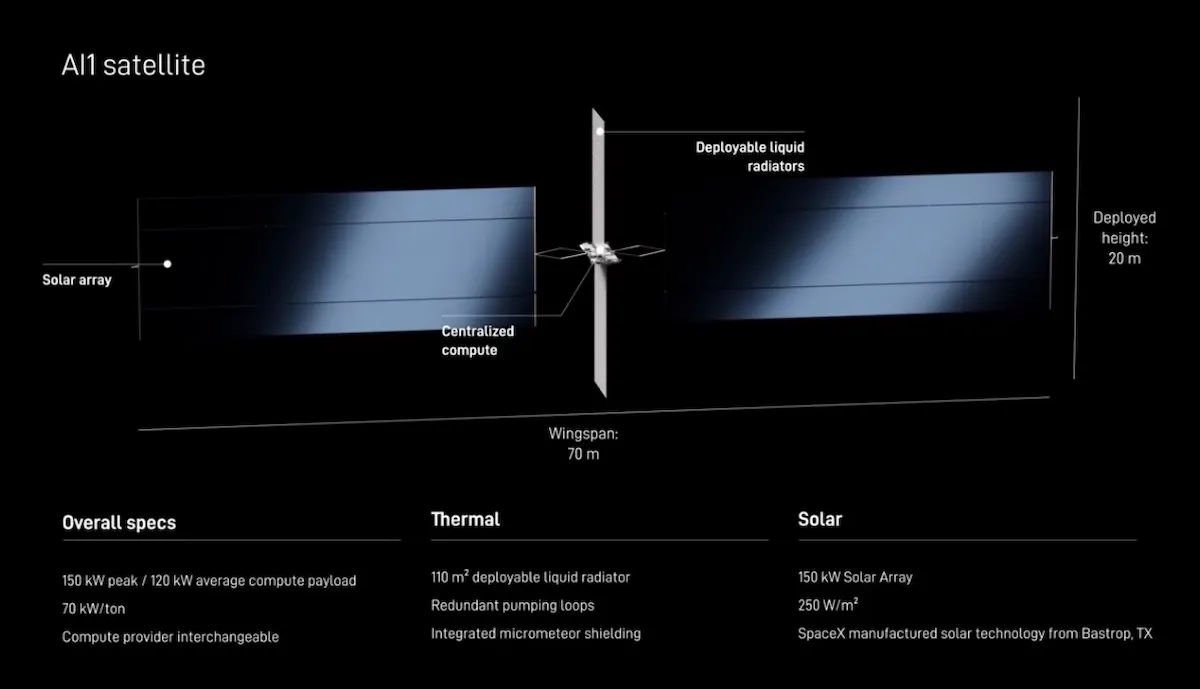
Image: SpaceX (planned AI1 satellite with Tesla)
Elon Musk aims high — now also in partnership with Tesla, as the electric car manufacturer, along with space company SpaceX, plans to install substantial AI computing power on satellites in orbit, according to the dual CEO. While initial talks focused on rocket launches starting in 2028, Musk has now confirmed that the Starmind project is set to become a reality as early as the fourth quarter of 2027. In the long term, Tesla and SpaceX aim to produce the AI chips themselves, but for now, Nvidia’s technology will be used.
SpaceX and Tesla want to go to space
Already at SpaceX’s quarterly conference in early August (the first since its record-breaking IPO), Musk indicated that the first launches of Starmind satellites would be pushed forward to 2027. Additionally, according to a report by Engadget, he said that the AI chips for these satellites would initially come from Nvidia. In the long term, Tesla and SpaceX’s joint Terafab is intended to be used for this purpose, though it is still in a very early stage.
On this Monday, Nvidia announced that SpaceX intended to use Vera CPUs, which were developed specifically for AI agents. This applies both to installations on Earth and to AI computing power in orbit: the first generation of SpaceX’s Starmind satellites (Tesla is not mentioned in the report) will be based on an optimized version of the Nvidia Vera Rubin NVL72 system. Both companies are working to adapt this foundation to the requirements of computing in space.
Musk: AI satellites by the end of 2027
According to Tesla and SpaceX CEO Musk, this collaboration appears to be well advanced. On X, he wrote regarding Nvidia’s announcement that SpaceX and Nvidia have developed a space-optimized NVL72 system as partners. It is scheduled for launch into orbit starting in Q4 2027. Significant scaling of Starmind is expected to occur in 2028.
SpaceX, in partnership with Nvidia, has designed a space-optimized Vera Rubin NVL72 system for launch to orbit in Q4 next year, with significant scale in 2028 https://t.co/qdDq8YBkzl
— Elon Musk (@elonmusk) August 24, 2026
In the Terafab section of its website, Musk’s space company lists the capabilities it will contribute itself and the experiences from Tesla that are expected to be useful for the project. With estimated investments of at least several hundred billion dollars in Texas, the factory is set to produce AI chips with 1 Terawatt of computing power per year—far more than all other manufacturers, including Nvidia, produce together today. A large amount of electricity is needed to power this operation. To meet this demand, Tesla plans to build 100 Gigawatt of its own photovoltaic production capacity, according to Musk.
Tesla briefly sides with SpaceX
The Starmind project also has its own section on SpaceX’s site. However, while Terafab mentions a shared chip called D3 intended for AI in space, Tesla is only briefly referenced on this page in connection with the planned chip factory. As for the solar modules meant to supply power to satellite data centers, it is explicitly stated that these are technology produced by SpaceX at its facility in Batrop, Texas.